To understand the Dutch Golden Age, one must examine how an unprecedented religious crisis gave birth to one of the most thriving art markets in history. In the 17th century, the destruction of sacred imagery (Beeldenstorm) and the absence of a royal court pushed painters in the Dutch Republic to invent new genres: still life, landscape, and domestic genre painting. In a nation of merchants with neither king nor pope, painting ceased to be a religious commission and became an everyday object. Here are 5 major artworks that embody this artistic and social revolution in Dutch painting.
How a country without a king or a pope became the world capital of painting
In 1566, a wave of religious violence swept through the Netherlands. Crowds entered cathedrals, smashed statues, tore apart paintings, shattered stained glass. The movement had a name: the Beeldenstorm – the storm of images. Tens of thousands of works were destroyed within a matter of weeks.
At first glance, this looks like a catastrophe for art. In retrospect, it may have been one of the tremors that made a different way of painting possible.
By emptying churches of their images, Calvinism posed a blunt question that European art had never previously had to answer: if you can no longer paint for God, and if the Dutch Republic has no king to commission equestrian portraits and gloriously painted ceilings – for whom do you paint? And what?
The response of seventeenth-century Dutch painters is among the most quietly radical revolutions in the history of art. They invented a market. They invented entirely new genres, still life, pure landscape, domestic genre scenes, that French and Italian academies consigned to the bottom of their hierarchy. And in this nation of merchants, a painting became an object to be bought, sold, and displayed in a bourgeois parlour. Not a royal commission. A commodity.
Historians estimate that the Dutch Republic produced tens of thousands of paintings each year – a density of output unmatched anywhere in Europe. This was not the age of the patron. It was the age of the market.
Five works from the Vmuseum collections help explain how a country without a king or a pope became the world capital of painting.
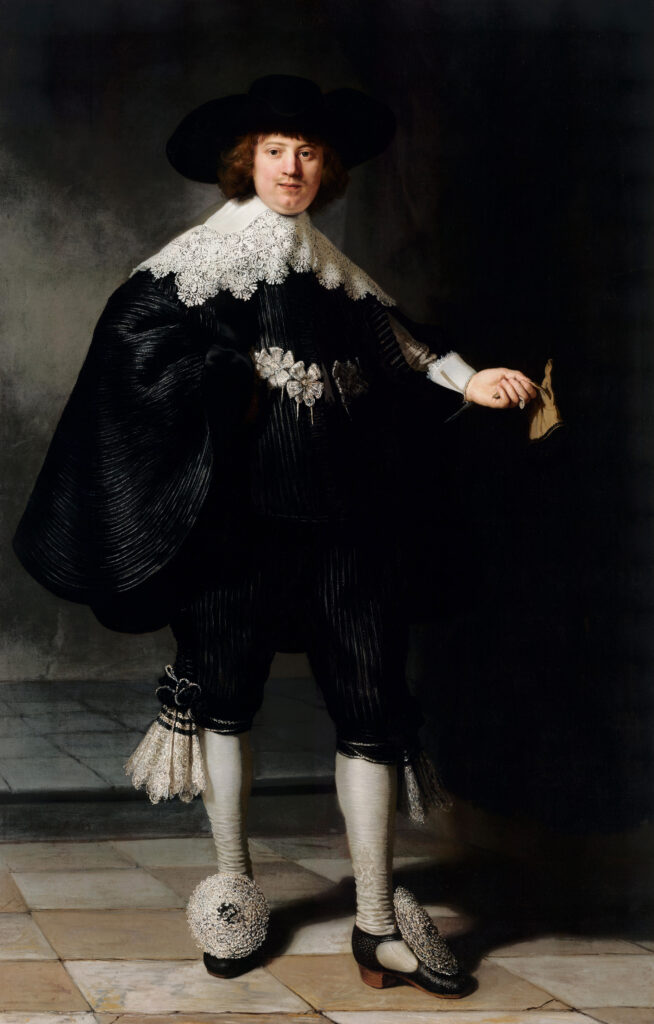
01 Rembrandt – Portrait of Maerten Soolmans, 1634
What this work reveals: The merchant class adopts the visual language of royalty
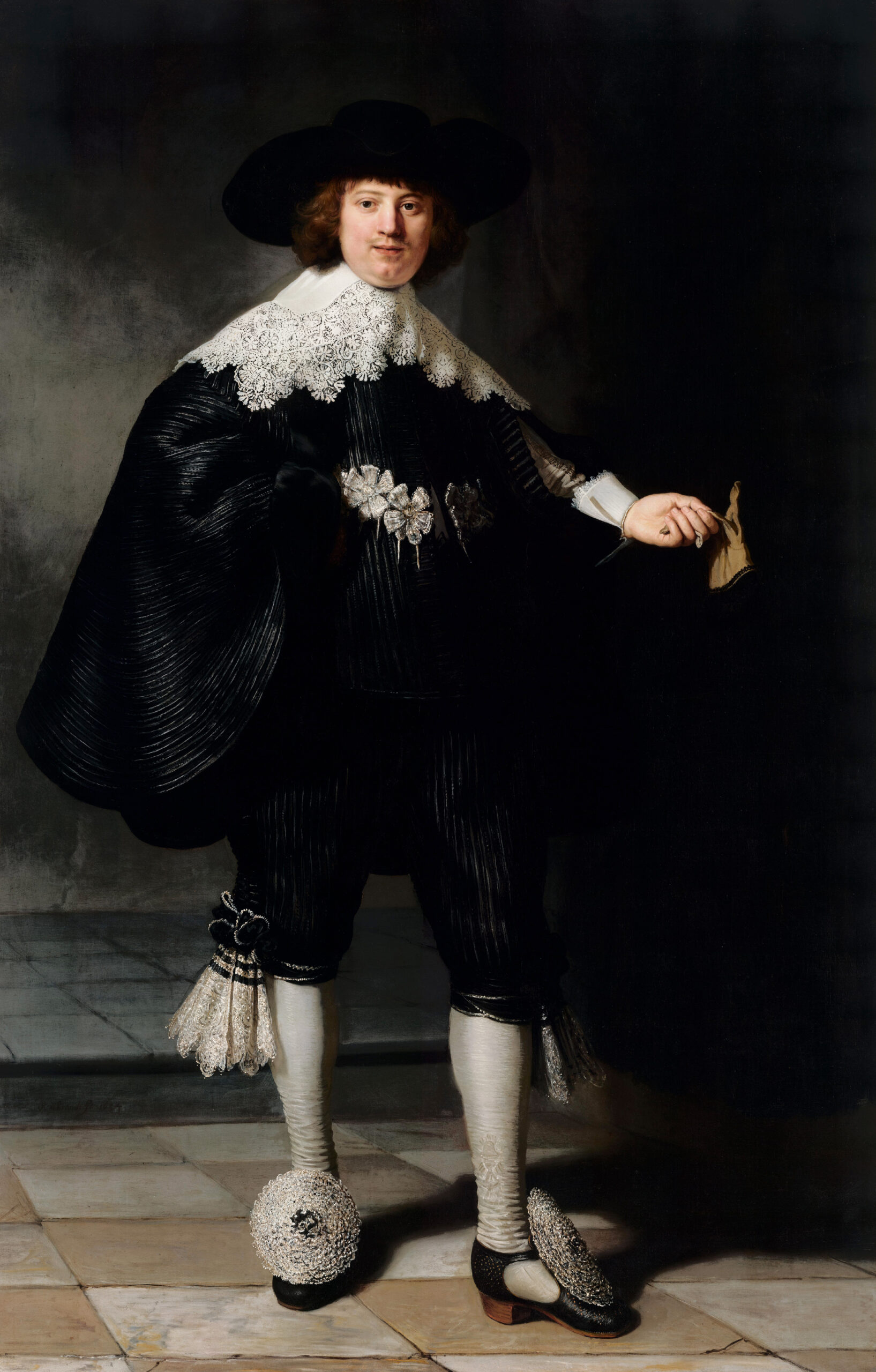
Maerten Soolmans was a sugar merchant. His father had made a fortune in trade with Brazil. He was twenty-two when he commissioned Rembrandt, already celebrated in Amsterdam, to paint two full-length pendant portraits to mark his marriage to Oopjen Coppit.
The full-length portrait – life-size, standing – was not a neutral choice. It was a social code. Across Europe at this time, the format was reserved for sovereigns, princes, and senior dignitaries: those whose authority warranted being measured from head to foot. Elsewhere in Europe, even a very wealthy merchant would not commission this kind of portrait.
In Holland, he could. Soolmans could afford it financially and socially. The Dutch Republic had no hereditary aristocracy monopolising prestige. Status was earned through commercial success and civic respectability. And money in Amsterdam in 1634 was invested, in part, in art – as a signal of social standing and an assurance of lasting memory.
In 2015, Eric de Rothschild sold the two portraits for 160 million euros – a record for a Rembrandt – jointly to the Rijksmuseum and the Louvre, who share ownership with the support of their respective governments. The portraits have since alternated between Amsterdam and Paris.
A seventeenth-century sugar merchant had commissioned portraits fit for a king. The king had not been required.
- Portrait of Marten Soolmans, by Rembrandt van Rijn, 1634
- 207.5 x 132 cm
- The Rijksmuseum, Amsterdam and Musée du Louvre, Paris (currently exhibited in Paris until 2029 before alternating back to Amsterdam for 5 years)
- At Rijksmuseum: https://www.rijksmuseum.nl/en/collection/object/Portrait-of-Marten-Soolmans–8e1e37eae253bf0f528928483b8ca933
- At Le Louvre: https://collections.louvre.fr/ark:/53355/cl010364287
02 Judith Leyster – The Serenade, 1629
What this work reveals: A woman in the guild – and in history
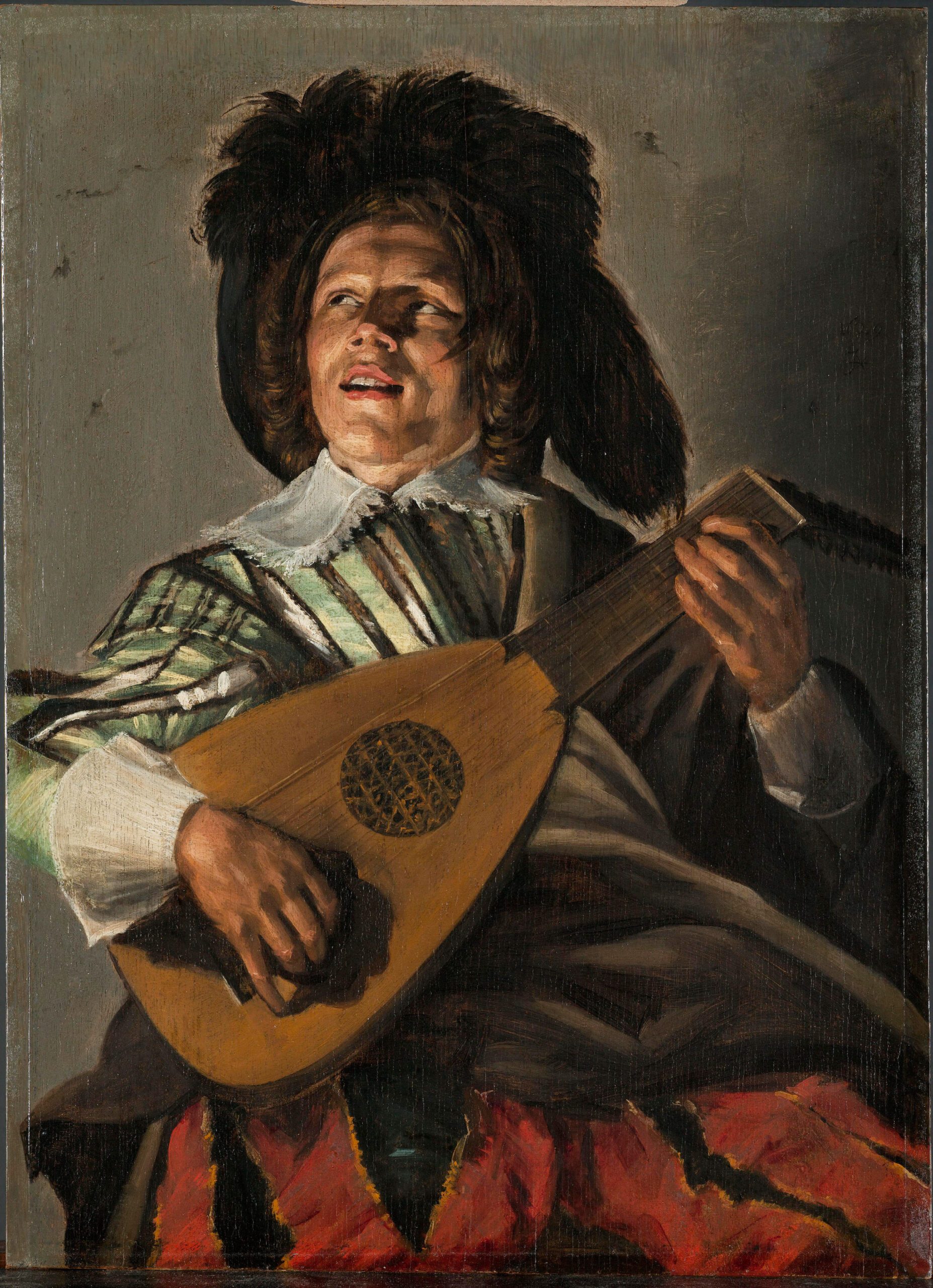
A young man plays a lute by candlelight. The scene is intimate, the gesture precise, the nocturnal atmosphere characteristic of the Utrecht Caravaggists – Van Honthorst, Baburen – who had brought back from Italy the lessons of chiaroscuro. Nothing extraordinary, at first glance.
Except that the author of this painting was twenty-one years old. And that she had just been admitted to the Guild of Saint Luke in Haarlem.
Judith Leyster was accepted into the guild in 1633, the professional body governing the right to paint commercially, to sell, to exhibit, and to take on apprentices. She ran her own studio. Three pupils. She sold her works on the open market.
In Catholic France, this would have remained exceptional for another two centuries. In Rome, women painters existed but on the margins, often in convents or under the protection of a painter father. In the Calvinist Dutch Republic, where the guild was less tightly locked by gender conventions inherited from ecclesiastical hierarchy, an imperfect meritocracy opened – however partially – to those women who possessed the talent and the determination.
For a long time, works by Leyster were attributed to Frans Hals, her Haarlem contemporary. Not out of bad faith, simply because no one was seriously looking for a female painter in the archives. The rehabilitation of Leyster in the twentieth century says something important about art history: you find what you look for. What you do not look for gets attributed to the nearest master.
Leyster may have influenced Hals as much as Hals influenced her. We do not know. We had not looked.
- “The Serenade” by Judith Leyster, 1629
- 47 x 34.5 cm
- The Rijksmuseum, Amsterdam
- https://www.rijksmuseum.nl/en/collection/object/The-Serenade–5b56863e2af8c41e0f4d27c4553ddc8f
03 Carel Fabritius – The Goldfinch, 1654
What this work reveals: Art as object – the birth of the open market
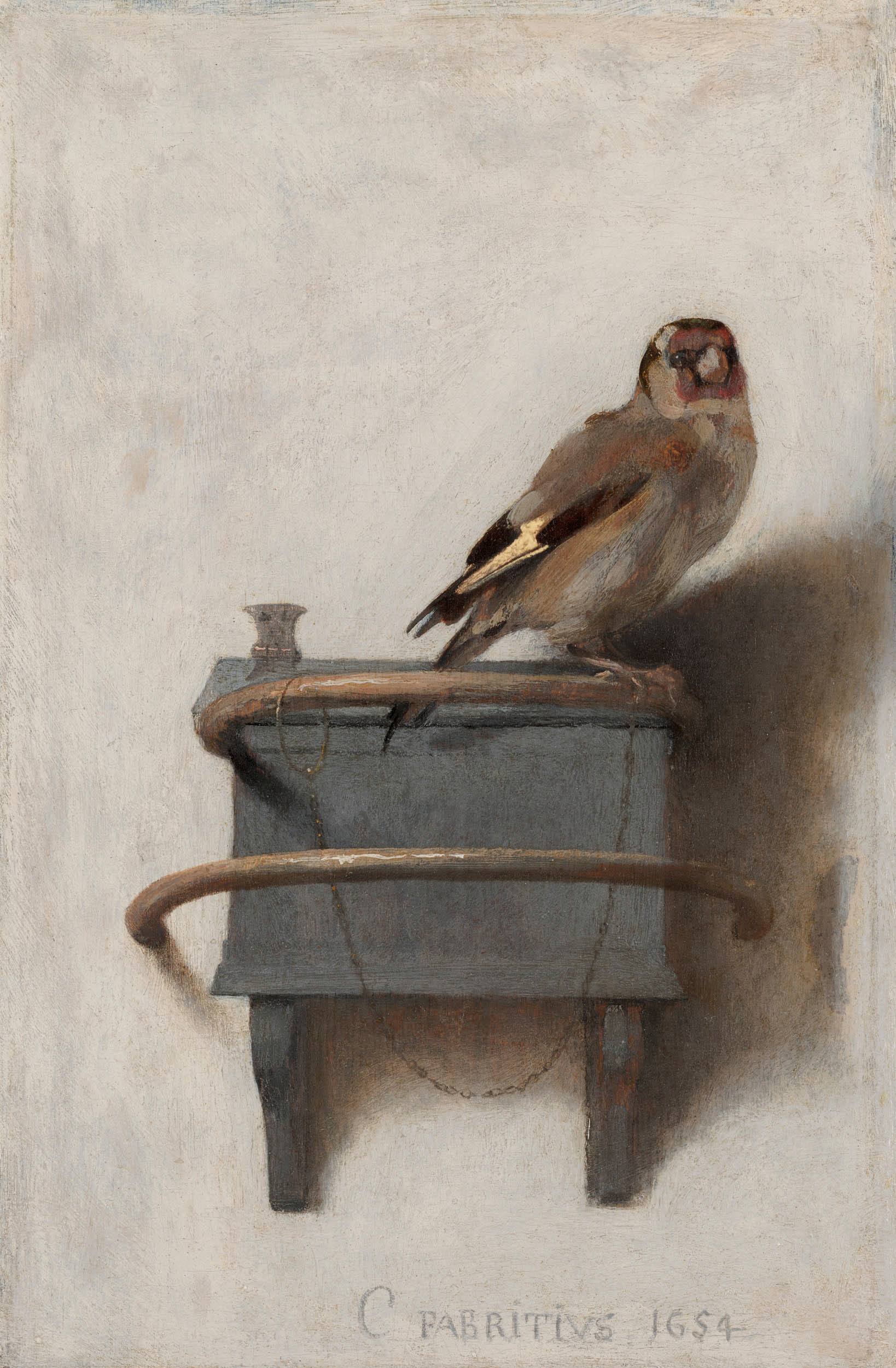
A bird. Tethered by a fine chain to its perch. Life-size. A pale, slightly curved background – probably a trompe-l’oeil panel intended to be set into wooden panelling. The whole thing on a surface of 33 by 23 centimetres.
This is not church decoration. This is not a state commission. It was made to hang in a bourgeois interior, to be examined closely, admired for its illusionism – the light on the feathers, the tactile presence of the metal chain. It is an object of visual pleasure for someone with money and a free wall.
Carel Fabritius painted this work in 1654, a few months before his death in the explosion of the Delft gunpowder magazine – a catastrophe that destroyed much of the city and almost certainly a large part of his output. He was thirty-two years old. He had been Rembrandt’s most gifted pupil, and was probably the teacher who formed Vermeer. Seventeenth-century Dutch painting is partly shaped by what Fabritius did not have time to transmit by any other means.
What makes The Goldfinch historically significant is its economic format as much as its virtuosity. It embodies the transformation of the painting into a commodity. In the Dutch Republic, an art market was functioning that closely resembles, in its structure, the one we have today: artists produced without prior commission, dealers bought, private collectors resold. Fairs, auctions, speculation. This market accounts for the extraordinary productivity of Dutch painters: Rembrandt produced roughly 600 paintings, 300 etchings, and 1,400 drawings.
The Goldfinch is a product of that market – and one of the most perfect things it ever produced.
- The Goldfinch, Carel Fabritius, 1654
- Oil on panel
- 33.5 × 22.8 cm
- Mauritshuis, The Hague
- https://www.mauritshuis.nl/en/our-collection/artworks/605-the-goldfinch
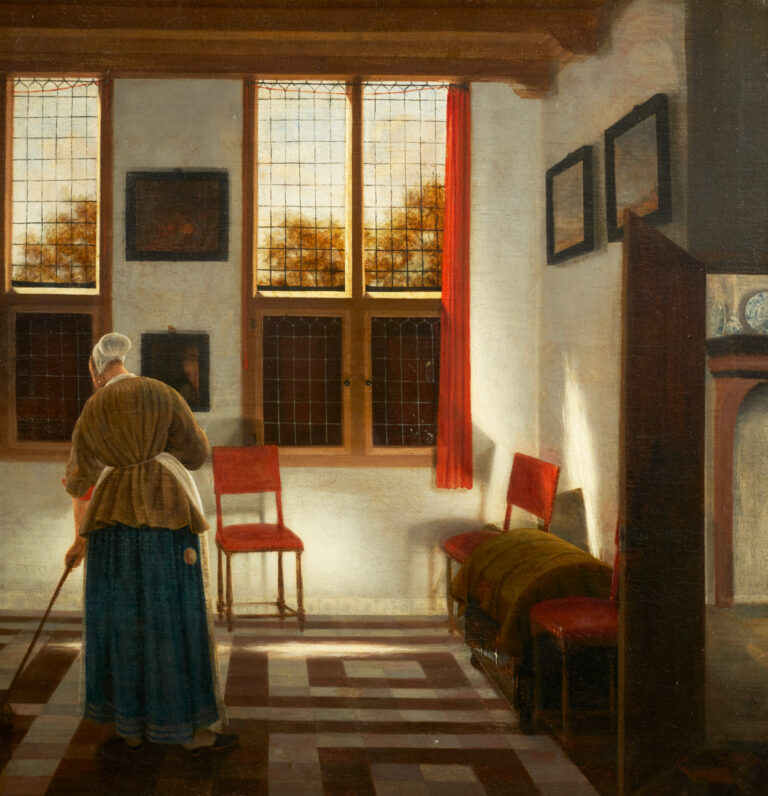
04 Pieter Janssens Elinga – The Sweeper, c. 1670
What this work reveals: Protestantism rewrites the hierarchy of subject matter
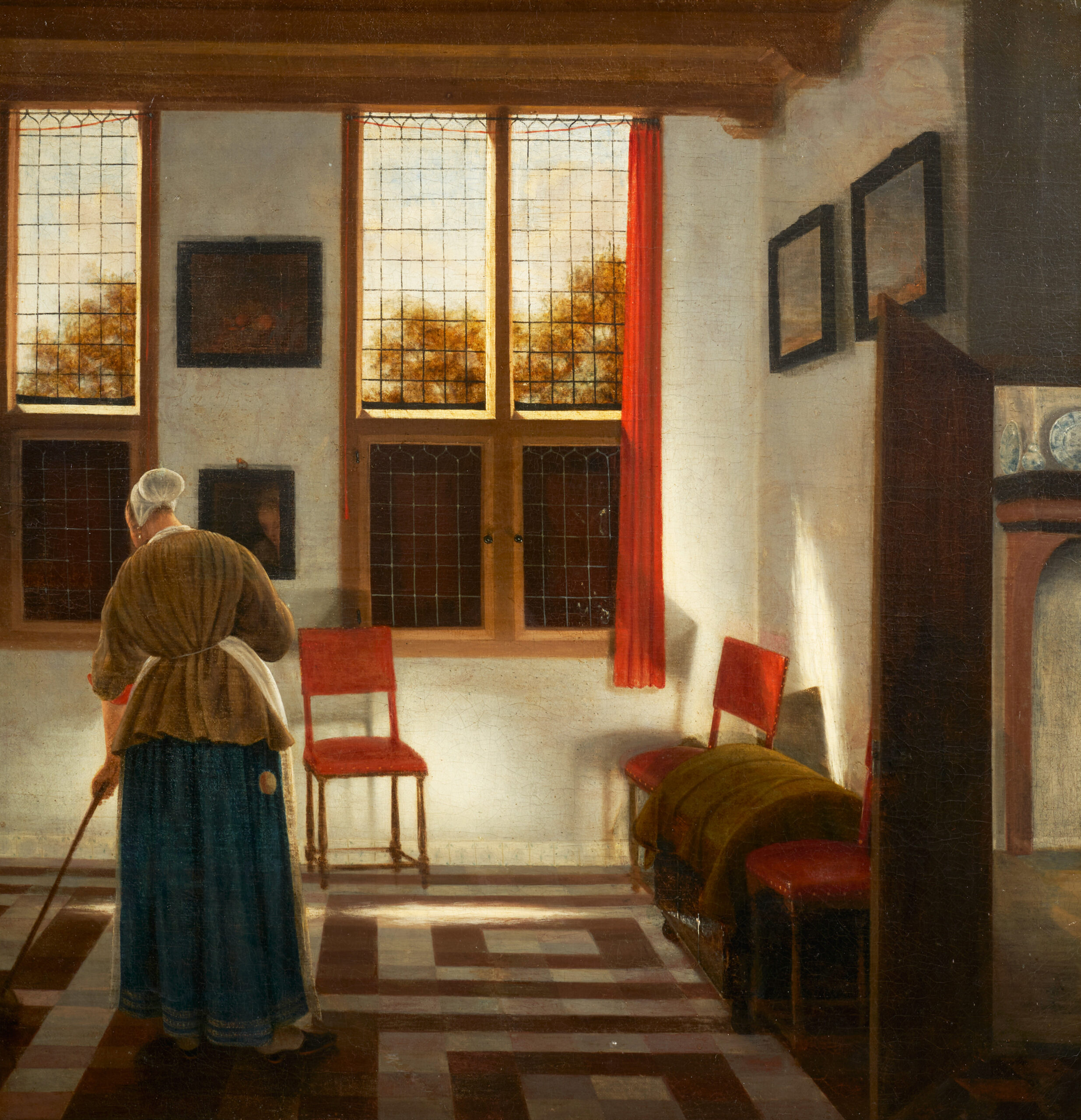
A woman sweeps. She is seen from behind. She is not identified. There is no hidden allegory, no overt moral symbolism, no mythological reference. Light enters from a window on the left and falls across the tiled floor.
In France, the Academie Royale de Peinture et de Sculpture, founded in 1648, ranked pictorial subjects in strict order of dignity: history painting (biblical, mythological, historical scenes) at the top, portraiture below it, then genre scenes, still life, and landscape at the bottom. To paint a woman sweeping was to work in the lowest register of the academic scale.
In the Dutch Republic, this hierarchy carried far less weight. Calvinism had no sacred images to produce for church interiors. There was no royal court commissioning grand historical cycles. What Dutch painters had was a bourgeoisie that wanted to see itself – its homes, its possessions, its servants, its markets, its streets.
The sweeping woman is not a degraded subject for the potential buyer of this painting. She is a figure of domestic order, of the well-kept home, of the everyday virtues that Calvinism elevated to the level of spiritual practice. A clean interior was a state of grace.
This reversal of the hierarchy of genres is among the most enduring innovations of the Golden Age. In 1905, Max Weber would write about the Protestant ethic and the sanctification of daily labour. Dutch painters had given it form two centuries before he theorised it.
The academy classifies. The market buys what it enjoys looking at.
- The Sweeper by Pieter Janssens Elinga, c. 1670
- 60 x 58.5 cm
- Paris Museums, Petit Palais, Museum of Fine Arts of the City of Paris, displayed on the Ground Floor, Room 26
- https://www.parismuseescollections.paris.fr/fr/petit-palais/oeuvres/la-balayeuse
05 Jacob van Ruisdael – The Windmill at Wijk bij Duurstede, c. 1668-1670
What this work reveals: Nature as homeland – the invention of national landscape
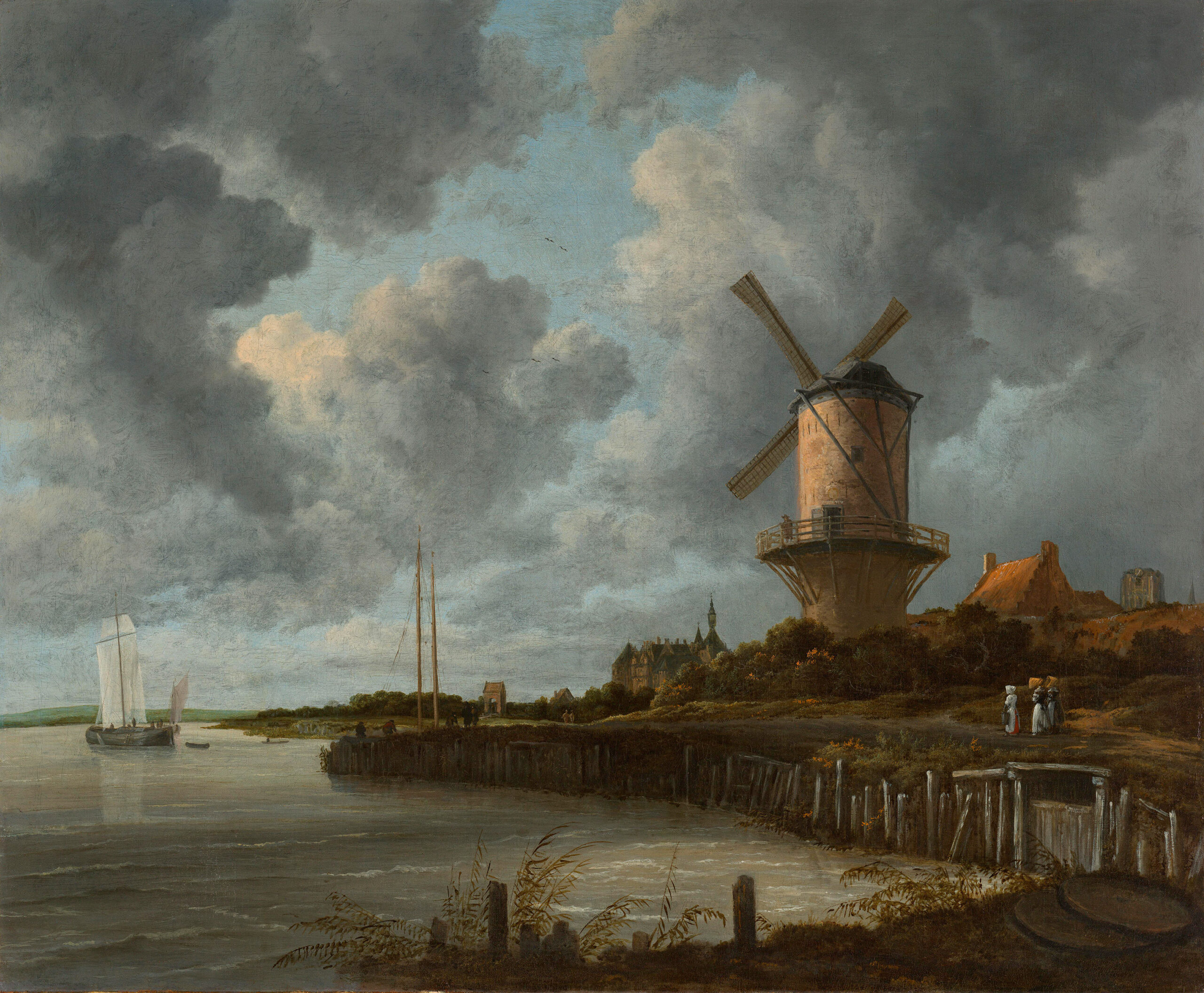
A windmill. A low, dramatic sky. Water. Boats. A brick tower in the background. No significant figure in the foreground.
In Italy at the same period, landscape – when it appeared at all – served as the backdrop to a sacred or mythological scene. Claude Lorrain painted idealised landscapes: golden light, ancient ruins, Arcadian shepherds. Landscape was a setting for something else.
Here, the landscape is the subject. And not just any landscape: one that is recognisably, specifically Dutch. A windmill pumping water from a polder. This machine is hydraulic engineering – the technology that made the Dutch Republic possible by reclaiming land from the sea. Without the mills, there is no country.
Ruisdael was painting a national identity at the very moment it was being formed. The Dutch Republic had secured its independence in 1648, after eighty years of war against Spain. This landscape is not neutral: it says this is what we have built, what we defend, what defines us. Not a royal dynasty. Not a universal religion. A stretch of land wrested from the water.
Historians Svetlana Alpers and Simon Schama have shown how Dutch landscape painting functions as a cartography of national identity. The Netherlands was built on the control of water – and represented that control with obsessive consistency. Every mill, every canal, every low horizon is a collective self-portrait.
A landscape without a sacred figure is not a minor genre. It is a political one.
- The Windmill at Wijk bij Duurstede, by Jacob Isaacksz van Ruisdael, c. 1668 – c. 1670
- 83 x 101 cm, oil on canvas
- Rijksmuseum, Amsterdam
- https://www.rijksmuseum.nl/en/collection/object/The-Windmill-at-Wijk-bij-Duurstede–fb2b57919550092bf709472f81426eab
What official history left out
Art history surveys celebrate the Golden Age as an era of commercial freedom, bourgeois individualism, and relative religious tolerance. They rarely mention what financed that prosperity.
In 1656, Andries Beeckman painted A Market Stall in Batavia – present-day Jakarta, Indonesia. The work shows the stalls of an open-air colonial market: vendors, buyers, merchandise. The setting is a city controlled by the Dutch East India Company (VOC) since 1619. By 1650, the VOC was the largest company in the world. It minted its own currency, raised armies, declared war, and administered territories. It financed the ramparts of Amsterdam, the houses on the Herengracht, and the commissions that sustained the painters.
It also financed the enslavement and trafficking of human beings, the forced exploitation of spices in Banda, and the massacre of local populations who resisted the Dutch monopoly. The VOC’s commercial structures reshaped entire economies across South-East Asia, with catastrophic demographic consequences.
A Market Stall in Batavia is a document of that colonial presence. It is in the Vmuseum collections. It is also, if one is prepared to look at it honestly, a painting about the conditions that made the Golden Age possible.
The domestic genre painting was financed, in part, by violence thousands of miles away. Both facts belong to the same history.
Look first, read later
Return to Rembrandt’s Portrait of Maerten Soolmans (Rijksmuseum, Amsterdam). Before consulting the analysis, spend two minutes with the image alone.
Three points to observe:
- Look at Soolmans’s hands. What is he holding? How are they positioned?
- Look at the lace of his collar and cuffs. How long might it have taken to dress for this sitting?
- Compare his posture with that of a king in a royal portrait. What is the difference – if any?
There are no correct answers – only your eye, before anyone tells you what to see. This is the core competence of the art historian, and it is acquired through practice, not through reading. Then compare with the full analysis on Vmuseum.
The Golden Age lives around you
- The apartment as personal gallery. Seventeenth-century Dutch households pioneered the idea of hanging paintings throughout the home – not only in grand reception rooms. Foreign visitors described their astonishment at finding paintings in the shops of butchers and bakers. The notion that an ordinary domestic space deserves to be adorned with art remains, structurally, an invention of the Golden Age.
- Instagram and the food photograph. Vermeer and his contemporaries made the kitchen, the laid table, and the light from a window falling on an everyday object worthy of a painting. Every food photograph posted on Instagram reprises this gesture: the ordinary deserves to be looked at carefully. The framing, the light, the choice of subject – this is pictorial composition.
- The stock exchange and art as investment. The Amsterdam Stock Exchange, founded in 1602, was the first securities exchange in the world. In the same city, an art market operated on similar logic: speculation, price-setting, resale. Today’s art fairs, auction houses, and NFTs extend precisely the model that Dutch merchants invented.
Frequently asked questions
What exactly is the Dutch Golden Age?
The term refers to the period of economic, scientific, and artistic prosperity in the Dutch Republic during the seventeenth century, roughly from 1588 to 1672. It was the era when Amsterdam was the leading commercial port in the world, when the VOC dominated trade across Asia, when Spinoza was writing in The Hague, and when Rembrandt, Vermeer, Hals, and thousands of other painters produced a volume of work without precedent in the history of art. The phrase ‘Golden Age’ (Gouden Eeuw) is a retrospective construction of the nineteenth century: the Dutch of the period did not use the term to describe themselves.
Why did Calvinism stimulate painting rather than destroy it?
Calvinism did indeed destroy religious images in places of worship – that is what the Beeldenstorm of 1566 was. But outside the religious space, it did not prohibit painting. What it forbade was the veneration of sacred images, not art as such. The paradox is that banning religious subjects from churches freed painters to address other subjects – and generated demand for works intended for private interiors rather than devotional spaces. Iconoclasm turned out to be an unexpected accelerator of genre diversification.
What is the difference between Flemish Baroque (Rubens) and the Dutch Golden Age?
The two coexist in the seventeenth century, separated by a political and religious border. The Southern Netherlands (present-day Belgium) remained under Spanish Catholic rule: Rubens painted vast Baroque canvases for cathedrals and royal courts. The Northern Dutch Republic was Calvinist and republican: its painters worked for merchants and produced smaller, more intimate formats aimed at a bourgeois market. Same period, same geographic roots, radically different aesthetics – because the patrons and the destination spaces were radically different.
Is Vermeer really a Golden Age painter?
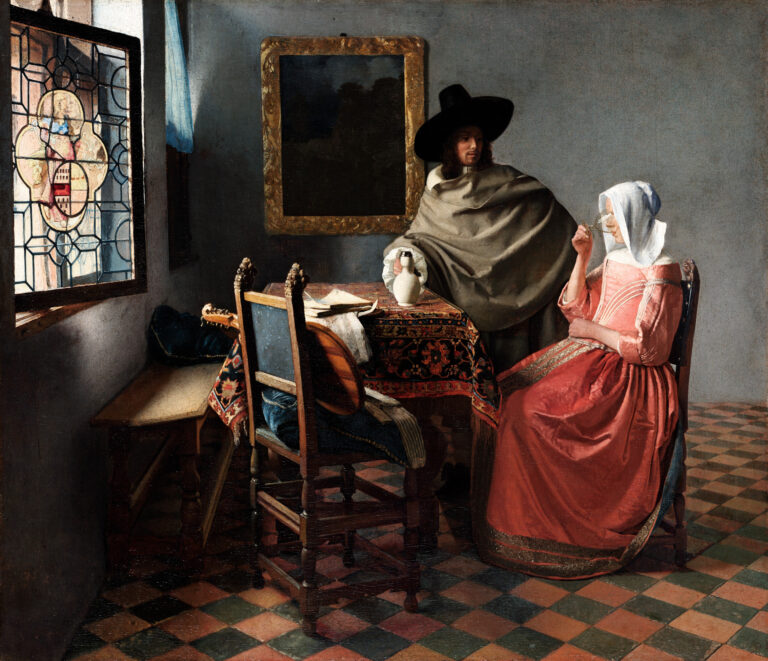
Yes, Vermeer (1632-1675) is one of the most emblematic figures of the Dutch Golden Age. He lived and worked in Delft, produced primarily domestic interior scenes of extraordinary luminosity, and sold his works on the local market. He died in relative obscurity and produced only around thirty-five paintings – very few by the standards of his time. His rediscovery in the nineteenth century by the critic Thoré-Bürger has made him retrospectively one of the canonical pillars of the Golden Age. Vmuseum holds two of his works: Girl with a Pearl Earring and The Wine Glass.
Further reading
Svetlana Alpers, *The Art of Describing: Dutch Art in the Seventeenth Century* (University of Chicago Press, 1983) – The foundational work on what distinguishes Dutch painting from Italian. Alpers argues that Dutch painters did not work from a text (biblical, mythological) but from an empirical gaze directed at the visible world. Demanding but indispensable.
Simon Schama, *The Embarrassment of Riches: An Interpretation of Dutch Culture in the Golden Age* (Alfred A. Knopf, 1987) – A total cultural history of the seventeenth-century Netherlands: wealth, the Protestant guilt it generates, death, domesticity, the tulip. A rare book – rigorous and literary in equal measure.
Online catalogues and resources
The Rijksmuseum (rijksmuseum.nl) makes collection notes available online for all its works, at varying levels of depth. The database is among the most comprehensive and freely accessible for Golden Age holdings.
The Mauritshuis (mauritshuis.nl) holds a focused Golden Age collection that includes Fabritius’s The Goldfinch. Its online notes are accessible and well documented.