The Hague, circa 1645. Bernard Zwaerdecroon receives a prestigious commission: to immortalize two young children from a wealthy family as idealized shepherds. An artistic fashion typical of the Dutch Golden Age.
A Carefully Orchestrated Pastoral Scene
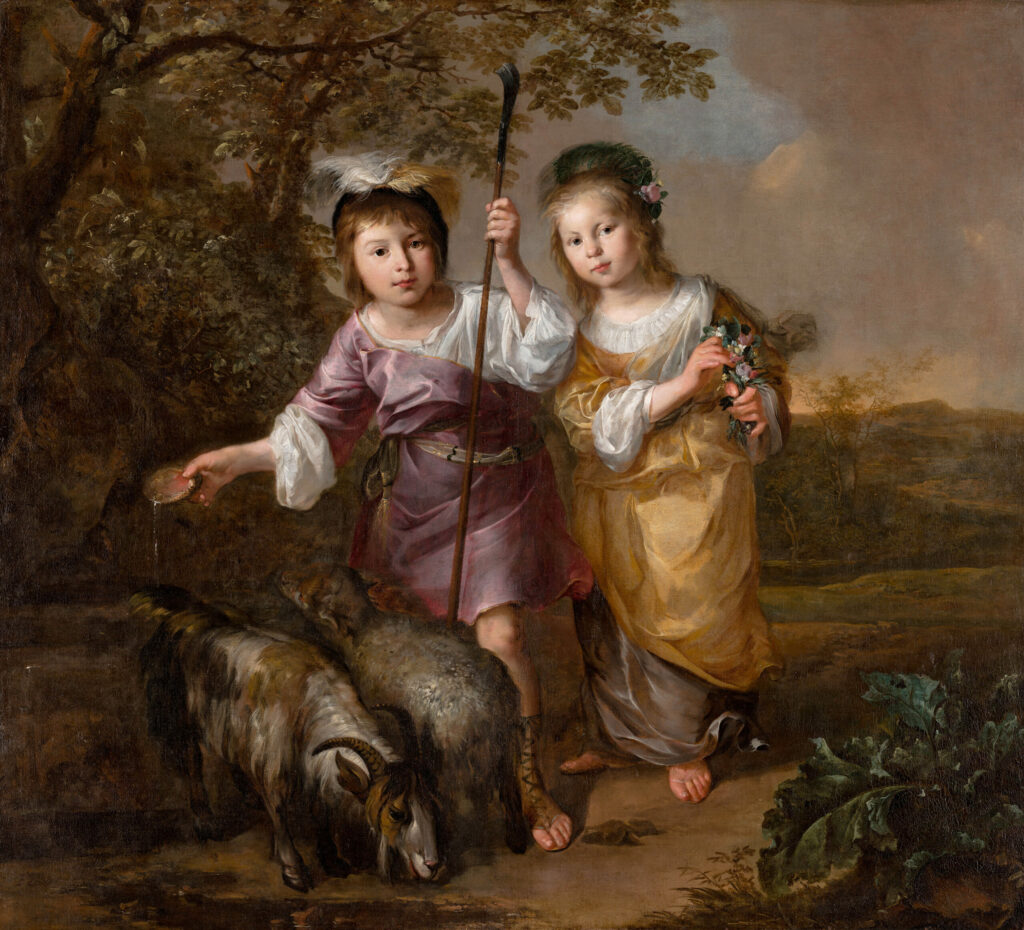
Two children stand in a rural landscape bathed in golden light. One wears a purple tunic and holds a long shepherd’s staff, the other a saffron dress and a bouquet of flowers. Their clothing is anything but rustic. At their feet, a goat and a sheep with meticulously rendered fur complete this bucolic staging. Zwaerdecroon masters the rendering of textures. The children’s faces fix the viewer with a direct and confident gaze. The composition structures the whole with elegance.
Disguised Portraiture, a 17th-Century Convention
This tradition of the “portrait as shepherd” enjoyed great success among the Dutch bourgeoisie. It allowed families to display their social status while celebrating a pastoral ideal borrowed from classical literature. These children would never tend flocks. Their disguise refers to Arcadia, that mythological land where innocence and harmony reign. Bernard Zwaerdecroon excels in this codified genre, combining Flemish realism with idealization. The large-format oil on canvas testifies to the prestige of the commission.
Zwaerdecroon, a Master of Dutch Portraiture
Active in The Hague in the mid-17th century, Bernard Zwaerdecroon (after 1616-1654) developed a wealthy clientele. He perfected the art of child portraiture in fancy dress, a highly sought-after genre. His pictorial technique combines descriptive precision with subtle atmospheric effects.
Think about it
💭 And today, what would one need to dress up as to assert social status?
About This Work
- Portrait of Two Children Dressed as Shepherds
- Bernard Zwaerdecroon
- circa 1645
- Oil on canvas
- 143.5 × 158 cm
- Mauritshuis, The Hague
- https://www.mauritshuis.nl/en/our-collection/artworks/675-portrait-of-two-children-dressed-as-shepherds
The Shepherd Portrait: A Dutch Social Convention
Having one’s children painted in pastoral costume was, in 17th-century Holland, a codified practice among the bourgeoisie and the aristocratic circles of The Hague. The shepherd or shepherdess disguise referred to Arcadia, the mythological space inherited from classical poetry (Virgil, Sannazaro) in which an ideal harmony reigns between humanity and nature. Choosing this register for a child’s portrait was not a sign of rural simplicity: on the contrary, it was a way of associating a family’s heirs with a learned imaginative world, accessible only to those familiar with ancient literature. The goat and the sheep with their meticulously rendered coats, as well as the crook carried by the child in the purple tunic, belong to this precise symbolic vocabulary.
Bernard Zwaerdecroon and The Hague Clientele
Active in The Hague at the mid-17th century, Zwaerdecroon built his practice among the wealthy families of a city that was then the administrative capital of the Dutch Republic and the residence of the House of Orange. This context explains both the ambition of the format (143.5 × 158 cm) and the quality of execution visible in the rendering of the coloured fabrics and the golden light that bathes the composition. The Mauritshuis, which now holds this painting, was itself the former residence of Count Johan Maurits van Nassau-Siegen, built in the 1630s: the work was therefore produced within the same social milieu that financed that very palace.
Light as an Argument for Prestige
The light in this portrait is not naturalistic: it is constructed to showcase every element of the composition. The golden tones of the foliage in the background, the light that defines the children’s silhouettes, and the interplay of textures between silk, wool, and animal fur all serve as demonstrations of painterly skill. In 17th-century Dutch painting, the technical quality of a portrait was an argument of reputation as much for the painter as for the patron who displayed it in their home.