El Greco
El Greco: the work of a visionary painter between two worlds
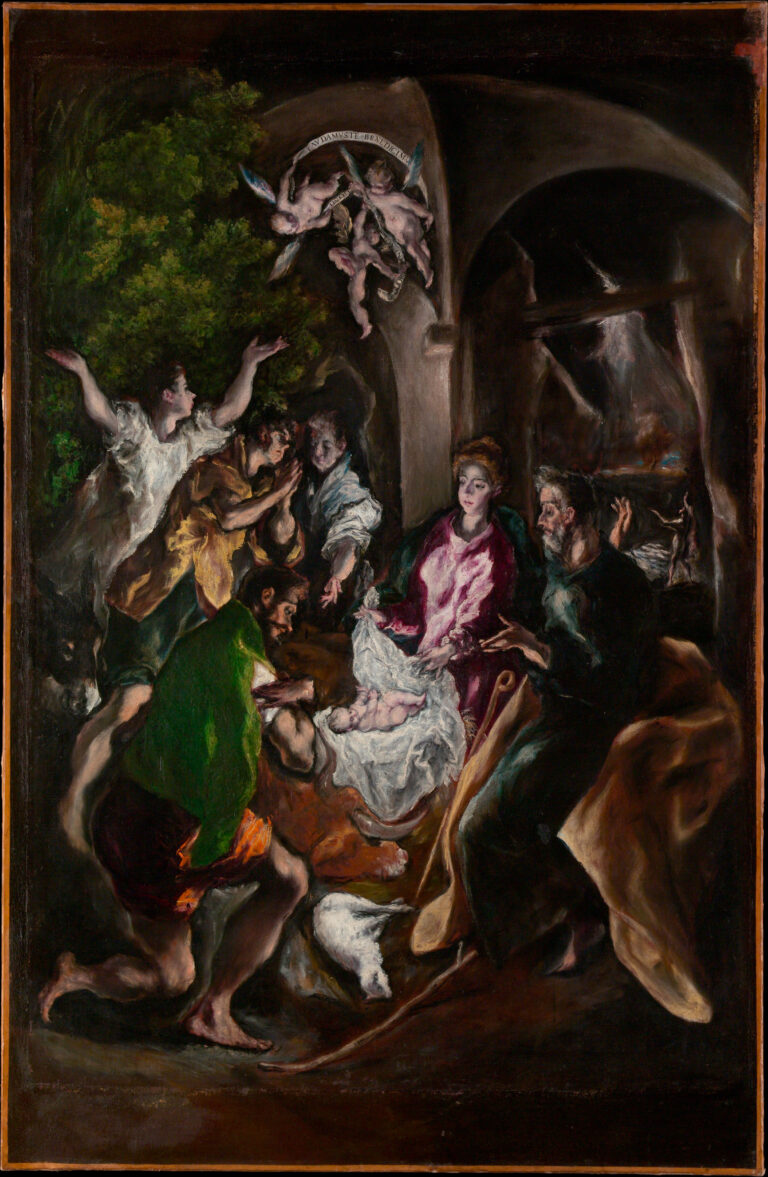
El Greco holds a singular place in the history of Western painting. His canvases, immediately recognisable for their figures stretched heavenward, their acid colours and their almost sourceless inner light, appear to resist the categories of their own time. Neither fully Renaissance nor yet Baroque, his work forged a radically personal visual language drawing on three distinct traditions: the Byzantine heritage of his native Crete, the colourist mastery absorbed in Venice, and the mystical fervour of Philip II’s Spain, where he settled permanently.
It is through his paintings that VMuseum invites you to enter El Greco’s world: from monumental religious commissions to portraits of Toledo’s nobility, each work reveals a painter who never ceased to interrogate the relationship between the body, the spirit, and the divine. For an account of his life and training, see the El Greco biography.
El Greco’s style: elongation, colour and supernatural light
El Greco’s formal signature is instantly recognisable: his human figures extend upward along the picture plane, as though drawn toward an immaterial beyond. Far from a failure of draftsmanship, this elongation is a deliberate expressive choice, a means of rendering the spiritual dimension of his subjects visible to the eye. His touch is rapid, almost nervous, laying colour in broken fragments that vibrate against one another rather than blending into smooth transitions.
His palette is among the most distinctive of the late Renaissance: acid greens, sulphurous yellows, luminous whites and steely blues appear alongside intense reds in combinations that read as nearly unreal. The light in his paintings has no identifiable source, it seems to emanate from the figures themselves, endowing his compositions with an almost visionary intensity.
El Greco’s major works
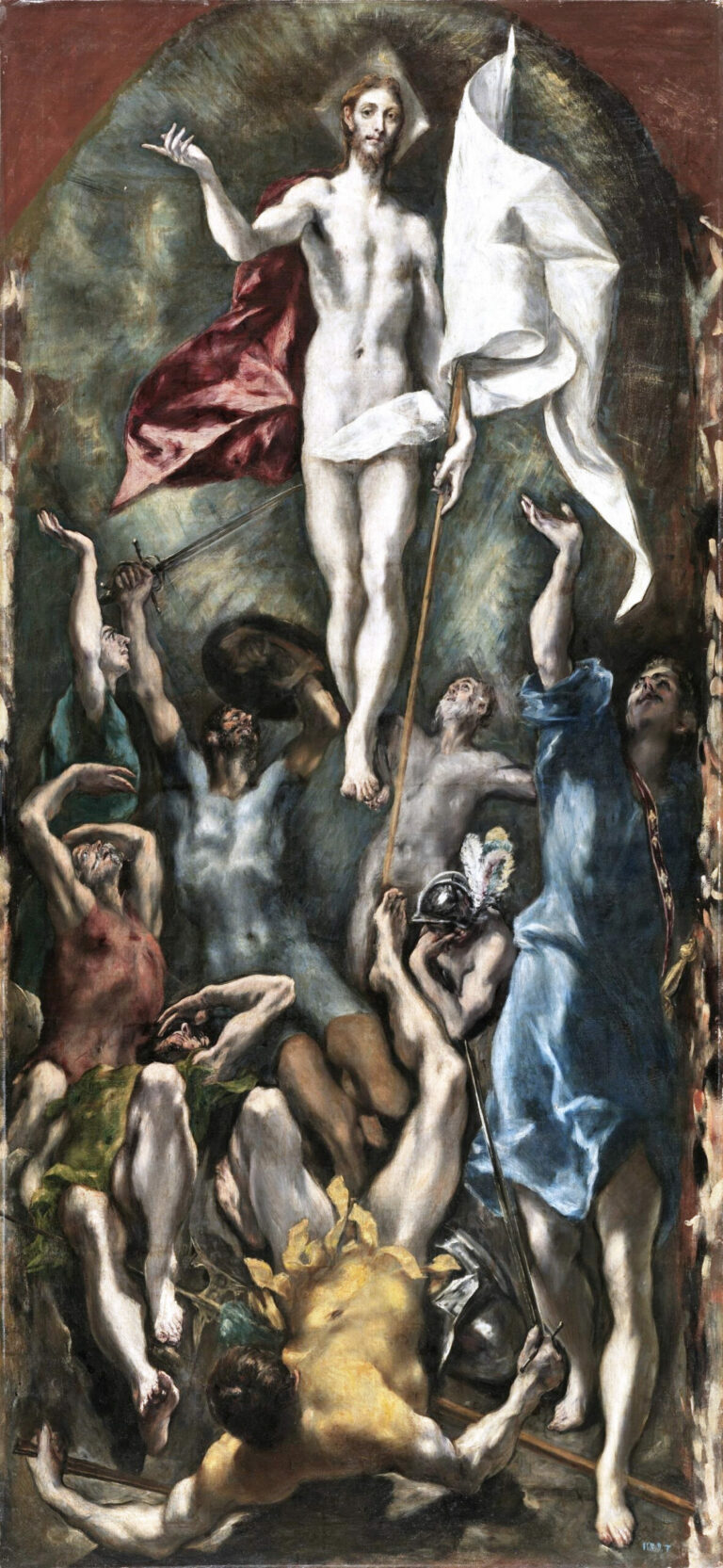
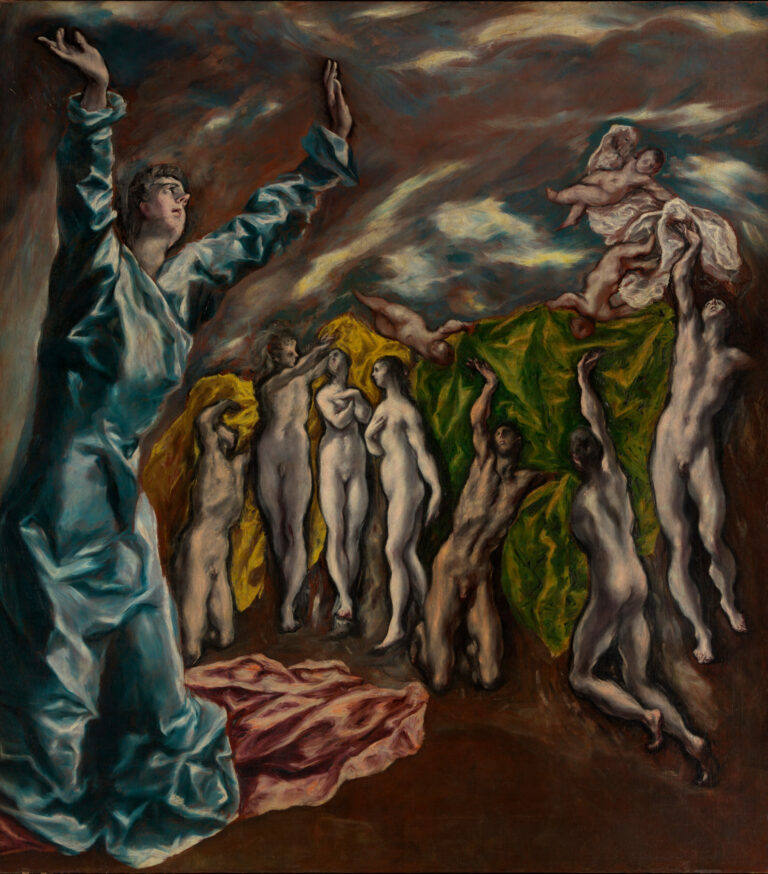
Among the most studied and affecting works in El Greco’s output, several are represented in VMuseum’s collection. The Vision of Saint John, also known as The Opening of the Fifth Seal, is striking for its almost Expressionist modernity and its extraordinary treatment of the human body in extremis. The Resurrection demonstrates his command of multi-figure compositions charged with dramatic intensity.
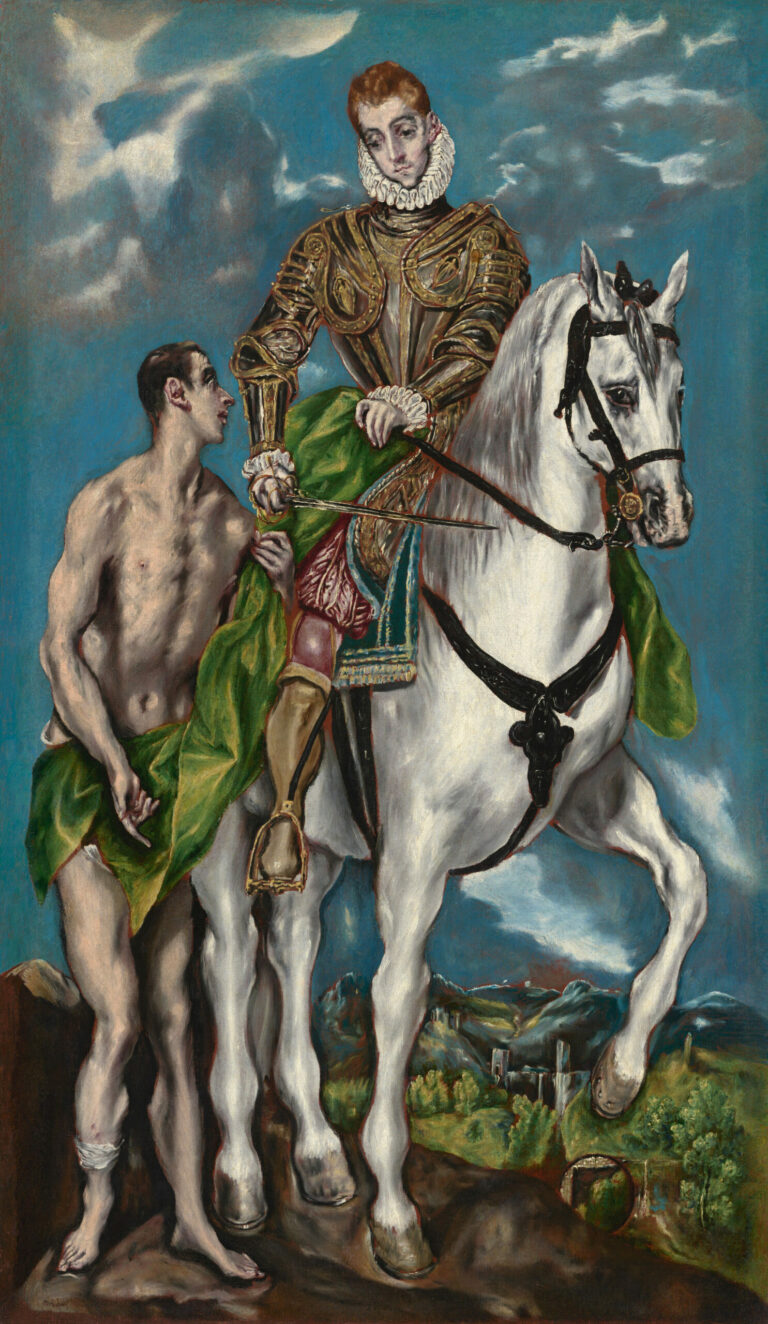
Saint Martin and the Beggar, a work from El Greco’s workshop, attests to the lasting influence the master exerted on his collaborators and to the wider dissemination of his style across Toledo. Picasso recognised in certain of these compositions a forerunner of Les Demoiselles d’Avignon; Cézanne was drawn to their spatial construction, evidence that his paintings have never ceased to provoke the art that came after them.
El Greco and Spanish religious painting
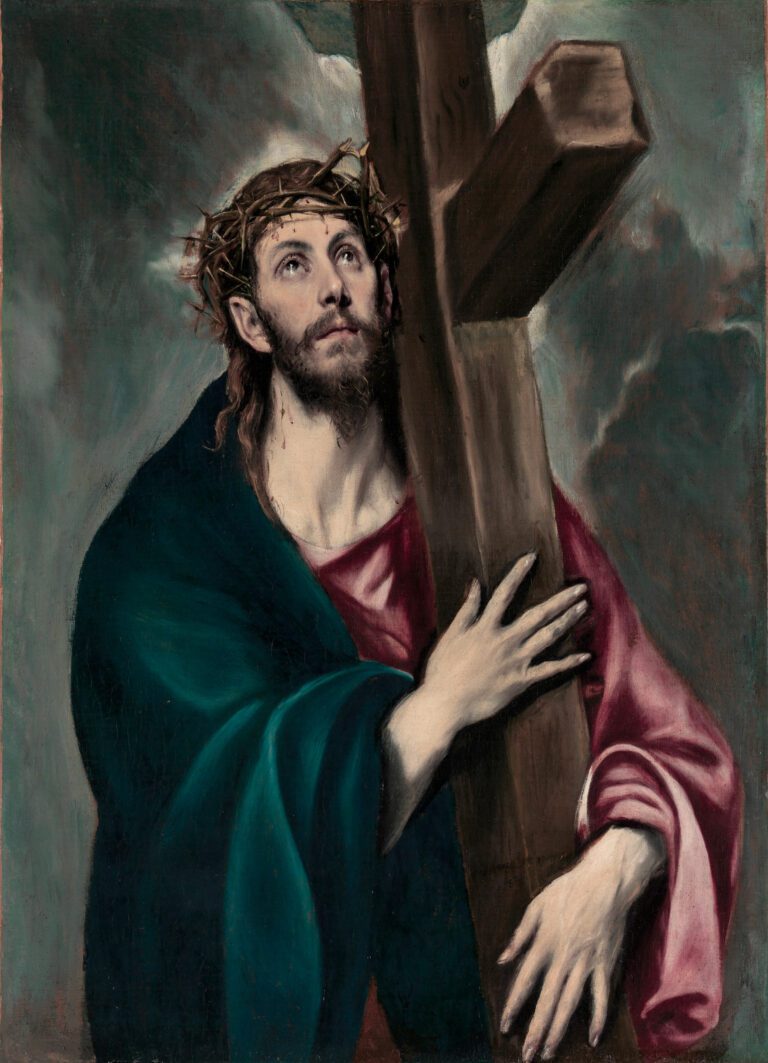
The greater part of El Greco’s output was produced for religious commissions in the context of the Spanish Counter-Reformation. His canvases adorned the altarpieces of Toledo’s convents and churches, conceived to elicit intense spiritual emotion from the faithful. Christ Carrying the Cross is among the most concentrated expressions of this ambition: the figure of Christ, luminous, inward, wholly absorbed, distils the painter’s capacity to transform a devotional subject into an act of genuine contemplation.
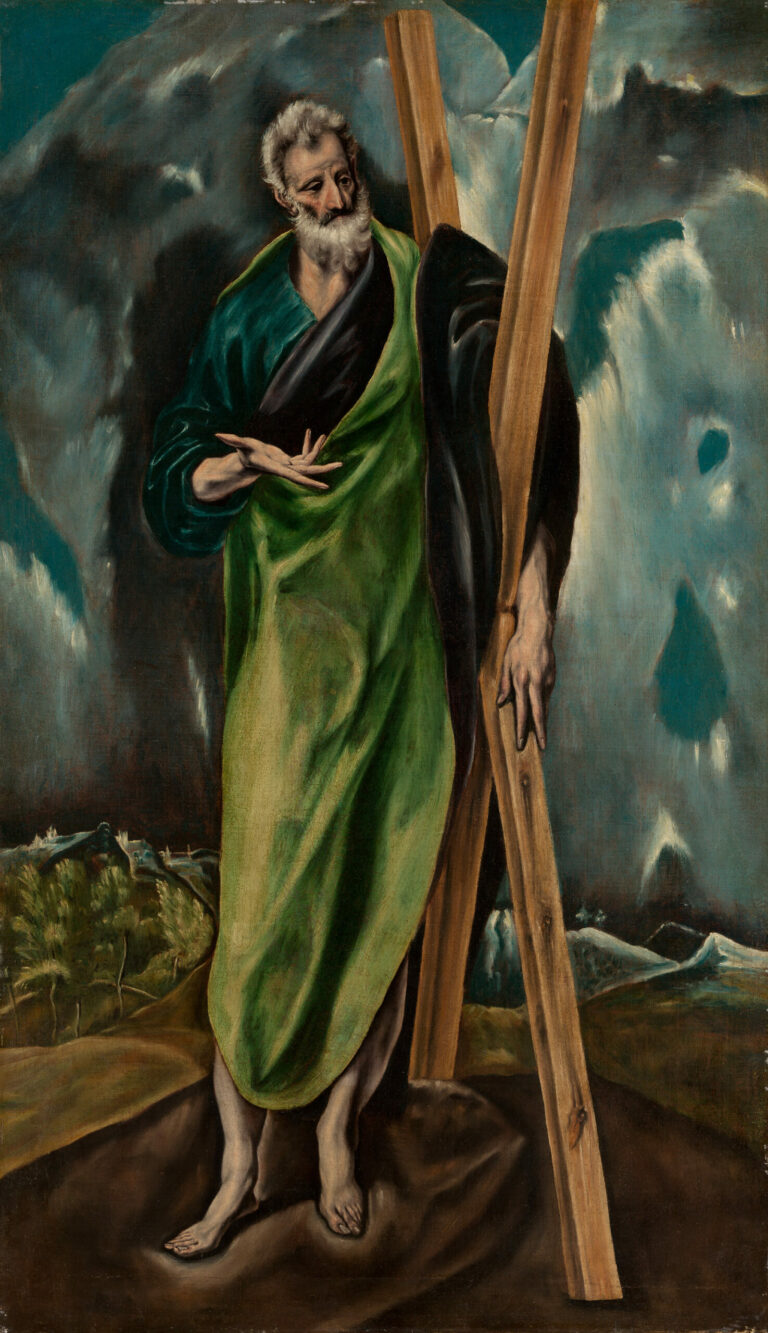
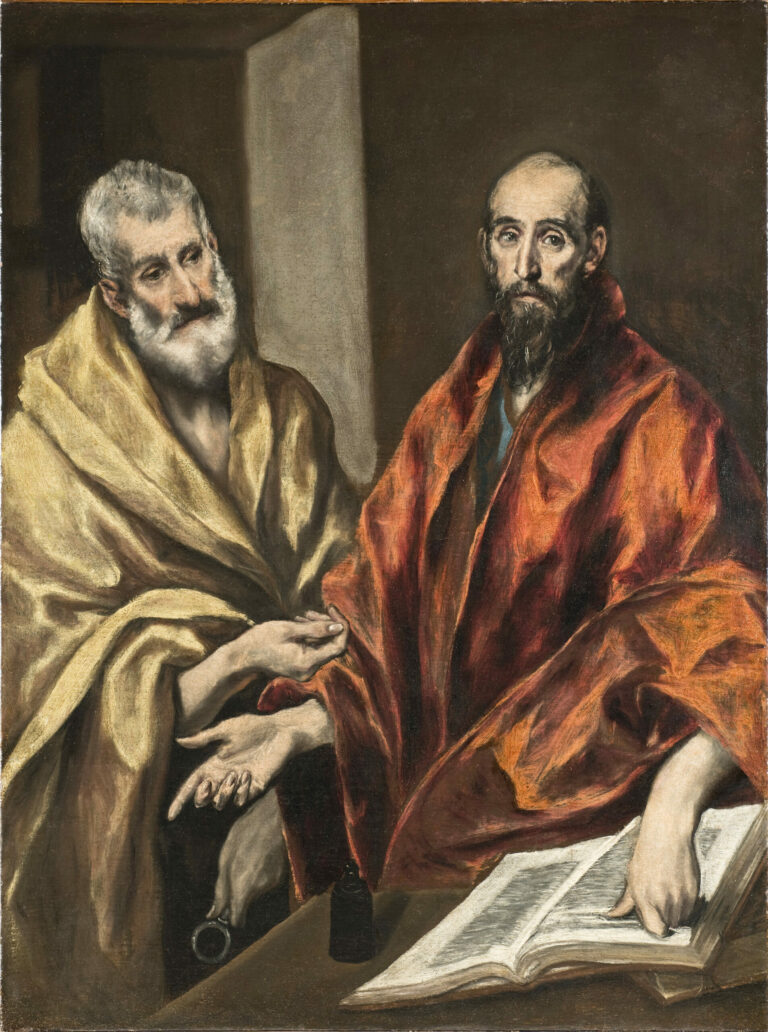
The series of Apostle portraits also holds a central place in his work. Saint Peter and Saint Paul and Saint Andrew illustrate his treatment of individual figures: each face is a psychological study, each drapery a demonstration of colourist mastery. It is in this body of religious painting that his style reaches its fullest maturity.
El Greco’s influence on modern art
Largely forgotten in the two centuries following his death in 1614, El Greco was rediscovered at the turn of the twentieth century by artists seeking alternatives to academic painting. This rehabilitation makes him a unique case in art history: a painter of the late Renaissance perceived as modern avant la lettre, whose works have continued to compel by their emotional force and radical formal freedom.
To study his paintings is to understand how a body of work can transcend its own historical moment and speak directly to sensibilities formed centuries later. The analyses available on VMuseum for each of his canvases restore this double perspective: that of sixteenth-century Spanish religious culture, and that which we, today, bring to a painter who seems always to have anticipated us.