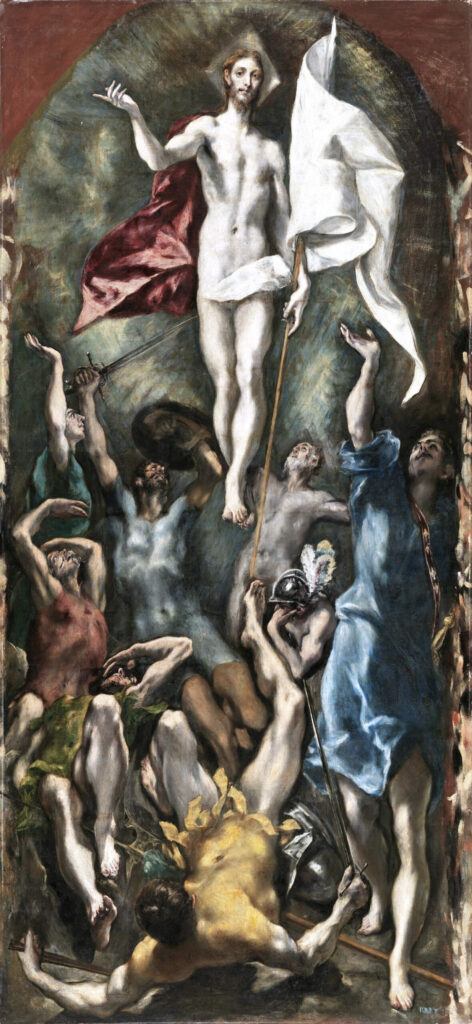
Madrid, late 16th century. El Greco receives an extraordinary commission: to adorn the altarpiece of the Colegio de la Encarnación. He conceives a Resurrection that defies gravity. Christ rises. The soldiers stagger. The world tilts.
A Light That Erupts from Nothingness
Look at this luminous Christ, almost unreal. He floats above the chaos. His white banner snaps in a space outside of time. The purple robe slips away — symbol of a sacrifice now fulfilled. Below, the soldiers of the sepulchre twist in arresting foreshortening — Mannerist scorcio at its peak. Bodies entangle, arms fly upward, faces register stupor. One soldier sleeps on, indifferent to the miracle. The colours — icy blues, deep reds, ghostly greens — are laid down with an almost Expressionist freedom.
An Altarpiece for a Foundress
In 1596, Doña María de Córdoba y Aragón placed the commission. This painting formed part of the high altarpiece of the church of the Colegio de María de Aragón, alongside other works now held at the Prado. El Greco chose a radical verticality: 275 cm high by 127 cm wide. The space is compressed, the light phantasmal. The diamond-shaped halo of Christ recalls the Byzantine tradition inherited from his native Crete. An intense, almost unsettling spirituality asserts itself. The painter signs his name at the bottom, in Greek letters — an openly assumed double identity.
El Greco (Domenikos Theotokopoulos)
El Greco (1541–1614), born in Crete, trained in Venice under Titian, and settled in Toledo from 1577 onward, invented a pictorial language entirely his own. Elongated figures, acid colours, vertiginous compositions: his late Mannerism belongs to no one else.
A Question for You
💭 Standing before this Resurrection, what do you actually feel — and where would you place El Greco in the history of Western painting?
About this work
- The Resurrection
- El Greco (Domenikos Theotokopoulos)
- 1597–1600
- Oil on canvas
- 275 × 127 cm
- Museo del Prado, Madrid
- https://www.museodelprado.es/en/the-collection/art-work/the-resurrection/2267dcd8-2b87-43b7-8104-0fb5070c4b5c
The Doña María de Aragón Altarpiece: El Greco’s Highest-Paid Commission
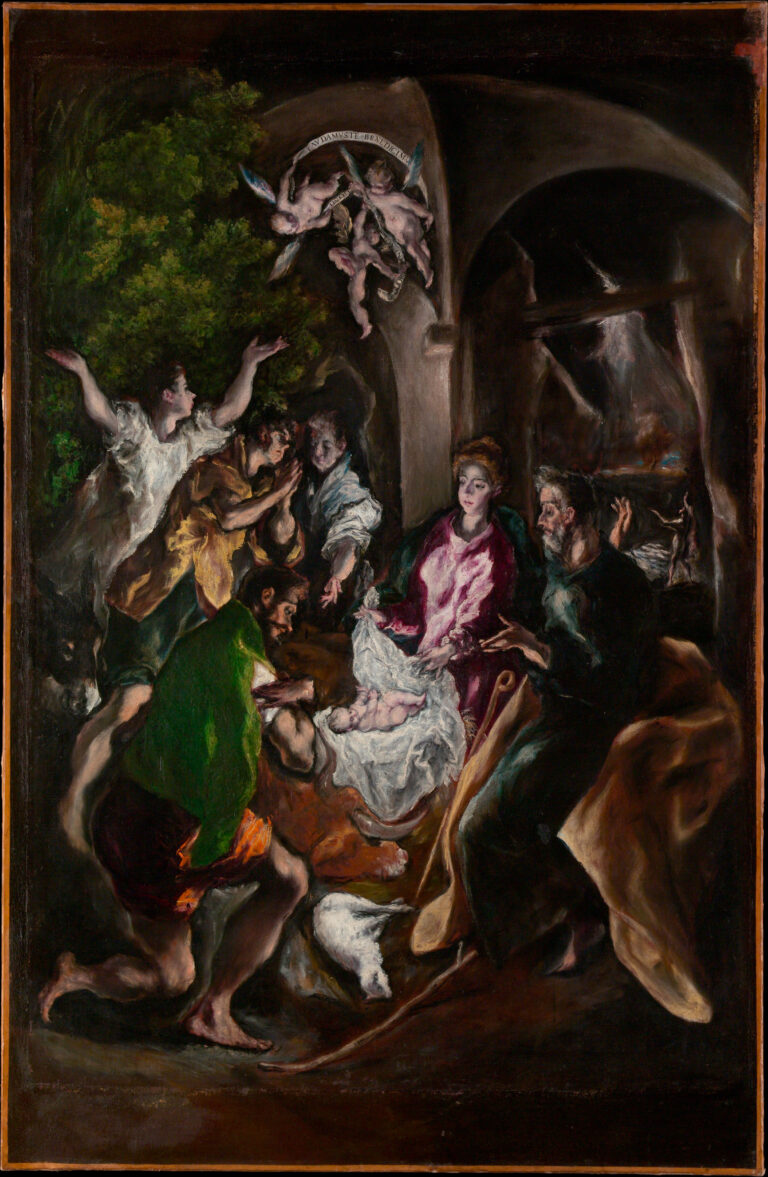
The Resurrection is one of the six surviving panels of the altarpiece commissioned by Doña María de Córdoba y Aragón for the Colegio de la Encarnación, an Augustinian seminary in Madrid. The contract was signed in 1596 for a period of three years; the panels were delivered between 1597 and 1600. The agreed price was 63,000 reales, the highest sum El Greco ever received for a commission in his lifetime. Alongside The Resurrection, the altarpiece comprised a Crucifixion, a Pentecost, an Annunciation, and a Baptism of Christ, all now held at the Prado, as well as an Adoration of the Shepherds today in the National Museum of Art of Romania in Bucharest. A seventh panel is lost.
A Vertical Format in the Service of Spiritual Elevation
At 275 × 127 cm, The Resurrection imposes a radical verticality that is not a gratuitous formal choice: it translates theologically the upward movement of the risen Christ. El Greco compresses the space by stacking the groups of collapsed soldiers at the base beneath the luminous Christ who breaks free above them. The diamond-shaped halo recalls the Byzantine icons of the Cretan tradition in which El Greco was trained before joining Titian’s workshop in Venice and settling in Toledo from 1577 onward.
Toledo and the Spanish Religious Commission
The Spain of the late 16th century was in the midst of the Counter-Reformation, shaped by the Council of Trent (1545-1563), which defined the norms of Catholic religious art: clarity of message, emotional power, and the depiction of sacred figures as models of identification. El Greco responded to these demands in his own manner, pushing the distortion of bodies and the intensity of colour to levels that his Spanish contemporaries had not reached. This singularity brought him incomprehension from some patrons, but also enduring loyalty from the Toledan clientele who recognised in his work a spiritual power unlike any other.The Doña María de Aragón Altarpiece: El Greco’s Highest-Paid Commission
The Resurrection is one of the six surviving panels of the altarpiece commissioned by Doña María de Córdoba y Aragón for the Colegio de la Encarnación, an Augustinian seminary in Madrid. The contract was signed in 1596 for a period of three years; the panels were delivered between 1597 and 1600. The agreed price was 63,000 reales, the highest sum El Greco ever received for a commission in his lifetime. Alongside The Resurrection, the altarpiece comprised a Crucifixion, a Pentecost, an Annunciation, and a Baptism of Christ, all now held at the Prado, as well as an Adoration of the Shepherds today in the National Museum of Art of Romania in Bucharest. A seventh panel is lost.
A Vertical Format in the Service of Spiritual Elevation
At 275 × 127 cm, The Resurrection imposes a radical verticality that is not a gratuitous formal choice: it translates theologically the upward movement of the risen Christ. El Greco compresses the space by stacking the groups of collapsed soldiers at the base beneath the luminous Christ who breaks free above them. The diamond-shaped halo recalls the Byzantine icons of the Cretan tradition in which El Greco was trained before joining Titian’s workshop in Venice and settling in Toledo from 1577 onward.
Toledo and the Spanish Religious Commission
The Spain of the late 16th century was in the midst of the Counter-Reformation, shaped by the Council of Trent (1545-1563), which defined the norms of Catholic religious art: clarity of message, emotional power, and the depiction of sacred figures as models of identification. El Greco responded to these demands in his own manner, pushing the distortion of bodies and the intensity of colour to levels that his Spanish contemporaries had not reached. This singularity brought him incomprehension from some patrons, but also enduring loyalty from the Toledan clientele who recognised in his work a spiritual power unlike any other.