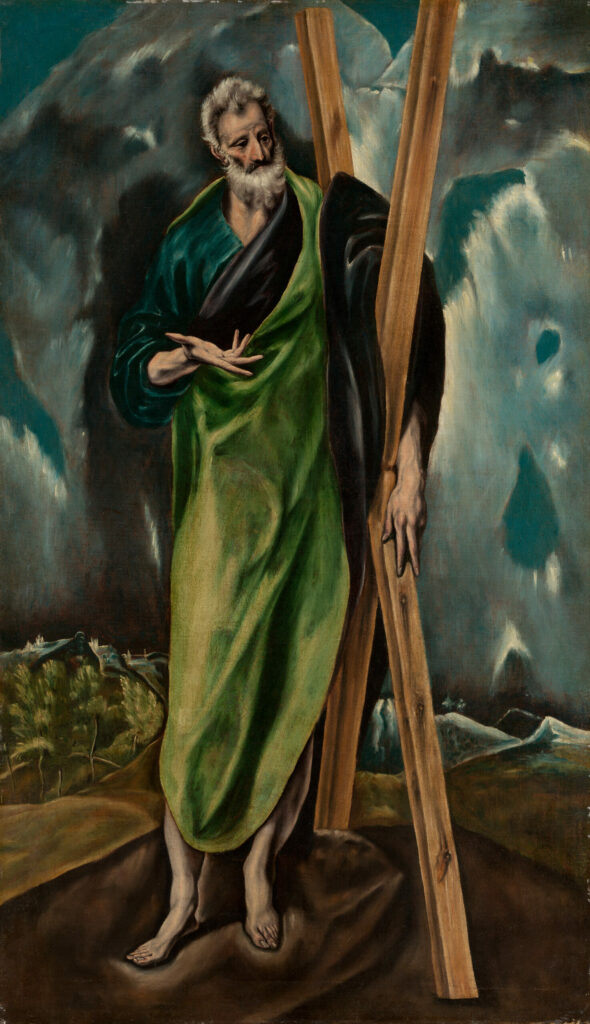
Toledo, circa 1610. El Greco’s workshop responds to the growing demand for devotional portraits. Saint Andrew, the first disciple of Christ, comes to life under the brushes of the Cretan master’s collaborators. This reduced replica testifies to the meteoric success of El Greco’s style among Spanish faithful.
A Vibrant Spiritual Figure
The apostle stands against a turbulent sky, blending stormy grays and deep blues. His elongated silhouette, characteristic of late Mannerism, seems to defy the laws of anatomy. El Greco favors spiritual expressiveness over physical verisimilitude. The saint’s emaciated face, crossed by a white beard, expresses intense meditation. The drapery undulates in complex folds: luminous olive green, deep black. The X-shaped cross, instrument of his martyrdom according to Christian tradition, structures the composition vertically. The canvas reveals a nervous technique, rapid touches that animate the pictorial surface.
A Prosperous Workshop in the Golden Age
This work comes from El Greco’s workshop, a common production system in 17th-century Spain. The painting reproduces a more monumental composition preserved at the Prado in Madrid (circa 1595). These workshop replicas allowed the master’s style to reach a pious clientele eager for sacred images.
El Greco
Domenikos Theotokopoulos, known as El Greco (1541-1614), arrived in Spain around 1577. This Cretan painter developed a unique visionary style in Toledo, combining Byzantine heritage with Venetian audacity. His workshop became one of the most active in Castile.
A Question for You
💭 Observe these unreal colors and elongated proportions. Why did El Greco choose to distort reality to better express the sacred, when his contemporaries favored naturalism?
About this Work
- Saint Andrew
- Workshop of El Greco (Domenikos Theotokopoulos)
- circa 1610
- Oil on canvas
- 109.9 × 64.1 cm
- The Metropolitan Museum of Art, New York
- https://www.metmuseum.org/art/collection/search/436577
El Greco’s Workshop: An Organised Production
This painting is a workshop piece, produced under El Greco’s direction by his assistants, reproducing with minor variations a composition by the master. The figure of Saint Andrew is taken from a larger work by El Greco entitled Saints Andrew and Francis (c. 1595), held at the Museo del Prado in Madrid. The workshop isolated the saint from the original composition to create an independent painting. This practice was thoroughly codified in the 16th and early 17th centuries: the workshops of major painters produced replicas to meet a demand that exceeded the capacity of the master alone. The designation “workshop” does not imply inferior quality: it indicates the master’s supervision and rigorous stylistic conformity.
Saint Andrew in Christian Iconography
Saint Andrew, brother of Saint Peter and the first apostle called by Christ according to the Gospel of John, was martyrised at Patras in Greece around 60 AD. Tradition attributes to him a cross in the shape of an X, known as the “Cross of Saint Andrew” or “saltire cross,” which forms the vertical axis of this composition. This cross is the primary iconographic attribute that identifies the saint in Christian painting. The work’s presence at the Metropolitan Museum of Art in New York, in gallery 619, places it within a significant body of Spanish paintings held by the institution, which also holds several other works by El Greco or his workshop.
Entry into the Metropolitan Museum
This version of Saint Andrew entered the Metropolitan Museum of Art through the bequest of Stephen C. Clark in 1960 (accession number 61.101.8). Stephen C. Clark (1882-1960) was a major American collector and one of the founders of the Baseball Hall of Fame. His bequest to the Metropolitan included many important works of European painting. The fact that this workshop piece was chosen by a collector of that calibre testifies to the enduring interest in the full body of El Greco’s production, beyond the master’s own hand alone.