Bruges, c. 1472. A young Florentine takes his seat before Hans Memling. He has commissioned his portrait from the most sought-after painter in the city. The sitting begins.
The precision of a gaze
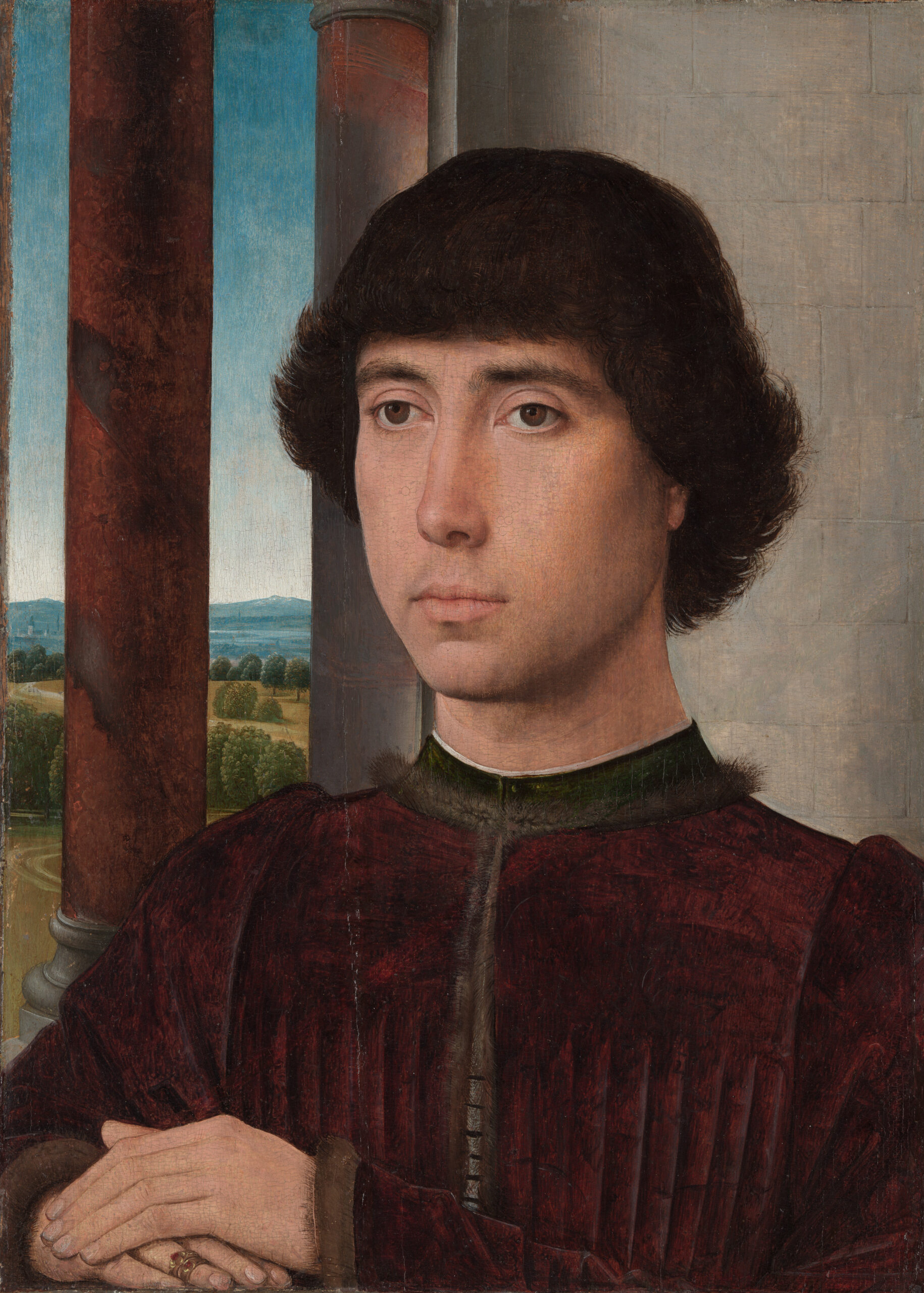
The face commands attention, almost alive. The skin is luminous; the brown eyes fix on something in the distance with quiet confidence. Look at the hands folded at the bottom of the panel: a ring catches the light discreetly. The burgundy velvet tunic absorbs the light with a deep, dense richness. Every fibre of the fabric, every reflection on the red marble columns — all rendered with extraordinary precision. Behind the sitter, a Flemish landscape opens onto a pale blue sky. The composition breathes.
Florence meets Bruges
In the 15th century, Bruges is a cosmopolitan merchant metropolis. Florentines pour in — wealthy traders captivated by Flemish painting. This young man commissions his portrait and sends it back to Florence shortly after. The work circulates. The Italianate columns in the composition are no accident: Memling knows Transalpine art and weaves it subtly into his work. The result? A Virgin and Child attributed to Ghirlandaio (Musée du Louvre, Paris) takes up this very same landscape and these very same columns. Flemish painting inspires the Italian Renaissance. The influence runs both ways.
Hans Memling, the Flemish master
Hans Memling, born c. 1430 in the Rhineland, settled in Bruges where he became the portraitist of the elite. A likely pupil of Rogier van der Weyden, he developed a style of singular luminous tenderness. This Portrait of a Young Man distils all his qualities: naturalism, balance, psychological depth.
Think about it
💭 This panel travelled from Bruges to Florence and changed the course of painting. Can a work of art still move through the world in the same way today — and transform how artists see?
About this work
- Portrait of a Young Man
- Hans Memling
- c. 1472–1475
- Oil on oak panel
- 40 × 29 cm
- The Metropolitan Museum of Art (MET), New York
Bruges and Florence: A Transalpine Dialogue
This Portrait of a Young Man illustrates Bruges’ role as an artistic and commercial crossroads in the 15th century. The sitter is most likely a Florentine merchant established in the Flemish city, then one of the nerve centres of European trade. The painting on oak panel (40 × 29 cm) dates from around 1472-1475, at a time when Memling was already the most sought-after portraitist among the bourgeoisie and aristocracy of northern Europe. The architectural elements framing the figure, red marble columns, a loggia open to a Flemish landscape, are a deliberate synthesis of the two dominant pictorial traditions of the period: Flemish precision in the rendering of light and material surfaces, and the references to Italian Renaissance forms that Italian patrons wanted to see incorporated in their portraits. According to Metropolitan Museum documentation, after being painted in Bruges, this panel was sent to Florence, where it exerted a direct influence on contemporary Italian painters.
The Lehman Collection and Entry into the Metropolitan
This panel entered the Metropolitan Museum of Art in New York in 1975 as part of the bequest of the Robert Lehman Collection (accession number 1975.1.112). Lehman (1891-1969) was one of the great American collectors of the 20th century: his collection, assembled over several decades, spans European painting from the 14th to the 20th century and is presented in a dedicated wing within the museum, gallery 953. The presence of this Memling in that ensemble reflects Lehman’s interest in the Early Netherlandish painters, long regarded as essential milestones in the history of Western painting.
Memling, Heir to Van der Weyden
Trained most likely in Rogier van der Weyden’s workshop in Brussels before settling in Bruges, Memling inherited a mastery of psychological portraiture that goes beyond mere physical likeness. His figures often gaze slightly away from the viewer, in an attitude of inward restraint that gives them an enduring presence. This quality, visible in the calm and assured gaze of the young man depicted here, is precisely what Florentine clients came to find by travelling to the Bruges workshops.