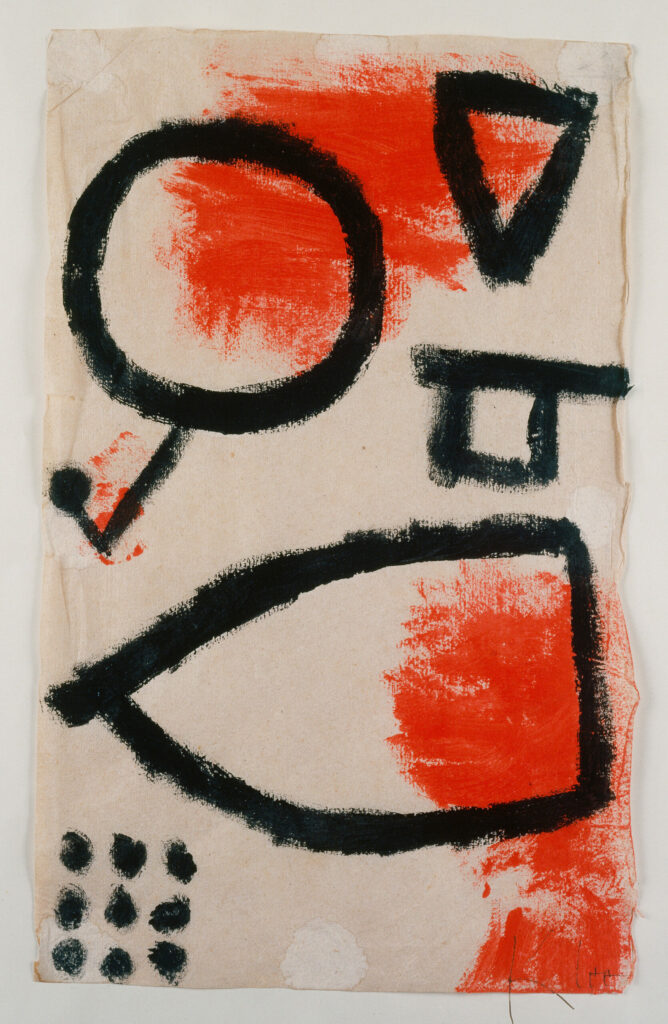
Bern, March 1940. Paul Klee, gravely ill, places his brush on a sheet of pink laid paper. He creates “Alea jacta,” “the die is cast.” A title borrowed from Caesar crossing the Rubicon, an echo of the humanist Ulrich von Hutten. Klee senses his approaching end.
A Language of Mysterious Signs
Observe these black forms applied in broad brushstrokes. A circle, a flag, perhaps an axe. Below, nine black dots align: not the faces of a die, but rather the hierarchy of angelic choirs. The speckled laid paper, slightly damaged, bears blood-red stains. The material creates tension: the fragility of the support contrasts with the force of the signs. Klee mounts the whole on cardboard, preserving this testamentary work. The composition might evoke a drumbeat seen from the sky, a pendulum still in motion, a boat linking distant shores.
Exile and Illness
Paul Klee painted this work three years before his death. Driven from the Düsseldorf Academy by the Nazis in 1933, he went into exile in Bern. In his Swiss studio, weakened by illness, he continued his artistic quest. “Alea jacta” crystallizes this period of intense creation in the face of announced death. The work explores elementary creative forces, carried by a constant critical consciousness.
Paul Klee, Master of Modern Symbolism
Throughout his career, Klee (1879-1940) developed a unique pictorial language, blending abstraction and symbols. Fascinated by the art of children and outsiders, he created a visual vocabulary of seemingly primordial nature. This late drawing marks the culmination of his artistic exploration of existence.
Think about it
💭 How does the fragile, damaged paper become an integral part of the message about human finitude?
About This Work
- Alea jacta
- Paul Klee
- 1940
- Brush and paste paint on mottled pink handmade wove paper, mounted on cardboard
- 45 × 29.4 cm
- Städel Museum, Frankfurt am Main
- https://sammlung.staedelmuseum.de/en/work/alea-jacta