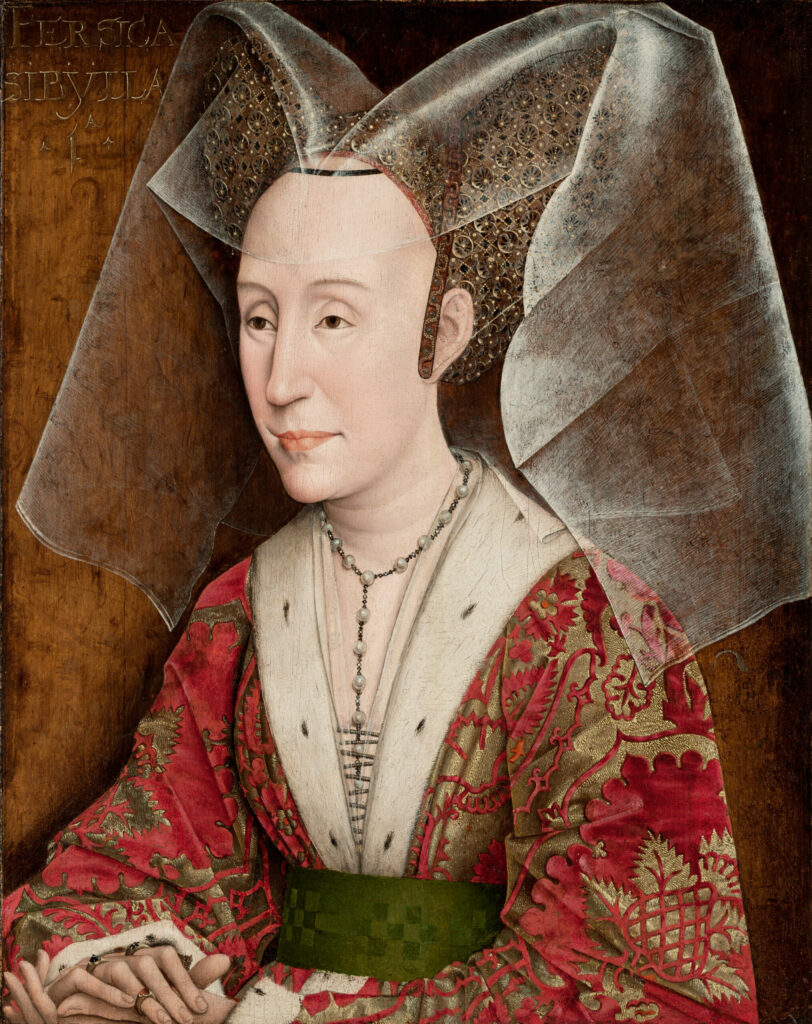
Circa 1450. Rogier van der Weyden’s workshop receives a prestigious commission: to immortalize Isabella of Portugal, Duchess of Burgundy, without her ever sitting for the portrait. The artist must capture the dignity of one of Europe’s most powerful women from a lost portrait.
A Magnified Court Portrait
Observe this majestic presence. Isabella stands upright, hands crossed in a posture of tranquil authority. Her scarlet red gown explodes with gold embroidery. The vegetal brocade serpentines across the fabric with a goldsmith’s precision. Her monumental hennin, this conical headdress enveloped in translucent veils, elevates her silhouette.
Between Dynastic Portrait and Iconographic Mystery
This oil on panel illustrates the power of the Burgundian court in the 15th century, then at its cultural and political apex. Isabella, wife of Philip the Good, embodies Burgundian splendor rivaling royal courts. The work reflects the art of Flemish portraiture: precision of details, subtle facial psychology. The duchess’s tender expression reveals Rogier van der Weyden’s sensitivity. But the inscription “PERSICA SIBYLLA IA” sows confusion. This reference to a Persian sibyl, added later by another hand, transforms the dynastic portrait.
Van der Weyden’s Workshop
Rogier van der Weyden (1399 or 1400-1464) dominates 15th-century Flemish painting alongside Jan van Eyck. His Brussels workshop produces portraits of unequaled emotional intensity. This work perpetuates his approach: linear elegance, refined psychology, sumptuous details that celebrate social status.
Think about it
💭 How can a portrait capture the essence of a person without ever having seen them? This image questions us about the construction of representations of power.
About This Work
- Portrait of Isabella of Portugal
- Workshop of Rogier van der Weyden
- circa 1450
- Oil on panel
- 46 × 37.1 cm
- The J. Paul Getty Museum, Los Angeles
- https://www.getty.edu/art/collection/object/103RDM