Florence, c. 1495. In the workshop of Sandro Botticelli, skilled hands reproduce the tenderness between a mother and her child. The gesture is universal. The painting, sublime.
Tenderness rendered in tempera
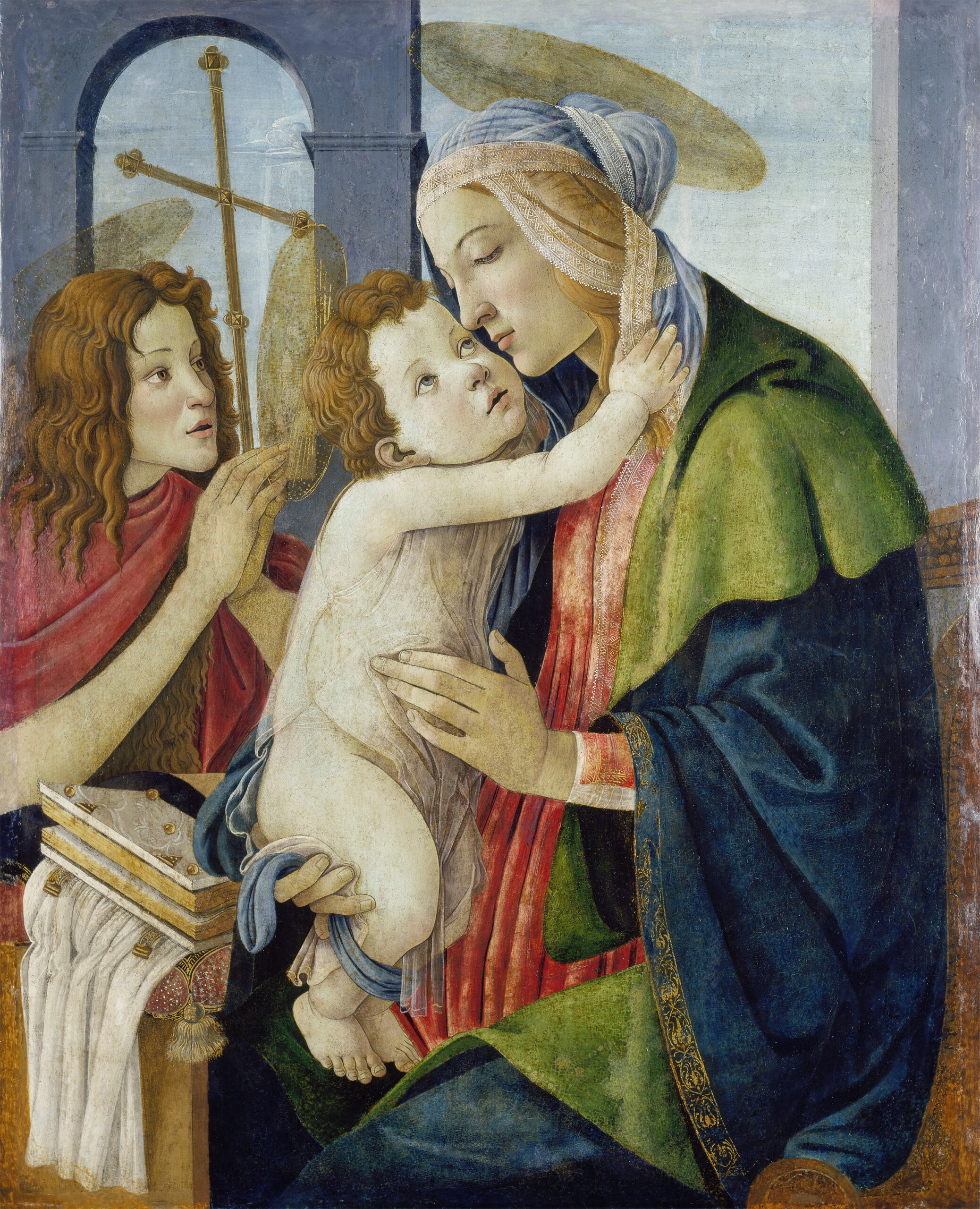
The Virgin tilts her face toward the Christ Child. Their foreheads nearly touch. The Infant looks up at her — blue eyes, arms wrapped around her neck. To the left, the young Saint John the Baptist watches the scene, hands clasped in prayer. Behind him, a gilded cross foretells the fate of Christ. The Virgin’s deep blue and green drapery falls with silken fluidity. The figures’ complexions are milky, luminous.
A masterpiece of Florentine devotion
At the close of the Quattrocento, Florence stands at the height of the Renaissance. Wealthy families commission Madonnas for their private chapels, works that are far more than simple devotional images. Botticelli’s workshop meets this intense demand by producing refined compositions, each bearing the unmistakable imprint of the master’s style. This painting is a perfect example: traditional iconography, yet an emotional rendering of striking modernity. The presence of the young Saint John roots the work in Florentine theology, of which he is the patron saint.
Sandro Botticelli
Born in Florence, Sandro Botticelli (1445–1510) built one of the most influential workshops of the Renaissance. A pupil of Filippo Lippi and a protégé of the Medici, he painted The Birth of Venus and Primavera. His style, sinuous line, gentle expressiveness, refined colour, permeates every work that emerged from his atelier.
Think about it
💭 This Madonna was made for a private chapel, not a church. Do you think a work of art changes meaning depending on the space for which it was created?
📌 About this work
- Madonna and Child with the Infant St. John
- Workshop of Sandro Botticelli
- c. 1490–1500
- Panel transferred to panel
- 93.6 × 76.2 cm
- Städel Museum, Frankfurt am Main
- https://sammlung.staedelmuseum.de/en/work/madonna-and-child-with-the-infant-st-john-2
Florence, Saint John the Baptist, and the Private Chapel Programme
The Virgin and Child with the Infant Saint John is a work from the workshop of Sandro Botticelli (1445-1510) produced for a private chapel commission, a context that explains both the generous dimensions of the painting and the iconographic programme chosen. The presence of the young Saint John the Baptist is not only devotional: it is also civic. John the Baptist is the patron saint of Florence, and any image representing him in a patrician Florentine interior says something about its patron’s belonging to the city and its values. The golden cross that the young John holds behind him, a direct allusion to the fate of crucifixion awaiting Christ, transforms the scene of maternal tenderness into a prophetic announcement, anchoring the Incarnation in the perspective of the Passion.
The Sinuous Line as Botticellian Identity
What Botticelli’s workshop produces here is a monumental-format translation of the aesthetic formula that made the master’s reputation: sinuous contour lines, gentle expressivity of faces, refined colouring. The Virgin inclines her face toward Christ, their foreheads nearly touching in an intimacy that suspends time; the Christ child, arms wrapped around his mother’s neck, looks up at her with absolute trust. The midnight blue and green drapery of the Virgin falls with a silky fluidity that Botticelli’s workshop mastered perfectly in the 1490s. The technical note “wood transferred to panel” indicates that the original support, a wooden plank, was detached and remounted on a new backing at a later date, a procedure common in the conservation of Italian Primitives that testifies to the high esteem in which the painting was held by subsequent collectors.