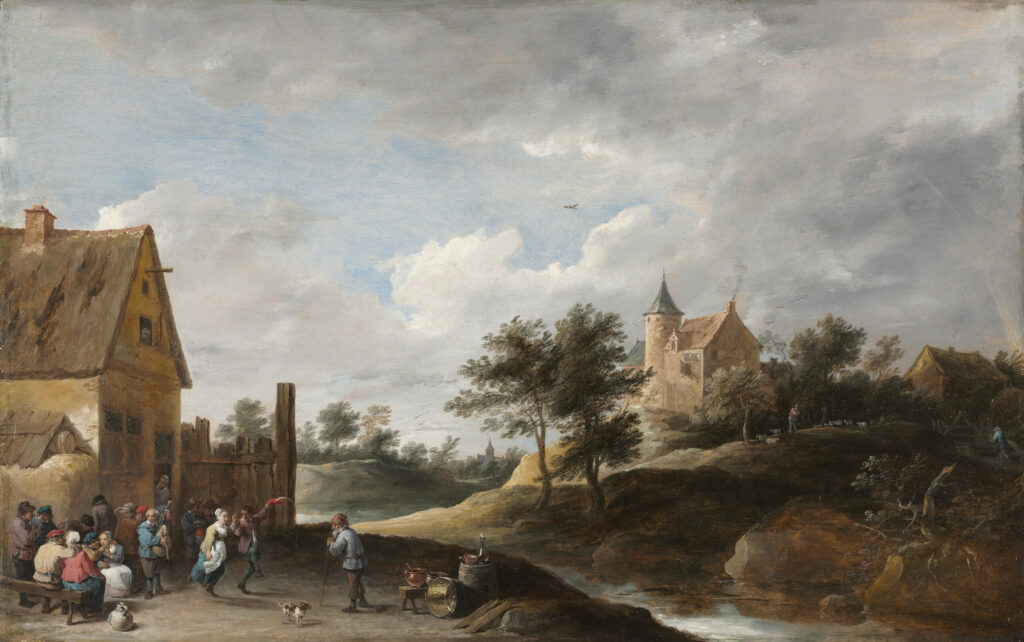
Flemish Brabant, circa 1645. David Teniers sets up his easel facing an ordinary life scene that will become extraordinary. A village inn welcomes peasants, musicians, and dancers. The painter captures this moment of collective joy.
A Village Celebration
Observe this animation: to the left, near the thatched-roof building, stand villagers—some dancing, others conversing, a couple embracing. In the center, a bagpipe player sets the rhythm for the festivities. Colorful clothing punctuates the composition. Teniers masters oil painting: every architectural detail, every clothing fold, every cloud in the dramatic sky is rendered with precision. To the right, a rolling landscape extends toward a fortified building, creating an atmospheric depth typical of the Flemish school.
The Idealization of Rural Life in the Golden Age
This canvas belongs to a flourishing artistic current in the Spanish Netherlands: genre painting celebrating the peasant world. But make no mistake. These works were not intended for villagers. They adorned the homes of wealthy bourgeois and urban aristocrats, fascinated by a romantic vision of the countryside. Teniers transforms rural reality into picturesque spectacle, erasing the harshness of labor to offer a soothing image.
David Teniers
David Teniers the Younger (1610-1690) was one of the most prolific and sought-after Flemish painters of his time. Trained by his father, he became court painter to Archduke Leopold Wilhelm in Brussels. His peasant scenes, executed with technical virtuosity, enjoyed immense commercial success.
Think about it
💭 Observing this celebration, do you feel invited to celebrate with the villagers, or do you sense the distance of the urban spectator for whom Teniers painted this scene?
About this Work
- Landscape with Dancing Peasants
- David Teniers the Younger
- circa 1645-1650
- Oil on canvas
- 49 × 78 cm (19 5/16 × 30 11/16 in.)
- The Cleveland Museum of Art
- https://www.clevelandart.org/art/1996.271