Murnau, summer 1910. Kandinsky sets up his easel facing the Bavarian village. Before his eyes: the Alps, a church, rooftops. Beneath his brush, everything tilts toward abstraction.
A Whirlwind of Liberated Colour
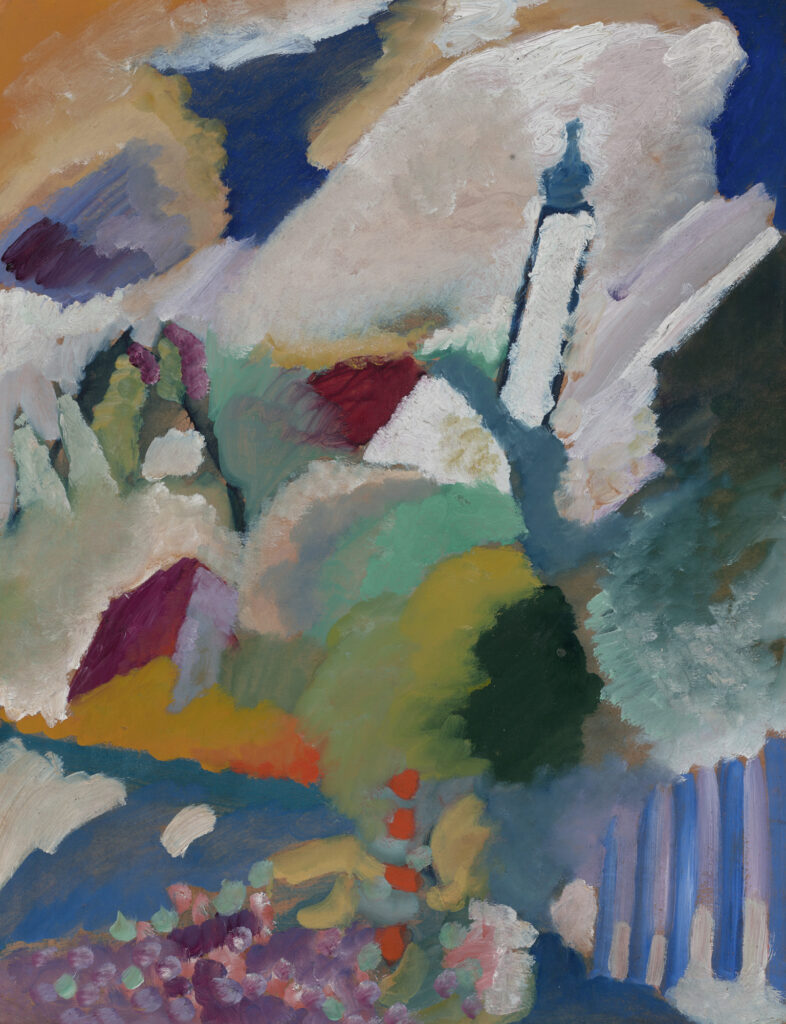
The bell tower rises, barely recognisable, at the centre of the composition. The houses are no more than coloured masses. The paint, applied in broad, spontaneous strokes on cardboard, allows the brown support to show through in places. Outlines dissolve. Deep blue mingles with warm orange at the top of the picture. Below, touches of violet and pink evoke a flowering garden. The vertical format heightens the dynamic momentum of this view. Kandinsky no longer describes the landscape. He feels it and projects it.
At the Threshold of Abstract Art
This oil on cardboard occupies a decisive place in the history of modern art. In 1910, Kandinsky was staying regularly in Murnau, a small town at the foot of the Bavarian Alps. There he pushed the dissolution of the subject to its extreme. Topographical fidelity gave way to a free orchestration of colour. It was perhaps before a similar canvas that Kandinsky one evening at dusk noticed one of his paintings resting on its side. He could not recognise the subject. The vision confirmed his intuition: abstract painting was possible. The path toward abstract expressionism and the Blue Rider was opening.
Wassily Kandinsky
Born in Moscow, Kandinsky (1866–1944) abandoned a career in law for painting at the age of thirty. A pioneer of abstraction and co-founder of the Blaue Reiter, he transformed landscape into pure coloured emotion. This work from Murnau is vibrant proof.
Think about it
💭 Looking at this explosion of colour, can you still make out the village — or do you already see the music Kandinsky was striving to paint?
About This Work
- Murnau with Church I
- Wassily Kandinsky
- 1910
- Oil on cardboard
- 64.7 × 50.2 cm
- Städtische Galerie im Lenbachhaus, Munich
- https://www.lenbachhaus.de/en/digital/collection-online/detail/murnau-mit-kirche-i-30018804