Kochel, February 1909. Wassily Kandinsky sets up his easel facing the snow-covered graveyard. The Bavarian village sleeps beneath the snow. The Russian artist, staying near Murnau with Gabriele Münter, seeks a new way of seeing the world.
Colors that Defy Reality
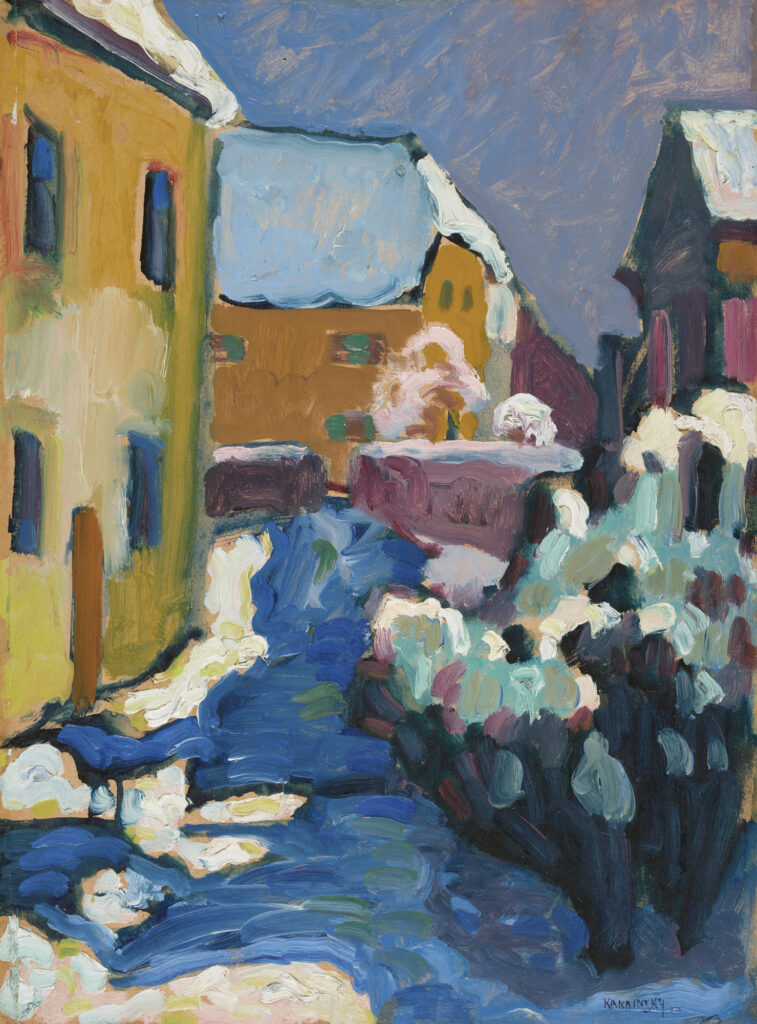
Observe these houses with sun-yellow walls contrasting with the blue of the winter sky. Kandinsky applies the paint with thick, visible strokes. The shadows are not grey: they become blue-black, almost violet in the snow. A dark bush occupies the right foreground, painted in broad flat areas. The roofs bear masses of white snow in relief. This small format captures the essence of the landscape rather than its photographic appearance.
The Invention of a New Pictorial Language
Between 1908 and 1914, Kandinsky spent many stays in Murnau, in the Bavarian Pre-Alps. These stays radically transformed his painting. He progressively abandoned the faithful representation of nature to explore pure interactions between forms and colors. “Kochel – Graveyard and Vicarage” illustrates this decisive transition. Kandinsky liberates color from its descriptive role: the yellow vibrates, the blue invades space. This non-realistic approach announces the abstraction he would develop a few years later. The Der Blaue Reiter (The Blue Rider) movement, which he cofounded in 1911, was born from these experiments.
Kandinsky, Pioneer of Abstraction
Wassily Kandinsky (1866-1944) revolutionized modern art. Trained as a lawyer, he devoted himself to painting at age thirty. He sought to express the spiritual through pure color and liberated form.
Think about it
💭 What if this winter landscape were merely a pretext for orchestrating a symphony of blues and yellows?
About This Work
- Kochel – Graveyard and Vicarage
- Wassily Kandinsky
- 1909
- Oil on cardboard
- 44.4 × 32.7 cm
- Städtische Galerie im Lenbachhaus und Kunstbau, Munich
- https://www.lenbachhaus.de/en/digital/collection-online/detail/kochel-friedhof-und-pfarrhaus-30003881
Kochel in Winter: Color Freed from Representation
Kochel, Cemetery and Rectory is one of the works painted during Vassily Kandinsky’s (Moscow, 1866 – Neuilly-sur-Seine, 1944) winter stay in Kochel, a village in the Bavarian foothills, at the start of 1909. The composition depicts the village cemetery and rectory under snow: houses with yellow walls stand out against an intense blue winter sky, dark bushes border the foreground, and snow-laden roofs define the volumes of the scene. But Kandinsky is not describing this landscape, he is translating it. Colors are applied with a directness and intensity that surpasses optical observation, and the visible, impasted touch signals that the painted material matters as much as the motif it renders.
The Lenbachhaus and the Blaue Reiter Legacy
The Städtische Galerie im Lenbachhaus in Munich holds the world’s most complete collection of Kandinsky’s work and of the Blaue Reiter group, thanks to the donation made by Gabriele Münter in 1957 on her seventieth birthday. That exceptional gift, hundreds of works she had kept hidden through the Nazi period, allowed scholars to reconstruct the full arc of Kandinsky’s development, from his earliest landscape studies through the abstract compositions of his maturity. Kochel, Cemetery and Rectory belongs to this ensemble as a record of the moment when modern painting began to construct itself, one winter, in a small Bavarian village, a starting point for one of the most consequential pictorial revolutions of the twentieth century.