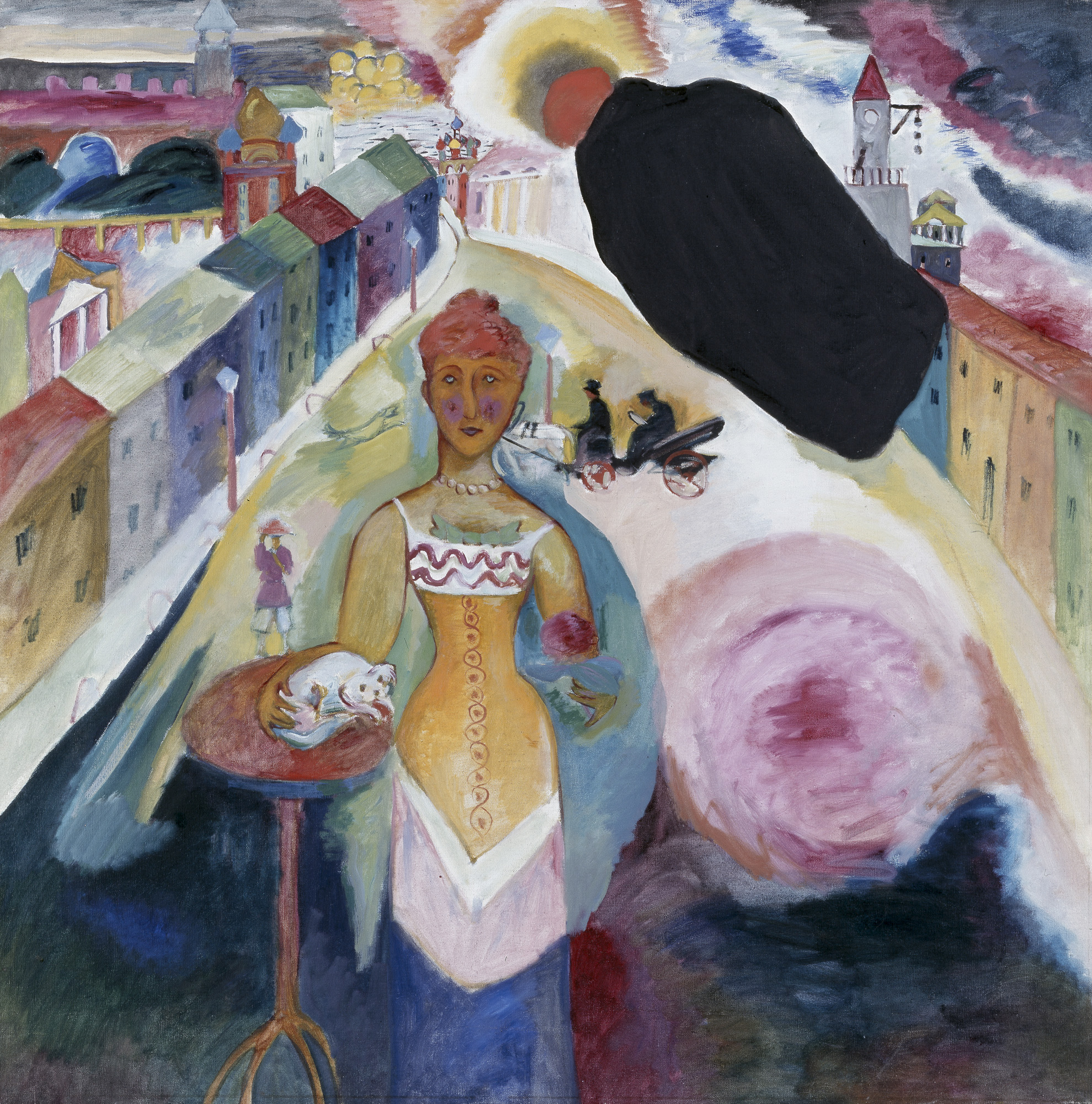
Munich, 1912. Kandinsky paints the invisible. A woman stands in a Moscow street. A yellow sun burns behind her. Her gaze meets the viewer’s, direct, almost unsettling. She holds a rose. A small dog rests on the table to her right. The scene seems almost ordinary, almost.
What the eye doesn’t catch at first
Look around her. An aura quietly envelops her silhouette. In the lower right, a nebulous pink form swirls, soft and vibrating. Above it, a large black shape with sharp edges bears down on the composition. Kandinsky works in oil on a square format. The colours are bold, laid in flat luminous planes. The city of Moscow recedes in a coloured perspective behind the figure. The style hovers between naïve figuration and threatening abstraction.
Between theosophy and the painting of the soul
At this time, Kandinsky is immersed in the writings of Leadbeater and Besant on thought-forms. From 1908, he attends Rudolf Steiner’s lectures in Berlin. These theories hold that emotions radiate outward as forms and colours visible around the body. In Lady in Moscow, he transposes this esoteric language literally onto canvas. The aura signals vitality. The pink circle embodies love or affection. The black shape threatens. Some art historians read in it a deeply personal biographical drama unfolding in the artist’s life in 1912.
Wassily Kandinsky
Born in Moscow, Wassily Kandinsky (1866–1944) abandoned law for painting at the age of thirty. Co-founder of the Blaue Reiter in Munich, he was one of the pioneers of lyrical abstraction. Lady in Moscow marks a pivotal moment: figuration gradually yields here to the pure vibration of form.
A question for you
💭 Can you think of other works where a painter makes visible what normally escapes the eye, dreams, emotions, invisible forces?
About this work
- Lady in Moscow
- Wassily Kandinsky
- 1912
- Oil on canvas
- 109.7 × 109.4 cm
- Städtische Galerie im Lenbachhaus, Munich
- https://www.lenbachhaus.de/en/digital/collection-online/detail/dame-in-moskau-30012217
A Figure between Two Worlds
Lady in Moscowis one of the most fascinating transitional works by Vassily Kandinsky (Moscow, 1866 – Neuilly-sur-Seine, 1944), painted at the precise moment when his art tips from figuration toward lyrical abstraction. A woman stands in a Moscow street, a rose in hand, a small dog on a table beside her, her gaze turned toward the viewer. But around her, representation dissolves: an aura envelops the silhouette, a nebulous pink form swirls in the lower right corner, a dark mass dominates the upper register. A city in colored perspective appears in the background, and the whole composition floats between a recognizable image and a pure arrangement of chromatic forces.
Kandinsky, Theosophy, and Invisible Forces
The composition of Lady in Moscow is shaped by Kandinsky’s theosophical readings, notably the work of Charles Leadbeater and Annie Besant on “thought-forms”, the visible shapes that emotions and thoughts take, according to theosophical doctrine, in the etheric realm. Kandinsky also absorbed Rudolf Steiner’s anthroposophical lectures and integrated into his painting the conviction that spiritual and emotional forces are real and can, must, be made visible. In this canvas, the figure’s aura, the dark mass, and the pink swirl are not decorative effects: they are representations of forces invisible to the ordinary eye, which painting alone can render perceptible.
The Lenbachhaus and the Blaue Reiter
The Städtische Galerie im Lenbachhaus in Munich holds the world’s largest collection of works by Kandinsky and the Blaue Reiter group, the avant-garde movement Kandinsky co-founded with Franz Marc in Munich in 1911. Lady in Moscow stands there as one of the most important examples of the transition between expressive figuration and abstraction, a fleeting and foundational moment that the Lenbachhaus documents with unparalleled depth and continuity.