Munich, 1913. Wassily Kandinsky, in his Bavarian studio, is preparing an artistic revolution. Between sketches and meditations, he seeks to capture the invisible: the soul of the world, chaos and harmony, the end of one cycle and the beginning of another.
A symphony of colors and movement
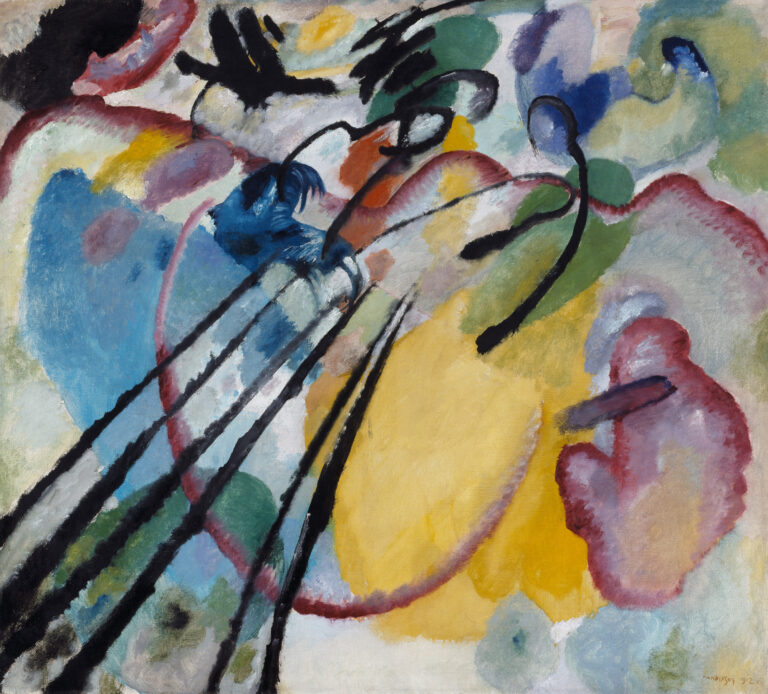
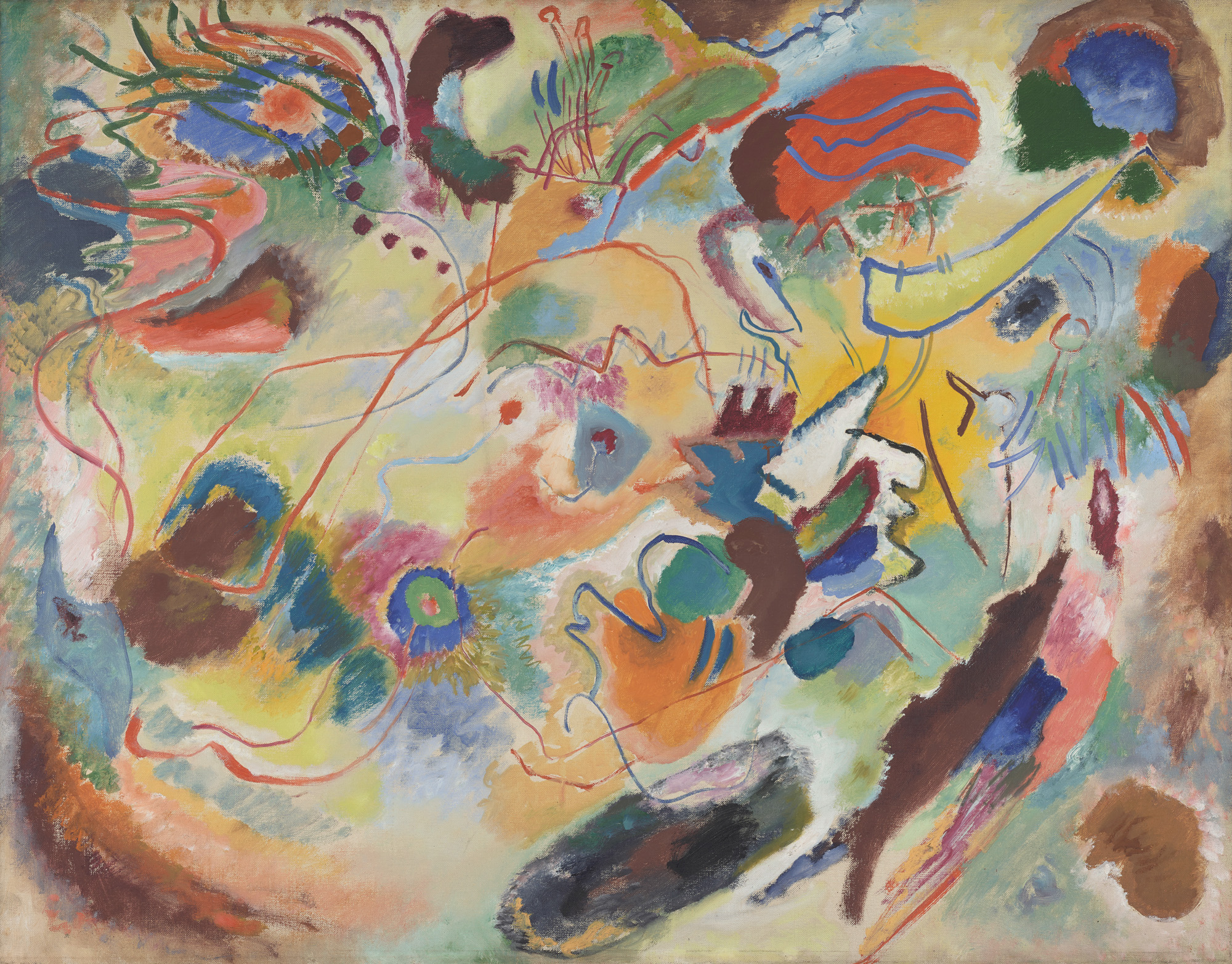
Look at this canvas: bursts of red, blue, and yellow, dancing lines, swirling circles. Kandinsky creates a vibrant texture. Pure abstraction unfolds here: no landscape, no figure — only a visual symphony in which every color, every stroke, plays its own part. The circular forms and curving lines conjure a sense of perpetual motion.
A masterpiece born of turmoil
This study for Composition 7 emerges from a moment of acute historical tension. Europe stands on the eve of the First World War. Kandinsky, deeply marked by the upheavals of his time, gives form to the invisible: the Last Judgment, the end of a world, but also its rebirth. A mirror of its age, this work embodies his spiritual quest. Abstraction becomes a universal language for transcending reality.
Wassily Kandinsky, pioneer of abstraction
Born in Russia, Kandinsky (1866–1944) settled in Munich in 1896. There he co-founded Der Blaue Reiter and published Concerning the Spiritual in Art in 1911, laying the foundations of non-figurative art. His innovative style broke with convention and opened the way to a new artistic era. In this study, his lifelong inquiry is fully present: the balance between chaos and harmony, between destruction and creation.
A question for you
💭 Let yourself be carried by Kandinsky’s forms and hues. Every gaze discovers a different story, a singular emotion. What do you see in this swirl of color?
About this work
- Study for Composition 7
- Wassily Kandinsky
- 1913
- Oil on canvas
- 78.7 × 100.4 cm
- Städtische Galerie im Lenbachhaus und Kunstbau, Munich
- https://www.lenbachhaus.de/en/digital/collection-online/detail/studie-zur-komposition-7-30018571