Bavaria, 1909. Kandinsky is walking along a path near Kochel. He stops. Before him, a white road cuts through the landscape. In the distance, a blue mountain asserts its presence. He reaches for his cardboard, his brushes. Something shifts.
A road toward abstraction
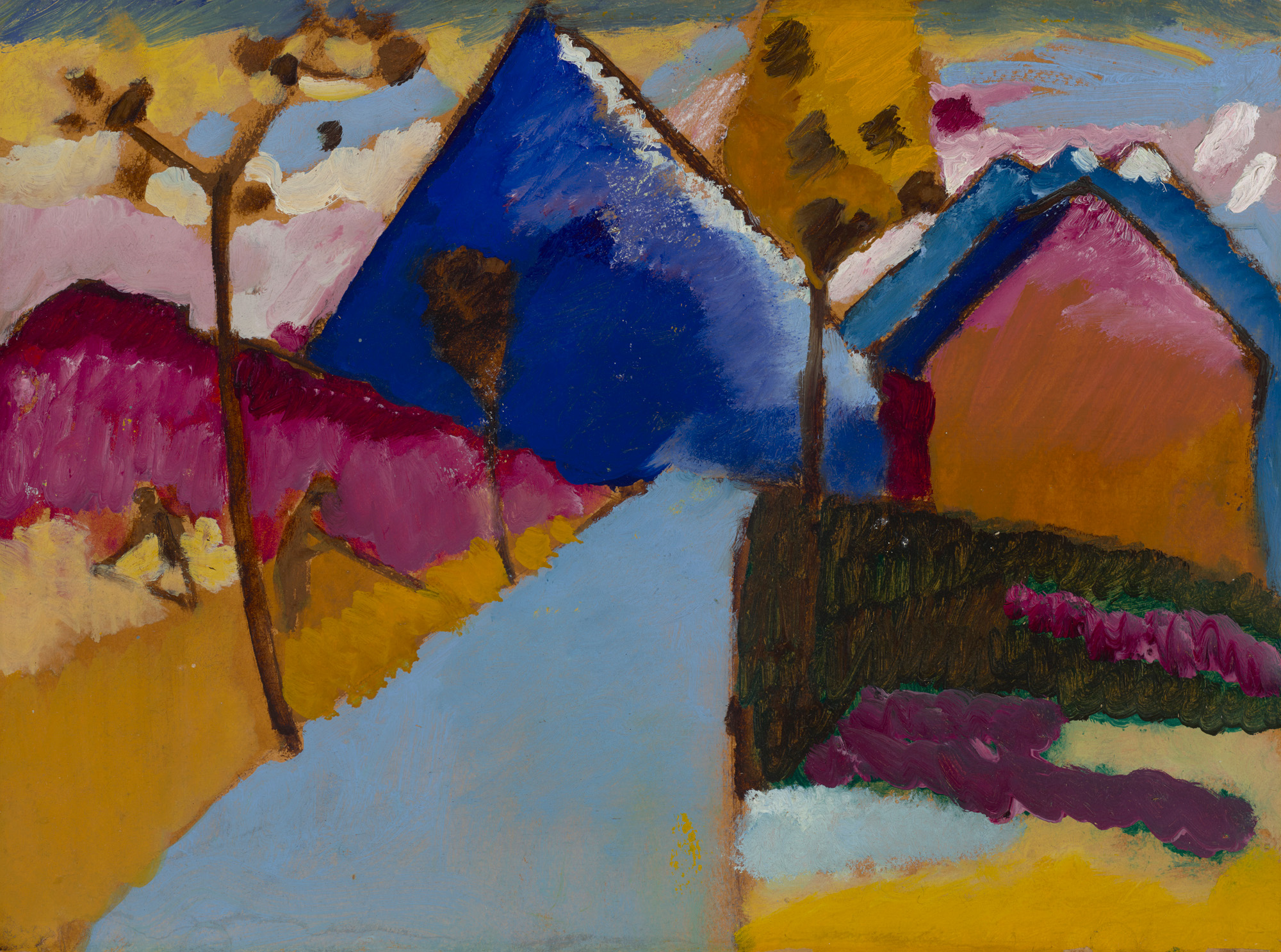
Look at this pale blue road. It slices through the composition like a blade. To the left, two tiny figures, farm labourers, are barely discernible. The trees become brown lines. The houses, flat planes of vivid pink and ochre. Wassily Kandinsky reduces every form to its geometric essence. The brushwork is free, almost impatient. Colour vibrates through bold contrasts. Dark outlines ring the volumes, recalling Bavarian folk art. On this small piece of cardboard, the oil paint is laid down with a palpable urgency.
The blue mountain, hieratic presence
Why does this blue mountain occupy the centre with such sovereign authority? In 1909, Kandinsky was staying in Murnau with Gabriele Münter and Alexej Jawlensky. Together, they theorised a principle of synthesis: reduce, condense, intensify. Jawlensky gave it a name; Münter spoke of “extracting the essence.” Kandinsky pushed further still. His outlines no longer merely describe, they exist independently, autonomous graphic symbols. This mountain would reappear in his abstract canvases. It is already a sign as much as a landscape.
Wassily Kandinsky
Kandinsky (1866–1944) abandoned law for painting at the age of thirty. Co-founder of the Blue Rider group in Munich, he crossed the threshold into abstraction between 1910 and 1913. Kochel, Straight Road is a decisive step on that journey. The Städtische Galerie im Lenbachhaus in Munich holds a major collection from this period.
Think about it
💭 Does this road still lead you to a landscape, or already to an abstraction?
About this work
- Kochel – Straight Road
- Wassily Kandinsky
- 1909
- Oil on cardboard
- 32.9 × 44.6 cm
- Städtische Galerie im Lenbachhaus und Kunstbau, Munich
- https://www.lenbachhaus.de/en/digital/collection-online/detail/kochel-gerade-strasse-30017628
Murnau and the Turning Point of 1909
Kochel — Straight Road (1909) belongs to one of the most decisive periods in Kandinsky’s career. In 1908 and 1909, he regularly stayed in Murnau, in Bavaria, accompanied by his partner Gabriele Münter, Alexej Jawlensky, and Marianne von Werefkin. This group painted outdoors, working rapidly on cardboard (32.9 × 44.6 cm), and explored chromatic registers that were increasingly free from the constraints of naturalistic representation. Kochel is a lakeside village near Murnau: the road Kandinsky depicts here is straight and frontal, like an arrow driving into the picture. But what strikes the eye is that the colour has broken free from the motif, the sky’s blue descends into the road, the green of the verges contaminates the ground, shadows turn pink or violet. The work is held at the Städtische Galerie im Lenbachhaus in Munich, the museum with the largest Kandinsky and Blaue Reiter collection in the world.
From Bavaria to Abstraction
The summer of 1909 was a hinge moment in Kandinsky’s evolution toward abstraction. In Murnau, he observed how light and colour could override drawing, how a road could become a direction rather than a description, how a landscape could be felt rather than copied. These Bavarian stays led him to progressively formulate a theory of “inner necessity”, the idea that form and colour should express an interior state rather than reproduce the exterior world. Kochel, Straight Road is not yet an abstract work, but it is one in which the landscape subject has become a pretext for a chromatic exploration that directly anticipates the first non-figurative compositions Kandinsky began painting from 1910 to 1911.
The Blaue Reiter in Gestation
This period in Murnau was also when Kandinsky and Franz Marc were conceiving the project of the Blaue Reiter (The Blue Rider), an avant-garde almanac and group founded in Munich in 1911. Jawlensky, present during these stays, brought the influence of French Fauvism and of Matisse, whom he had met in Paris. Münter, whose techniques drawn from Bavarian folk art (Hinterglasmalerei, reverse glass painting) influenced Kandinsky’s style, participated actively in the experiments of this period. Kochel, Straight Road belongs to this collective laboratory where a pictorial revolution was taking shape, one that the European 20th century would recognize as among its founding moments.