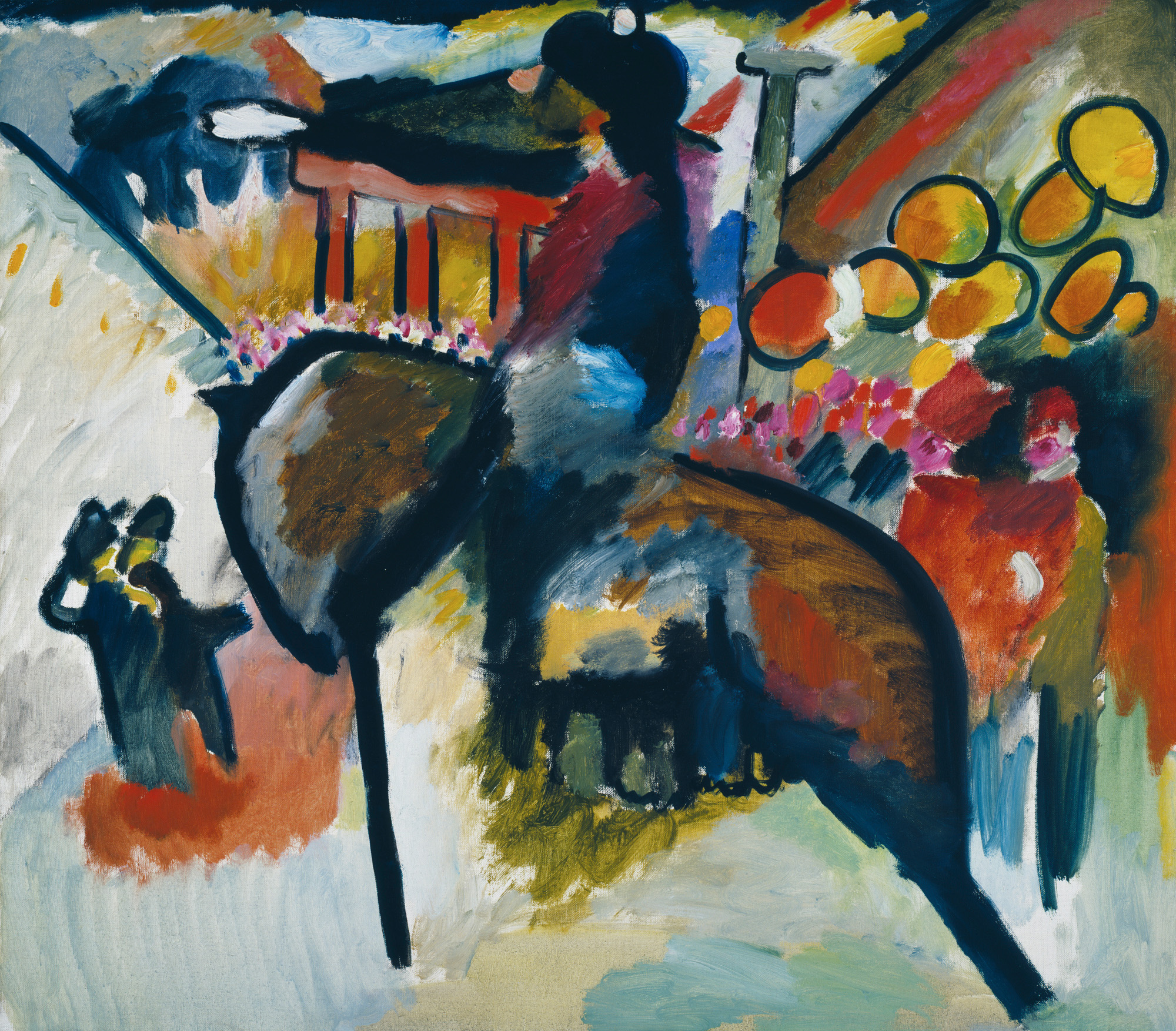
What strikes me about this canvas, discovered while browsing the Lenbachhaus’s online collection, is the fragile balance it holds between scene and abstraction. We see a gendarme on horseback, a handful of figures, a landscape dotted with architecture and floral touches, all swept by broad diagonals that impose movement before the eye even identifies the forms.
This wealth of detail coexists with a composition that no longer seeks to represent, but to convey the impression left by a lived scene, the colours, laid in vivid flat planes, mattering here more than the motif itself. What deepens my admiration is that in 1911, Kandinsky chose to name the work “Impression IV” rather than give it a narrative title: the term points to his own classification of his canvases into Impressions, Improvisations, and Compositions, organised by the degree of spontaneity or elaboration in the creative process. The subtitle “Gendarme” is no more than an indication, almost incidental, of the starting motif. It is this way of placing category above subject that, to my eye, embodies the full modernity of his approach: the work no longer tells a story, it captures a state.
See
A thick black outline first traces the horse’s reclining back. The eye then climbs toward the rider, a dark mass almost without a face. Two diagonals run from the centre toward the edges. On the left, a row of columns; on the right, yellow and orange circles, like lanterns. Between them, pink and mauve touches sketch a crowd without defined contours.
Understand
Wassily Kandinsky painted this canvas in 1911. That same year, he founded the Blue Rider movement in Munich with Franz Marc. The scene is thought to draw on a lantern procession held on the Königsplatz, marking the Prince Regent’s ninetieth birthday on 12 March 1911. Kandinsky placed this oil on canvas among his “Impressions,” a category he distinguished from his “Improvisations” and “Compositions” by creative process rather than subject. Six “Impressions” were painted that year, each carrying a subtitle, a simple marker rather than a narrative title. Born in Russia, the artist settled in Munich, where his thinking moved steadily toward abstraction.
Feel
Step closer, to where black gives way to colour. The horse seems suspended, neither at rest nor in motion. This tension between the celebration announced by the subject and the dissolution of forms is never resolved. Kandinsky does not narrate a procession: he retains its sensation, its cadence, the vertigo of its flat colour. Stay a moment with this ambiguity, without trying to settle it.
In the news
In spring 2026, the LaM (Lille Métropole Musée d’art moderne) hosted, in partnership with the Centre Pompidou, a major Kandinsky retrospective titled “Kandinsky face aux images.” Conceived as the inaugural exhibition marking the museum’s reopening after eighteen months of renovation, it unveiled works and archives from Nina Kandinsky’s bequest to the Centre Pompidou, exploring the role of photographs, scientific illustrations, and press images in the artist’s path toward abstraction. The exhibition confirms the lasting interest major French and European institutions hold in Kandinsky’s work, more than eighty years after the artist’s death.
Source: https://musee-lam.fr/fr/kandinsky-face-aux-images
A question for you
💭 Had Kandinsky needed to file this canvas under the traditional genres of painting, rather than his own system, which category would he have chosen: genre scene, urban landscape, or history painting?
📌 About this work
- Impression IV (Gendarme)
- Wassily Kandinsky
- 1911
- Oil on canvas
- 95.7 x 108.3 cm
- Städtische Galerie im Lenbachhaus und Kunstbau München
- https://www.lenbachhaus.de/en/digital/collection-online/detail/impression-iv-gendarme-30011856