Moscow, 1921. Kandinsky stands before his canvas in revolutionary Russia. He dialogues with Constructivism but refuses to submit to it entirely. Pure form calls to him, the circle fascinates him.
An Emancipated Geometric Composition
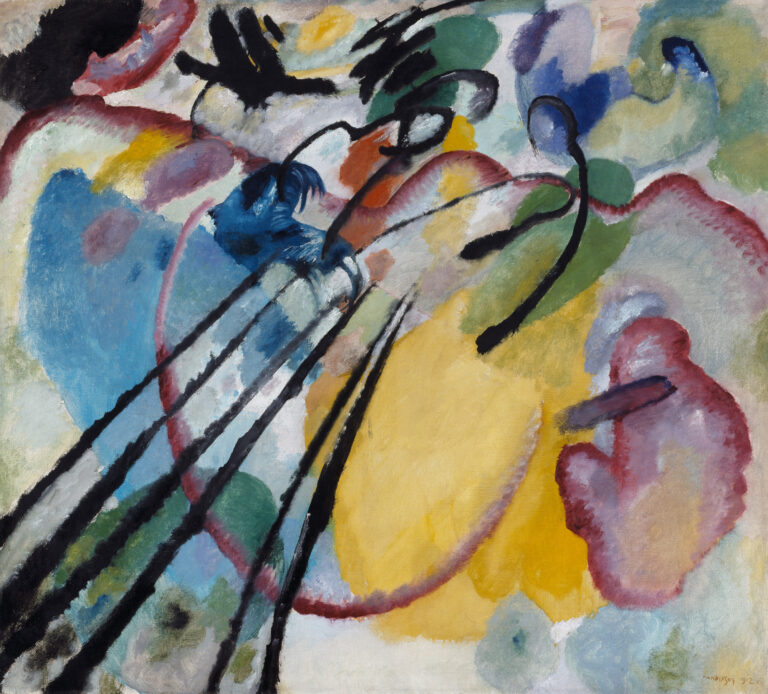
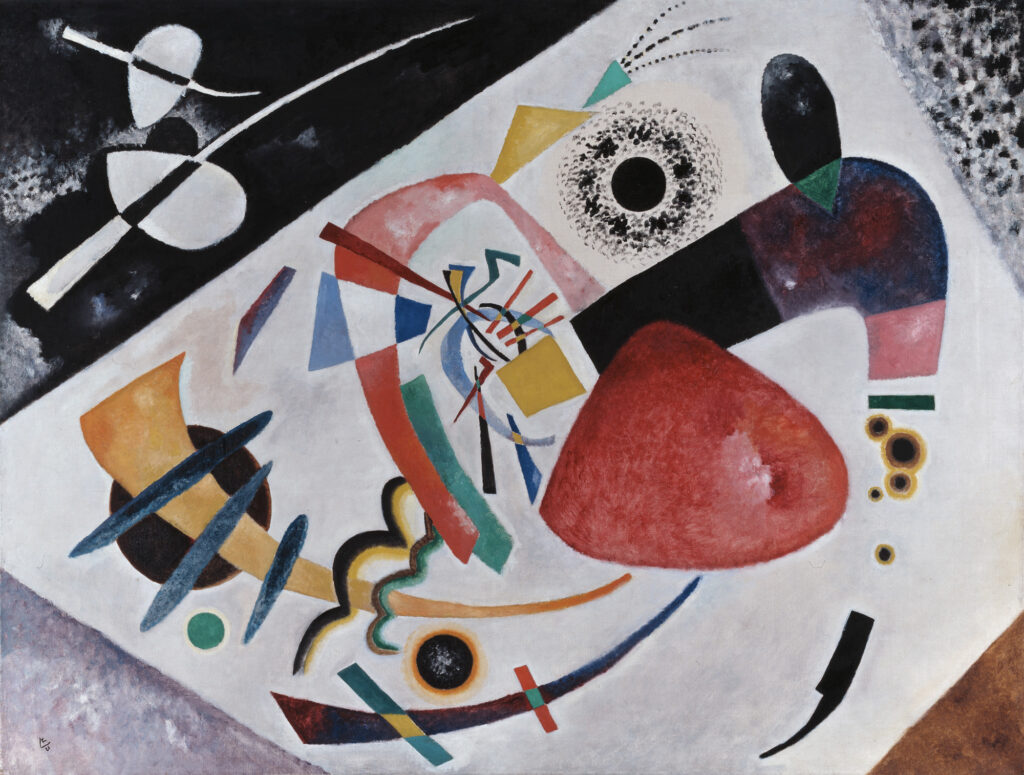
Observe this large monumental canvas. Kandinsky arranges geometric forms: triangles, circles, arcs. The famous red spot dominates the composition, an organic form with blurred contours. Black circles, one of them punctuated with expressive splatters, create visual tensions. The application of oil paint remains fluid. The contours dissolve slightly. The arrangement seems free, almost musical. No strictly Constructivist structure here. The elements accumulate without rigid logic.
The Postwar Turning Point
World War I brutally interrupts Kandinsky’s career. In Germany, then back in Russia, he devotes himself to cultural committees. “Red Spot II” marks his return to painting. The artist discovers Malevich, Tatlin, Popova. Russian Constructivism influences his palette and forms. But Kandinsky maintains his distance. His research on abstraction privileges pure sensation. He seeks forms liberated from all figurative association. The circle becomes his obsession: “I love the circle today as much as I once loved the horse.”
Wassily Kandinsky, Pioneer of Abstraction
Born in Moscow, Wassily Kandinsky (1866-1944) revolutionizes modern art. He theorizes abstraction, explores correspondences between color and sound. As a professor at the Bauhaus, he develops a personal geometric language, always anchored in sensation.
Think about it
💭 Does this work seem cold or vibrant to you? Can geometric forms convey as much emotion as a human figure?
About This Work
- Red Spot II
- Wassily Kandinsky
- 1921
- Oil on canvas
- 131 × 181 cm
- Städtische Galerie im Lenbachhaus und Kunstbau, Munich
- Acquired through funds from Hypo-Bank AG München, now UniCredit Bank AG
- https://www.lenbachhaus.de/en/digital/collection-online/detail/roter-fleck-ii-30014568
Moscow 1921: Between Revolution and Rupture
Red Spot II (1921) was painted in Moscow in a specific context: Kandinsky had returned to Russia in 1914 at the start of the First World War and lived there through the Bolshevik revolution. These Russian years were marked by intense institutional activity, he founded museums, drafted pedagogical programmes, and participated in the reorganization of Soviet artistic life. Around him, Constructivism was asserting itself as the official revolutionary aesthetic, with Malevich, Tatlin, and Rodchenko advocating for an art entirely in service of the new society. Kandinsky observed and was influenced by this geometric rigour, but refused to reduce art to a social or industrial function. Red Spot II (131 × 181 cm, oil on canvas, Lenbachhaus Munich) reflects this singular position: a geometric abstraction that maintains the primacy of inner expression over ideological utility.
The Circle as Central Form
In Red Spot II, the circle occupies a dominant position, not only the red spot of the title, but several circular forms that punctuate the composition. During these years Kandinsky was developing an extensive reflection on the philosophical and plastic status of the circle: for him, it was the most tensioned form, the one that synthesized movement and rest, warmth and cold, expansion and concentration. This fascination with the circle would reach its fullest expression in the Bauhaus works (1922-1933), but Red Spot II already constitutes an advanced articulation of it. The large-scale composition imposes a physical presence that exceeds intimate contemplation: it is a work conceived to be inhabited as much as viewed.
The Departure for the Bauhaus
The year 1921 was Kandinsky’s last in Russia. He left Moscow in December and joined the Bauhaus in Weimar in 1922, where a new phase of his work would begin. Red Spot II is therefore a pivotal work: it closes the Russian period and anticipates the geometric systematization of the Bauhaus years. The presence of this canvas at the Lenbachhaus, at the heart of the collection that unites the entire Kandinsky and Blaue Reiter corpus, allows one to measure the scope of an artistic trajectory without equivalent in 20th-century painting.