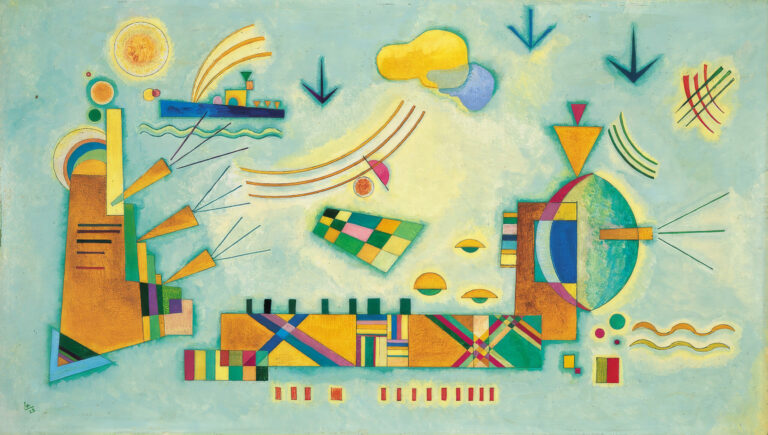
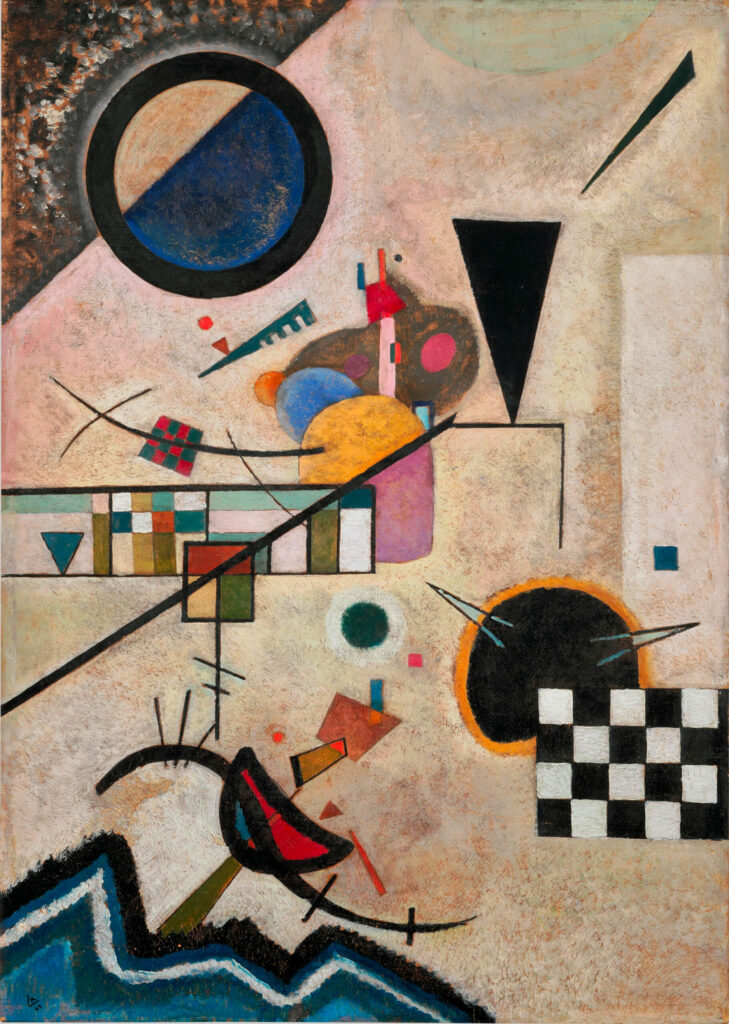
Weimar, 1924. Kandinsky, professor at the Bauhaus, composes a visual symphony. On his cardboard, geometric forms and pure colors dialogue in perfect balance. The Russian painter explores “opposing accords,” those harmonious tensions that structure his plastic research.
An Orchestrated Composition
Observe this painting: a large black circle encloses a deep blue half-disk in the upper left corner. An inverted black triangle responds to this round form. Between them, black lines cross the cream space. Colored forms accumulate: a black and white checkerboard, a bright pink rectangle, staggered triangles. Below, a sinuous line undulates like a wave. Wassily Kandinsky paints in oil on cardboard with almost architectural precision. Each element finds its place in this dynamic equilibrium. Primary colors neighbor earthy tones. Black structures, white breathes.
Bauhaus Geometric Abstraction
This work emerges from the heart of Europe’s most revolutionary art school. The Bauhaus unites art, craft, and industry. Kandinsky has been teaching there since 1922. He develops a theory of forms and colors, seeking correspondences between painting and music. “Opposing Accords” expresses this research: tensions and harmonies coexist as in a musical score. The artist refuses the imitation of nature. He creates a universal visual language, based on pure geometry.
Kandinsky, Pioneer of Abstraction
Wassily Kandinsky (1866-1944) abandoned a legal career at thirty for painting. Trained in Munich, he created the first abstract watercolor in 1910. His theoretical work “Concerning the Spiritual in Art” revolutionized modern artistic thought.
Think about it
💭 What music do you hear while contemplating these dancing forms?
About This Work
- Gegenklänge (Opposing Accords)
- Wassily Kandinsky
- 1924
- Oil on cardboard
- 72 × 52 cm
- Musée des Beaux-Arts de Nantes
- https://www.navigart.fr/museedartsdenantes/artwork/vassily-kandinsky-gegenklange-accords-opposes-110000000002175
The Bauhaus and the Logic of Opposites
Gegenklänge (1924), translated as Opposing Accords, is a work from Kandinsky’s mature Bauhaus period. He joined the Bauhaus in Weimar in 1922, at Walter Gropius’s invitation, and taught the preliminary course and mural painting there. This immersion in a school where theory and practice, arts and crafts, form and colour were taught together nourished his thinking about productive tensions: how can two opposing elements, warm and cold, dark and light, circular and angular, coexist within a composition and generate a visual energy that exceeds each taken separately? Opposing Accords responds to this question in an intimate format (72 × 52 cm, oil on cardboard) held at the Musée des Beaux-Arts in Nantes. Triangles, circles, and curves confront and balance each other, arranged on a ground that is neither entirely neutral nor fully active.
Painting and Music: A Theorized Correspondence
The notion of “accord” in the title deliberately invokes musical vocabulary. As early as 1911, in Concerning the Spiritual in Art, Kandinsky had developed a theory of correspondences between colours, forms, and sounds. For him, yellow “sounds” like a trumpet, blue like a cello, and each geometric form generates an “inner vibration” analogous to that of an instrument. Opposing Accords enacts this pictorial synaesthesia: the composition functions like a score in which the forms play distinct roles and whose combination produces something analogous to a harmony — or a resolved dissonance. This approach, which Kandinsky deepened during his Bauhaus years, makes him one of the most systematic theorists of abstraction in Europe.