Key facts
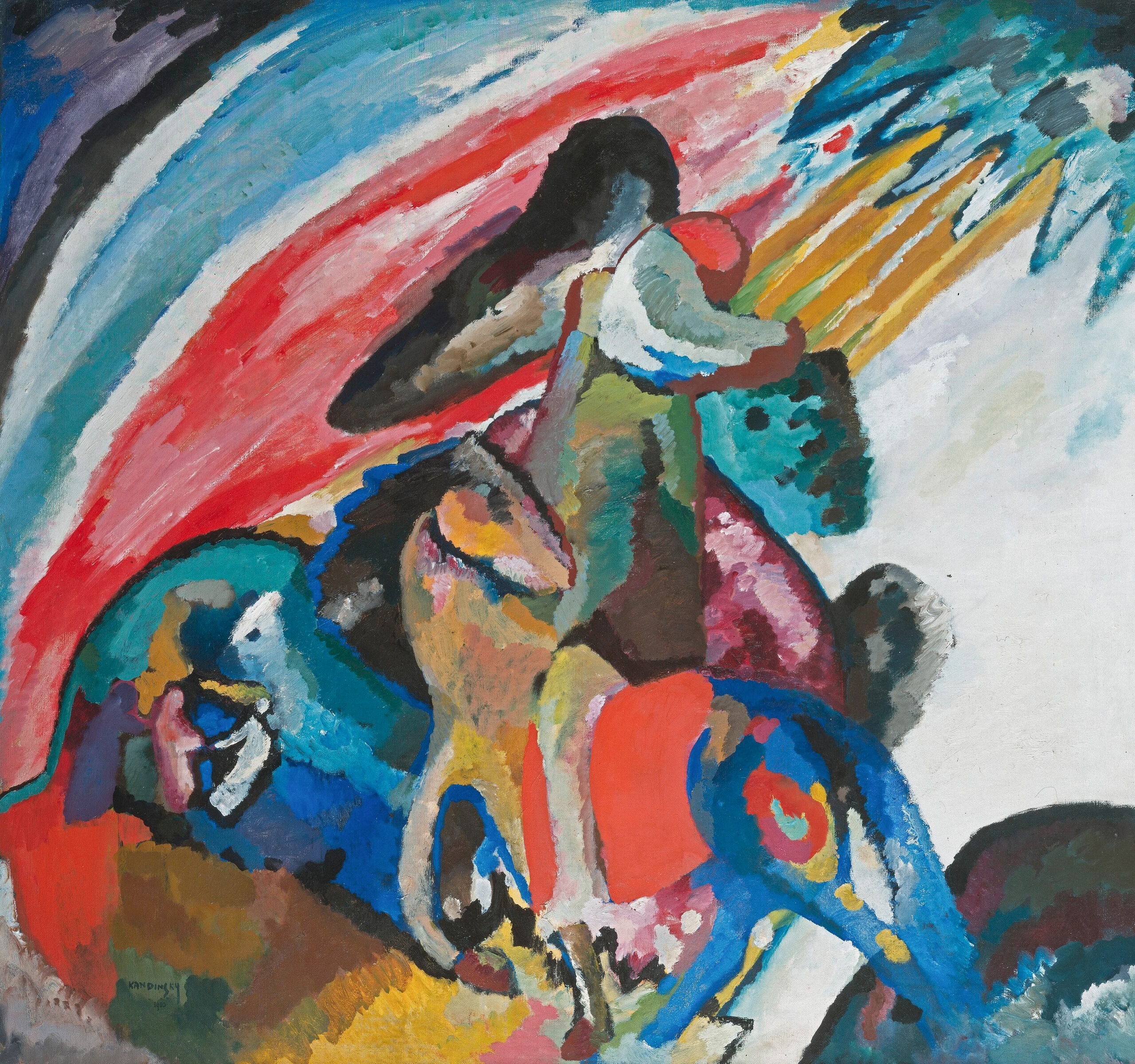
This work, Improvisation 12 (The Rider), painted by Wasily Kandinsky in 1910 in Munich, marks a step toward abstraction in the Russian artist’s career. The painting belongs to the series of Improvisations, which Kandinsky distinguished from his Impressions and his Compositions as the most spontaneous expression of his inner life. The motif of the rider, recurrent in the painter’s work, predates the formation of the Der Blaue Reiter group, founded the following year with Franz Marc. Held today at the Pinakothek der Moderne in Munich, this oil on canvas measuring 97 x 106.5 cm illustrates Kandinsky’s gradual move toward a pictorial language detached from figurative representation, a few years before his first fully abstract works.
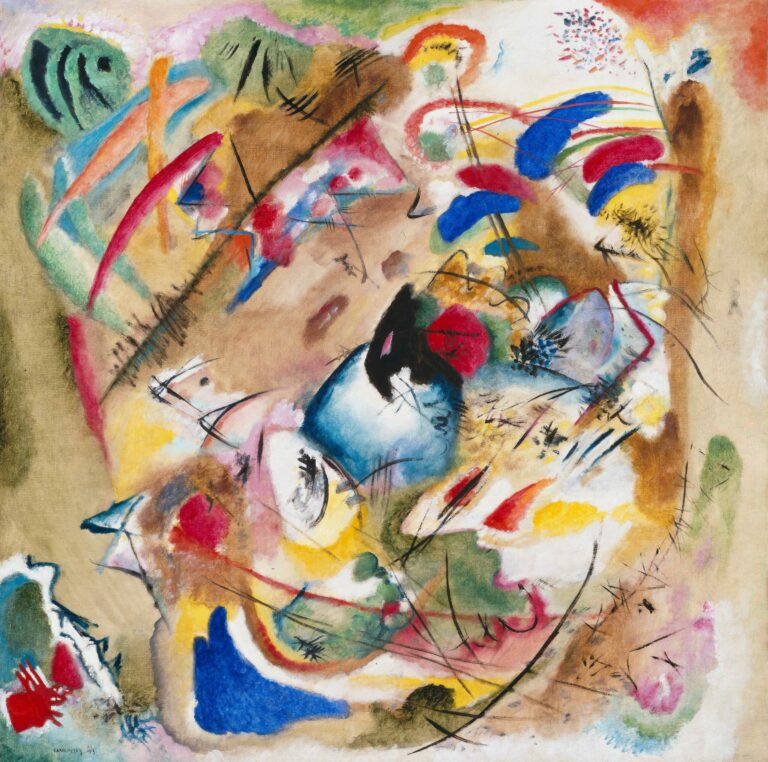
We have already featured two of Kandinsky’s Improvisations on VMuseum: Improvisation 30 (Cannons), painted in 1913, and Improvisation 26 (Rowing), from 1912. All three sit at the edge of abstraction, still partly figurative, and all three deploy forms and colours that evoke dense musical scores. I have a particular fondness for Improvisation 12: earlier than the others, dating from 1910, with its vivid colours and this rider launched at full gallop. Nothing here is left to chance; everything seems to answer that search for correspondence between sound and colour which Kandinsky would soon formalise into theory, in the tradition of the synaesthesia often attributed to him.
This is not a heroic charge. One would expect a proud rider, upright in the saddle, thrown into a clear battle. It is nothing of the sort: Wasily Kandinsky dissolves the figure into a whirlwind of pure colour, somewhere between oil paint and chromatic vertigo.
Formal and Technical Analysis of Improvisation 12 (The Rider)
The horse rears at the centre of the composition. Its limbs unfold in broad, almost disjointed flats of blue, ochre and red. The rider leans forward, a dark silhouette absorbed by the movement, almost swallowed by it. A band of red sweeps across the entire sky like a signal, almost a visual cry directed at the viewer. Kandinsky applies the oil in broad, rapid strokes, unconcerned with exact outline or anatomical accuracy. Forms overlap, merge, and at times contradict one another from one area of the canvas to the next. Green and pink also appear, in more discreet touches, like secondary harmonics within a visual score. Red, blue and yellow dominate: here, colour carries the emotion, not line or preparatory drawing. Signed and dated 1910 in the lower left, the canvas measures 97 x 106.5 cm. Nothing truly illustrates a scene; everything instead composes a tension between the subject and its dissolution.
Historical and Artistic Significance of Kandinsky’s Work
In 1910, Kandinsky had been living in Munich for over a decade, at the heart of a bubbling avant-garde. He had just co-founded the New Artists’ Association of Munich. The motif of the rider had already haunted his painting since the beginning of the century, drawn in part from Russian legend and from the figure of Saint George slaying evil. Kandinsky distinguished three types of works in his practice: Impressions, born of direct contact with the external world; Compositions, long considered and constructed; and Improvisations, arising more spontaneously from inner life. This canvas belongs to that third category, which he considered closest to the unconscious. A year later, Kandinsky theorised this approach in Concerning the Spiritual in Art, before co-founding, with Franz Marc, the almanac Der Blaue Reiter, which would give the movement its name. Held today at the Pinakothek der Moderne in Munich, this canvas would never itself bear the name Blaue Reiter; it precedes it, yet already announces its spirit.
Wasily Kandinsky was born in Moscow in 1866. He abandoned a promising legal career to devote himself to painting and settled in Munich in 1896. A major theorist of emerging abstraction, he would later teach at the Bauhaus in Germany, before dying in France in 1944.
Current Events
The musical vocabulary Kandinsky chose for this canvas, Improvisation, is no accident. This year again, the exhibition “Kandinsky, la musique des couleurs,” presented from 15 October 2025 to 1 February 2026 at the Musée de la musique of the Philharmonie de Paris, in partnership with the Centre Pompidou, shed light on this fundamental link between the painter and music. The exhibition brought together nearly two hundred works and objects from the artist’s studio, revealing how profoundly music nourished his vocation and shaped his evolution toward abstraction, echoing the compositions of Alexander Scriabin, Arnold Schoenberg and Igor Stravinsky. A concrete reminder that Kandinsky’s Improvisations, including the one presented here, were never merely evocative titles, but the direct expression of a search for correspondence between sound, form and colour, an approach the artist would later formalise in his book Concerning the Spiritual in Art.
Source: LaM Museum
A Question for You
Standing before this rider dissolving before your eyes, are you still looking for the scene, or already only for the colour?
About This Work
- Improvisation 12 (The Rider)
- Wasily Kandinsky
- 1910
- Oil on canvas
- 97 x 106.5 cm
- Pinakothek der Moderne, Munich
- https://www.sammlung.pinakothek.de/de/artwork/Qm45QQj4No/wassily-kandinsky/improvisation-12-der-reiter