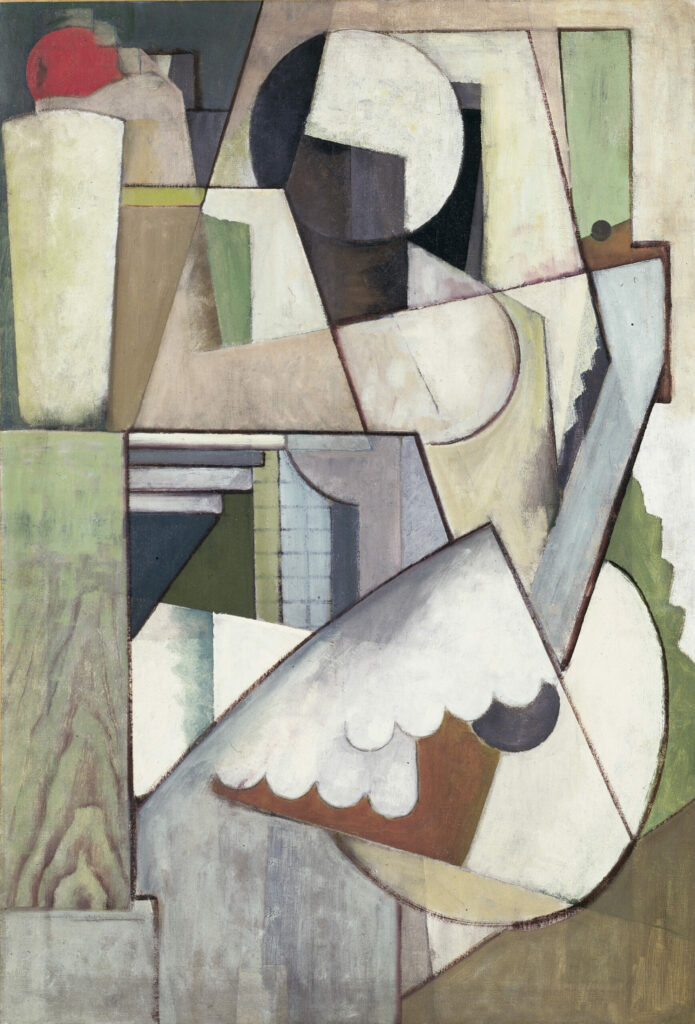
New York, 1914. Henry Fitch Taylor sets down his brushes before a canvas that transforms his practice. A woman with a guitar breaks down into geometric fragments, as if the painter’s gaze had explored a thousand facets.
A Fragmented Body in Modern Space
The female figure is barely discernible beneath planes of muted colors: beiges, gray-greens, off-whites punctuated by a vivid red in the upper left. The curves of the body mirror those of the guitar and an apple, creating a dialogue between flesh and object. Taylor divides the image into interlocking geometric forms, like pieces of a complex puzzle. Each fragment reveals a different part: a shoulder, the curve of a hip, the hollow of an arm. Sharp angles and vertical forms evoke buildings, an urban landscape that surrounds the musician. He captures this tension between organic softness and architectural rigor.
American Cubism Awakens
Henry Fitch Taylor discovers European Cubism at the 1913 Armory Show, the exhibition that revealed Picasso and Braque to the United States. In 1914, he seizes upon this visual revolution to create his own experiments. This work demonstrates his assimilation of Cubism: less radical than the French, more attached to color. Taylor belongs to those pioneers who imported European modernism onto American soil, radically transforming their country’s art.
Henry Fitch Taylor
Co-founder of the Madison Gallery, Taylor (1853-1925) devoted his life to promoting the avant-garde. His style oscillates between late Impressionism and moderate Cubism, always with that chromatic sensitivity that distinguishes him.
Think about it
💭 How do you perceive your own image when it fragments in the reflection of a shop window or a broken mirror?
About This Work
- Figure with Guitar II
- Henry Fitch Taylor
- 1914
- Oil on canvas
- 88.9 x 61 cm
- Smithsonian American Art Museum, Washington
- https://americanart.si.edu/artwork/figure-guitar-ii-23817
The 1913 Armory Show and the Conversion to Modernism
Figure with Guitar II documents the transformation that the encounter with European modernism produced in Henry Fitch Taylor (1853-1925). Taylor was a co-founder of the Madison Gallery in New York, and in that capacity played an organisational role in the Armory Show of 1913, the landmark international exhibition that first revealed Cubism, Fauvism, and abstraction to the American public on any significant scale. The experience was decisive for his own practice: the female figure holding a guitar in this canvas is resolved into interlocking geometric planes, in a palette of beiges, grey-greens, and off-whites punctuated by a vivid red accent in the upper left. This Cubist vocabulary is not a direct copy of Picasso or Braque, Taylor’s touch remains softer, more attentive to colour, but it is a sincere and considered assimilation of European lessons by an artist who had helped to import them.
Taylor’s Place in American Modernism
Taylor belongs to the generation that bridged late Impressionism and geometric modernity in American painting of the 1910s. His practice oscillated between a colourist sensibility inherited from his studies in France and a structural approach he developed after 1913. Figure with Guitar II is among the most coherent works of this transitional period: an artist absorbing new forms without abandoning his own identity. The Smithsonian American Art Museum, which holds this canvas in Washington, presents it as an important document of how European modernism was received and transformed by the American avant-garde in New York during the years immediately before the First World War.