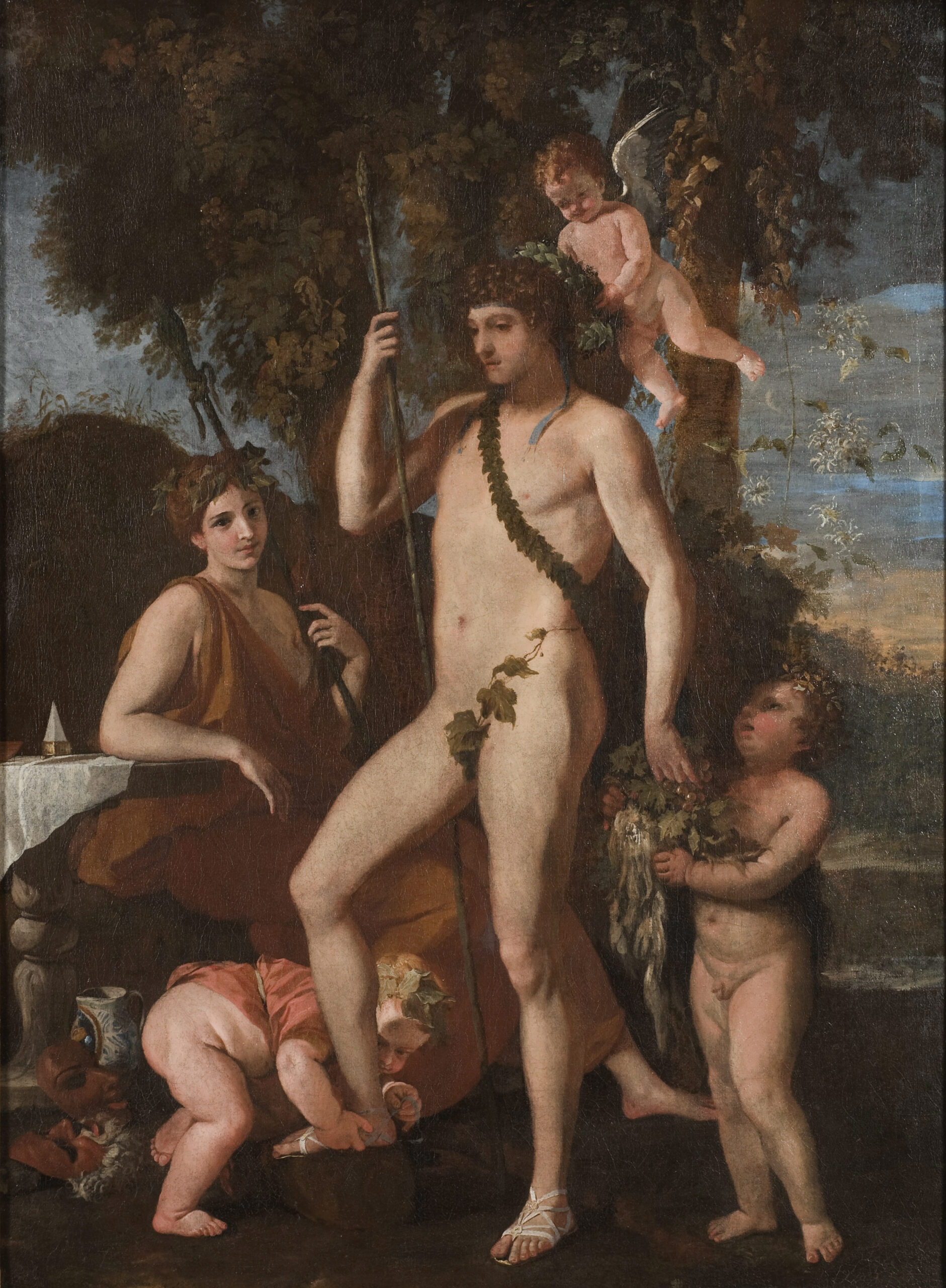
Nicolas Poussin, a young French painter in self-imposed exile in Italy, immerses himself in Antiquity. Here, he merges two gods into a single body: Bacchus, lord of wine, and Apollo, god of the arts.
The divine fusion
At the centre, a male figure stands crowned with ivy. He holds a thyrsus, the sacred staff of Bacchus, with a confident hand. Garlands of leaves wrap sensuously around his body. To the left, a seated figure in an ochre robe plays a stringed instrument. Two putti flank the scene, one perched in the tree, one resting on the ground. Poussin works in oil on canvas with a warm palette: ochres, browns, and luminous flesh tones. The composition is pyramidal, balanced, classical.
Two gods, one soul
In seventeenth-century Rome, humanists debated the relationship between creative intoxication and poetic inspiration. Poussin answers in images. He creates a syncretic figure: Bacchus-Apollo unites Dionysian power with Apollonian harmony. This duality captivated the Ancients, and it equally captivated the Roman patrons who were commissioning refined mythological subjects at the time. The work belongs to the nascent classicist movement, shaped by Raphael and the antique friezes Poussin studied with tireless dedication.
Nicolas Poussin
Born in Normandy, Poussin (1594–1665) left for Paris before settling in Rome in 1624. Founding figure of French classicism, he built rigorous compositions steeped in philosophy and mythology. This painting belongs to his Italian formative period, intense, exploratory, and searching.
Think about it
💭 Antique friezes and Raphael inform every gesture, every fold of drapery here, do you see the imitation of the Ancients as a constraint, or as a creative springboard?
About this work
- Bacchus-Apollo
- Nicolas Poussin
- 1620–1625
- Oil on canvas
- 98 × 73.5 cm
- Nationalmuseum, Stockholm
- https://collection.nationalmuseum.se/en/collection/item/19729/
Antique Syncretism: Bacchus and Apollo United
Nicolas Poussin settled in Rome in the mid-1620s and there absorbed the dual lesson of Raphael and the ancient friezes he studied with the attention of an antiquarian. Bacchus-Apollo illustrates the mythological syncretism prized by 17th-century Roman humanist circles: the central figure, crowned with ivy and carrying the thyrsus, Bacchus’s sacred staff, is also endowed with a serenity and solar beauty that evoke Apollo, god of the arts and of light. This fusion of two opposing deities, one embodying Dionysian intoxication, the other Apollonian harmony, expresses the idea of an artistic inspiration that reconciles reason and enthusiasm, order and excess.
Poussin and the Formation of French Classicism
This early work already anticipates what would make Poussin singular in the European artistic landscape: a pyramidal composition inherited from Raphael, a palette of warm tones, ochres, browns, luminous flesh, indebted to the study of ancient polychrome sculpture and Venetian painters, and a rigour in the organization of pictorial space that stands apart from contemporary Baroque exuberance. The presence of putti and the musician in ochre robes to the left enriches the scene with an additional allegorical dimension: music, one of the disciplines of the god Apollo, is here invoked as the attribute of a doubly inspired poetic state, both Bacchic and luminous. Held in Stockholm since the 17th century, this painting attests to Poussin’s early reputation among collectors in northern Europe.