Brussels, 1634. Van Dyck must immortalise a French aristocrat in exile, seductive, ambiguous, flamboyant. The Flemish painter seizes the moment with formidable precision.
Portrait of a Dandy with a Forgotten Armour
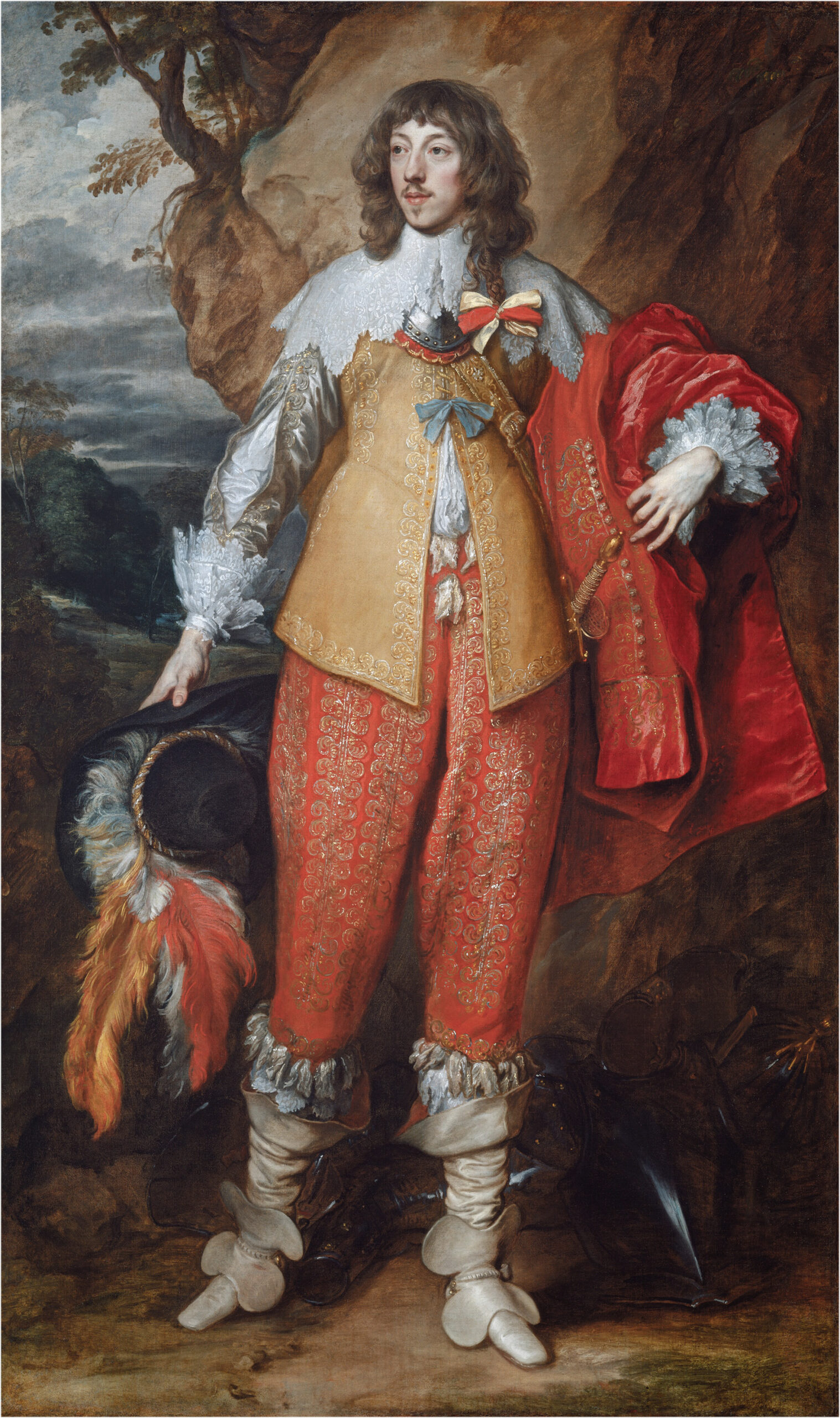
Look at this man. He stands sovereign, against a backdrop of rocks and a troubled sky. His brown hair falls in loose curls over a wide lace collar. The embroidered beige doublet and vivid red breeches, trimmed with gold braid, catch the eye immediately. At his feet lies a dark suit of armour, almost an afterthought. Van Dyck works with virtuosity: the satin gleams, the lace quivers, the leather drinks in the light. Every texture speaks.
An Exile Between War and Frivolity
In March 1634, Van Dyck left the court of Charles I of England and returned to the Southern Netherlands. There he painted several French aristocrats who had taken refuge in Brussels as partisans of the exiled Marie de’ Medici. Henri II de Lorraine was one of them. Scion of the powerful House of Guise, appointed Archbishop of Reims at fifteen, he nonetheless preferred battlefields to cathedrals. His motto says it all: There are only two things in life: war and women. After Nördlingen, he most likely settled into the entourage of the Cardinal-Infant Ferdinand, the new Governor of the Southern Netherlands. The armour at his feet recalls his recent military engagements, but his bearing tells a different story.
Anthony van Dyck
Anthony van Dyck (Antwerp, 1599 – London, 1641) formed his style under Rubens before establishing himself as the defining Baroque portraitist in Europe. Painter to Charles I, he mastered the art of giving the powerful precisely the image they desired, or deserved.
A Question for You
💭 Which man did Van Dyck truly paint the soldier, the seducer, or the aristocrat in search of an identity?
About this work
- Henri II de Lorraine
- Sir Anthony van Dyck
- c. 1634
- Oil on canvas
- 204.6 × 123.8 cm
- National Gallery of Art, Washington
- https://www.nga.gov/artworks/34046-henri-ii-de-lorraine
Portrait of an Aristocrat in Exile
Henri II de Lorraine is one of the most elegant portraits Sir Anthony van Dyck (Antwerp, 1599 – London, 1641) painted during his Brussels period. In March 1634, Van Dyck interrupted his duties as official painter to King Charles I of England and returned to the southern Netherlands. During the nine months he spent in Brussels, he executed several portraits of exiled French aristocrats, among them Henri II de Lorraine, fifth Duke of Guise. The sitter is presented full-length in a posture of sovereign composure, wearing an embroidered beige doublet and bright red breeches trimmed with gold, against a background of turbulent rock formations. An abandoned suit of armor lies at his feet, an allusion to his military engagements.
Van Dyck and the Art of Aristocratic Portraiture
In this portrait as in his great British commissions, Van Dyck deploys his incomparable mastery of the full-length aristocratic portrait: posture, fabrics, expression, everything contributes to conveying the sitter’s social dignity without the rigidity of traditional official portraiture. The turbulent landscape backdrop, dark clouds, craggy rocks, contrasts with the elegance of the clothing and the serenity of the face, creating a tension between hostile nature and the nobleman’s self-possession. This visual rhetoric, which Van Dyck inherits partly from Titian and develops to an unmatched degree of sophistication, would exert a defining influence on European portraiture through the seventeenth and eighteenth centuries. The National Gallery of Art in Washington holds this canvas as one of the most accomplished examples of the genre in its collection.