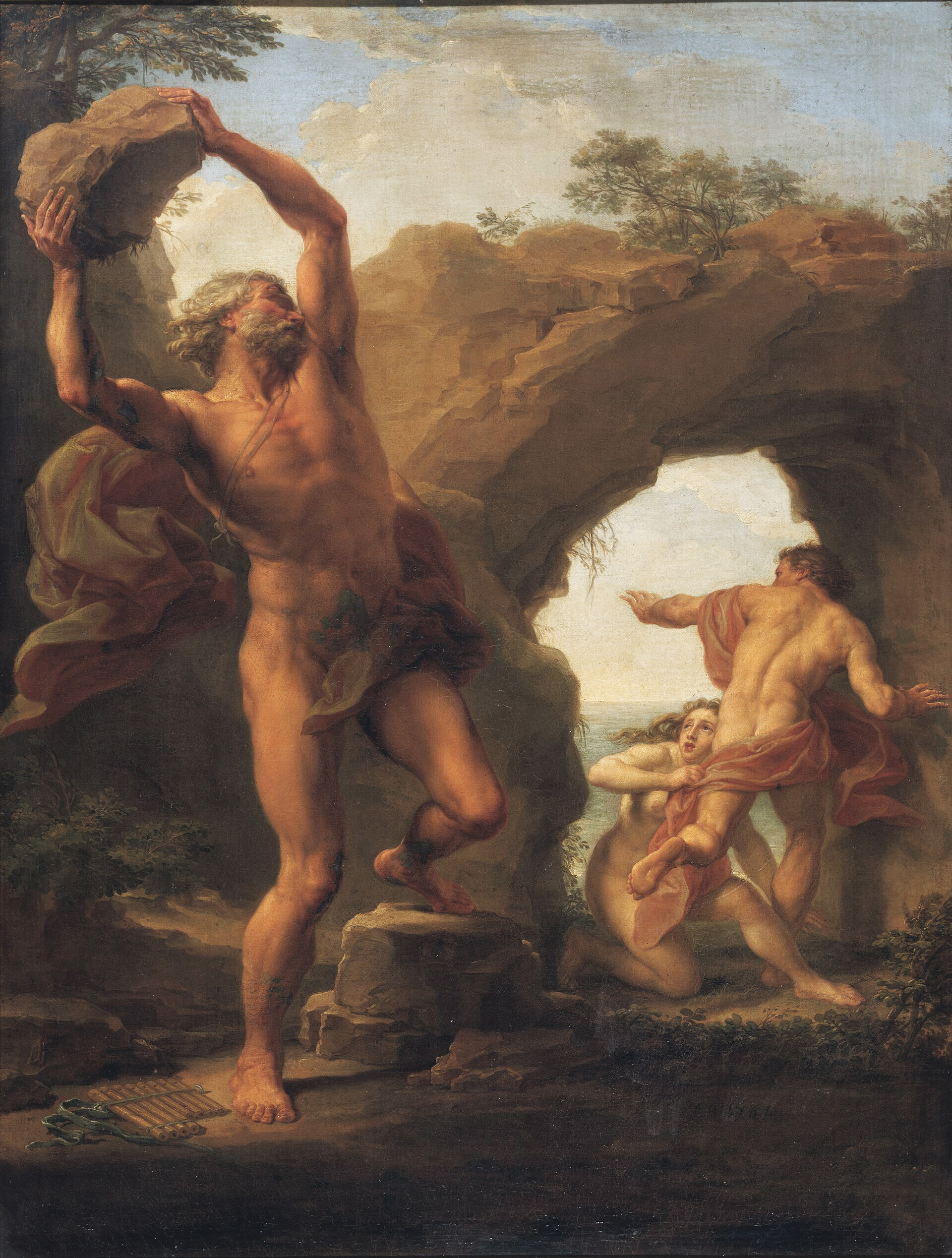
Rome, 1761. Pompeo Batoni seizes a mythological instant suspended between desire and violence. The cyclops Polyphemus raises a boulder. Below, two lovers attempt to flee.
The Impossible Escape
On the left, the colossal silhouette of Polyphemus dominates the canvas. His arms stretched toward the sky, he holds a menacing block of stone. His gaze blinded by jealousy, he no longer sees anything at all. On the right, Acis shields Galatea with his body. She looks up, terrified. Batoni renders with precision the cyclops’s bulging muscles, the nacreous flesh of the nereid. The palette plays across the reds of the drapery and the ochres of the rock. On the ground, an abandoned pan flute recalls the interrupted love song.
Carracci as Inheritance
This work belongs to a long pictorial tradition. Batoni draws directly from Annibale Carracci’s celebrated fresco in the Palazzo Farnese in Rome, painted around 1597. He reinterprets the scene drawn from Ovid’s Metamorphoses. In the 18th century, mythology remained a field of excellence for Italian painters. The work answered the expectations of a cultivated clientele, fascinated by Antiquity. Added late to the collection of the Nationalmuseum in Stockholm, it illustrates the lasting influence Batoni held over European collectors. King Gustav III of Sweden himself acknowledged Batoni as the only great master still living in Italy, during his visit to Florence in 1783.
Pompeo Batoni
Pompeo Batoni (1708–1787) was born in Lucca. He established himself in Rome as the indispensable portraitist of the Grand Tour. His style blends classical rigour with Baroque sensuality. This work demonstrates his mastery as much of narrative as of technique.
A Question for You
💭 Batoni borrows from Carracci without copying him. Where does homage end and creation begin? Is not the history of art made precisely of these knowing reprises?
About this work
- Acis and Galatea
- Pompeo Batoni
- 1761
- Oil on canvas
- 98.5 × 75 cm
- Nationalmuseum, Stockholm, photo Cecilia Heisser, Public Domain
- https://collection.nationalmuseum.se/en/collection/item/23711/
Ovid in the Eighteenth Century: Batoni and Learned Mythology
Acis and Galatea is one of the major mythological compositions of Pompeo Batoni (Lucca, 1708 – Rome, 1787), the painter who dominated the Roman Grand Tour scene throughout the eighteenth century. The subject is taken from Book XIII of Ovid’s Metamorphoses: Galatea, an incomparably beautiful Nereid, loves the shepherd Acis; Polyphemus, the giant cyclops consumed by unrequited passion for her, surprises them and crushes Acis beneath a boulder torn from the mountainside. The gods, moved by Galatea’s grief, transform the young man’s blood into a river, granting him an immortality of water and current. Batoni chooses the moment of maximum tension: the rock is already raised, Polyphemus looming over the composition with his colossal mass, musculature rendered with an anatomical care that reflects direct study of ancient sculpture. Below, Acis shields Galatea in a gesture that is at once a declaration of love and an acknowledgment of his powerlessness before the coming violence.
Batoni, Rome, and the Grand Tour Clientele
Son of a goldsmith in Lucca, Batoni arrived in Rome around 1728 and rapidly established himself as the preferred portraitist of European aristocrats undertaking the Grand Tour: English lords, German princes, princes of the Church. His mythological works, fewer in number than his portraits, reveal a deep classical culture nourished by study of ancient sculpture and the frescoes of Annibale Carracci at the Palazzo Farnese, a source to which the composition of Acis and Galatea is clearly indebted. The canvas passed into the Swedish royal collection, evidence of the European reputation Batoni had built from his Roman base. Now in the Nationalmuseum in Stockholm, it illustrates how Batoni carried the great formulas of late Baroque painting toward what art historians call nascent Neoclassicism: the drama is still entirely Baroque, but the archaeological precision of the figures and the clarity of the spatial organisation point toward a new aesthetic.