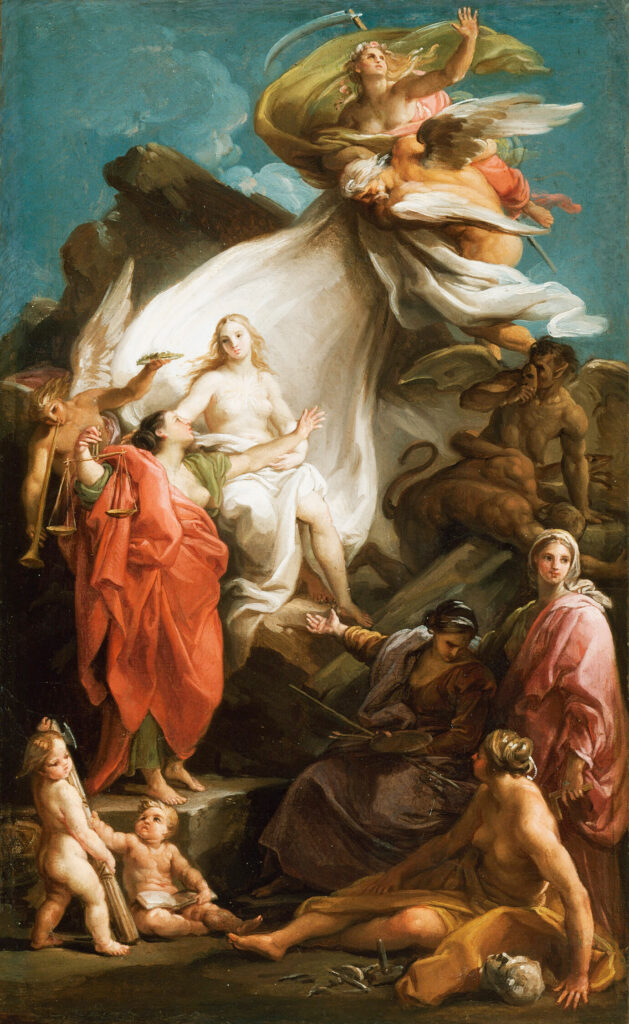
Pompeo Batoni presents, in this allegorical composition, a theatrical and vibrant vision of triumphant truth.
At the center of the work, a strikingly white female figure personifies Truth, being unveiled by Time, depicted above her as a winged old man carrying his emblematic scythe.
The swirling composition revolves around these two protagonists, surrounded by a multitude of richly draped allegorical figures. On the left, Justice in red holds her scales, while on the right, the dark figure of a vanquished demon can be distinguished. Putti and other female characters complete this dramatic scene, creating a complex balance between the different planes. The luminous and contrasting palette underscores the moral message of the work: truth always ultimately triumphs, revealed by the inexorable passage of time.
Additional Information
- Title: Time Unveiling Truth
- Artist: Pompeo Batoni
- Date: circa 1740-1745
- Dimensions: 43.3 × 26.5 cm
- Location: The Art Institute of Chicago, European Paintings and Sculptures, Gallery 216
- https://www.artic.edu/artworks/51130/time-unveiling-truth
Pompeo Batoni (1708-1787), a major figure of Italian Neoclassicism, was one of the most influential painters in 18th-century Rome. Born in Lucca, he established himself early in the Eternal City where he developed an elegant style that admirably combined the Roman classical heritage with the emerging clarity of Neoclassicism.
A celebrated portraitist sought after by European aristocracy, particularly young Britons on their Grand Tour, Batoni also excelled in historical and mythological scenes. His impeccable technique, characterized by precise drawing, luminous colors, and balanced compositions, made him the direct rival of Mengs. Batoni captured the spirit of his era, ensuring the transition between flamboyant Baroque and the Neoclassical rigor that would dominate the end of the century.
An Allegory of Clarity
Time Unveiling Truth is one of the most elaborately conceived allegorical compositions from the early career of Pompeo Batoni (Lucca, 1708 – Rome, 1787). Truth, a young woman nude or lightly draped — is unveiled by Time, a winged elder bearing a scythe and hourglass, emblems of duration. Beside them, a figure of Justice clothed in red holds a balance, while a defeated demon lies at the base of the composition. Putti animate the background. The canvas condenses into a single image several moral and political virtues whose allegorical representation was common in European visual culture from Rubens to Tiepolo, and gives each figure the clarity of silhouette that Batoni was already making his signature.
Batoni in Rome: Between Raphael and the Antique
Batoni settled definitively in Rome in 1727, following training in Lucca in his father’s goldsmith workshop. It was in Rome that he developed the style that would make him one of the most sought-after portraitists of the eighteenth century and one of the principal representatives of nascent neoclassicism. Time Unveiling Truth, painted around 1740-1745, belongs to the formative phase of that style, when his pictorial language was still being shaped by close study of Raphael, Correggio, and ancient sculpture. The pyramidal composition, the precision of the modeling, and the clear light that separates the figures from a neutral ground are characteristics that anticipate the neoclassical manner and set Batoni apart from the Roman Baroque of the preceding generation.
A Painter of Two Careers
Batoni’s career had two distinct phases: a sought-after history painter celebrated for allegorical and mythological compositions in his earlier decades, he became from the 1750s onward the preferred portraitist of the aristocrats and princes making the Grand Tour through Rome. His large-format portraits, models posed before carefully chosen ancient ruins, defined an iconography of the cultivated traveler that would exert considerable influence on European portraiture through the end of the century. Time Unveiling Truth belongs to the earlier of these two careers, the Batoni of allegory, less familiar to general audiences but essential for understanding the full coherence of his art.