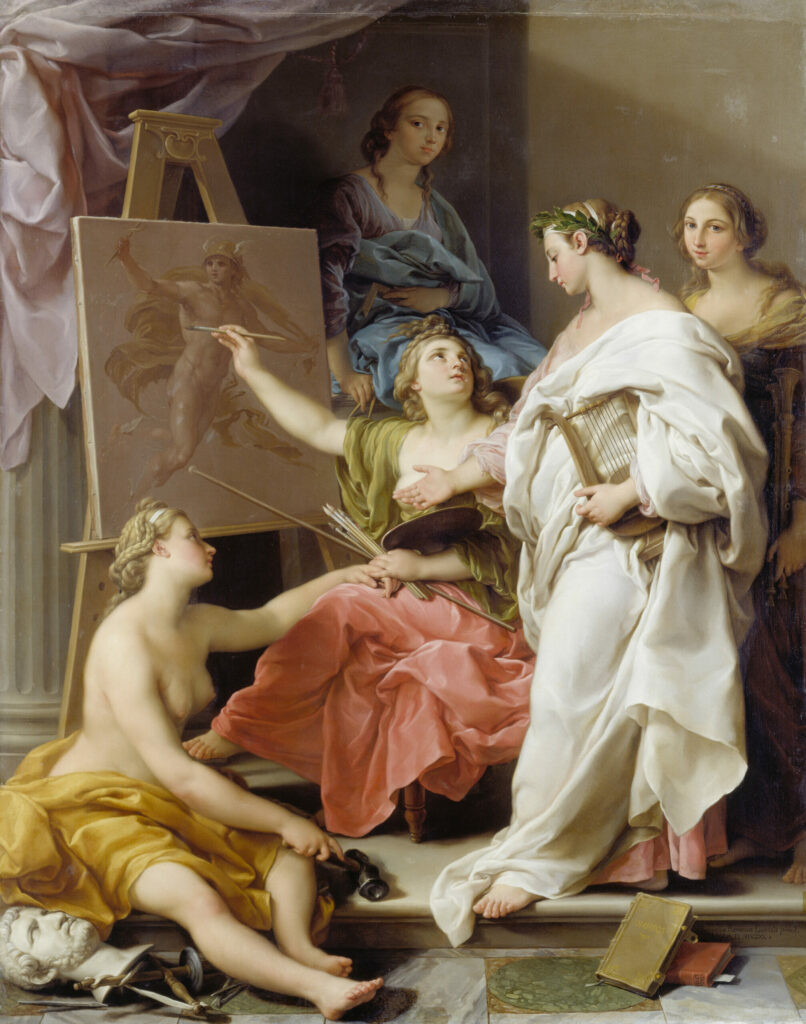
Rome, 1740. Batoni paints a scene where the muses take flesh: five women embody the arts in silent dialogue. At the center of the composition, Painting reigns, seated near her easel, palette in hand.
An Artistic Hierarchy Staged
Observe the arrangement of the figures. Painting occupies the heart of the canvas, bathed in light. Before her stands Poetry, crowned with laurels, breathing inspiration into her. On the left, Sculpture contemplates her, gaze raised toward her. Architecture and Music, relegated to the background, complete this assembly. Silky draperies undulate. Each fold testifies to great technical mastery. Soft flesh tones, delicate gestures create an atmosphere of grace. Batoni erases all trace of the brush: his touch, smooth as enamel, pays homage to classicism.
The Paragone Debate in the 18th Century
This visual hierarchy reflects the “paragone,” that artistic quarrel that animated Europe since the Renaissance. Which art deserves supremacy? Batoni answers unambiguously: painting. It synthesizes the other disciplines, capable of representing architectural space, sculptural form, poetic emotion. In 18th-century Rome, this assertion held the value of a manifesto. Academies debated, artists competed. Batoni defends his medium with elegance.
Batoni, a Master of Roman Neoclassicism
Pompeo Girolamo Batoni (1708-1787) embodies Roman pictorial refinement. A portraitist sought after by European aristocracy, he developed a style where classical rigor and modern sensibility combine. This allegory concentrates his art: impeccable drawing, harmonious colors, balanced composition.
Think about it
💭 What place would you grant each art in your personal pantheon?
About This Work
- Allegory of the Arts
- Pompeo Girolamo Batoni
- 1740
- Oil on canvas
- 175.4 × 138 cm
- Städel Museum, Frankfurt am Main
- https://sammlung.staedelmuseum.de/en/work/allegory-of-the-arts