Rome, 1756. Pompeo Girolamo Batoni completes a royal commission: to immortalize the divine union of Cupid and Psyche. This painting would become Frederick the Great’s wartime companion.
A Celestial Ceremony
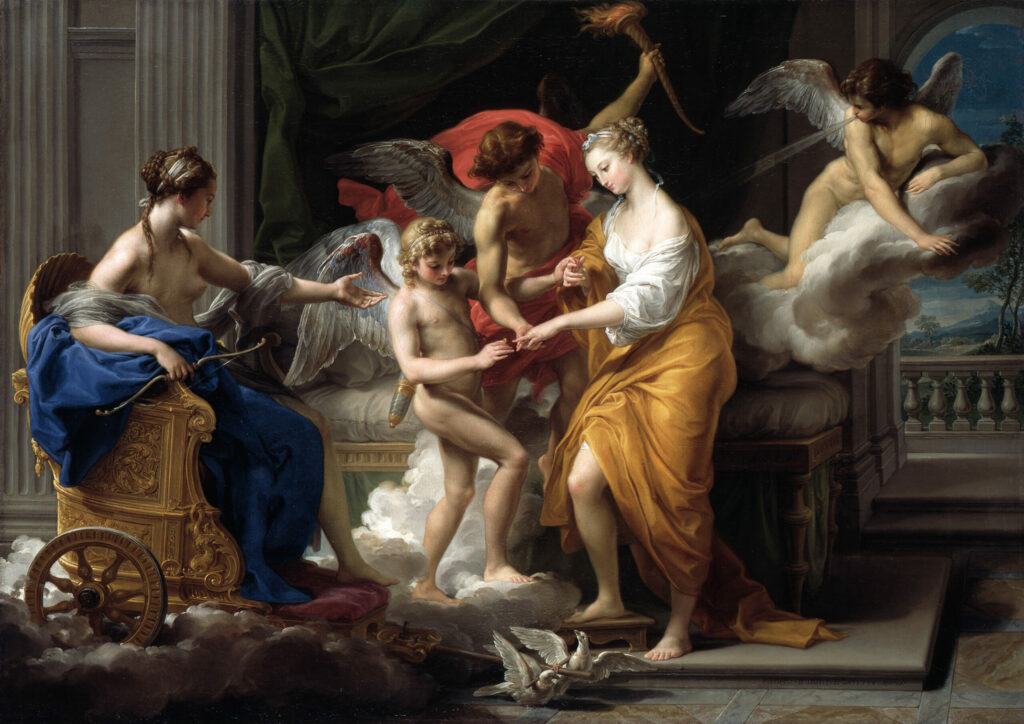
Observe the scene: Venus, seated on a golden chariot drawn by two doves, guides the hand of her son Cupid. He slips the ring onto Psyche’s finger. Hymen, god of marriage, delicately holds the young mortal’s hand. The bodies unfold upon vaporous clouds. Psyche, the only earthly figure, rests on the floor of the bridal chamber.
The draperies undulate in saffron and deep blue. Batoni paints with a goldsmith’s precision. The chiaroscuro modeling sculpts pearlescent flesh. The faces breathe grace. The composition is organized around a perfectly balanced tripartite central group.
A Work Between Two Eras
This mythological marriage arrived in Berlin under extraordinary circumstances. Commissioned before the Seven Years’ War, the work crossed battlefields. Frederick the Great carried it with him everywhere. It would not be paid for until 1763, after the peace treaty.
Batoni follows in the classical tradition of Carlo Maratta and Raphael. Yet his elegance already heralds the emerging Neoclassicism. Four years after this painting, Mengs would officially inaugurate the new style.
Pompeo Girolamo Batoni
Batoni (1708-1787) then reigned over Rome as Europe’s most celebrated portraitist. Trained in his father’s goldsmith workshop, he mastered the precious rendering of materials. His refined classicism captivated the Grand Tour aristocracy. Psyche’s head bears the features of his wife Lucia, celebrated as one of Rome’s most beautiful women.
Think about it
💭 Why did this divine union fascinate so deeply? Perhaps because it transforms mortal love into immortality?
About This Work
- The Marriage of Cupid and Psyche
- Pompeo Girolamo Batoni
- 1756
- Oil on canvas
- 85.3 × 120 cm
- Gemäldegalerie, Berlin
- https://recherche.smb.museum/detail/863127/die-verm%C3%A4hlung-amors-mit-psyche
A Commission from Frederick the Great
This work was commissioned directly by King Frederick II of Prussia, known as Frederick the Great, through Marshal Jakob Keith, before March 1756. The decision to purchase a Batoni was not self-evident for the king: initially little interested in contemporary Italian painters, he was convinced by the advice of his sister, Margravine Wilhelmine of Bayreuth, who returned enthusiastically from a stay in Rome in 1755. This painting is thus the first of three that Frederick would eventually acquire from Batoni over time.
A Painting That Went to War
Completed in 1756, the canvas accompanied Frederick throughout the Seven Years’ War (1756-1763), transported during his campaigns and stays at winter quarters in Dresden. Payment to Batoni was made only after the signing of the peace treaty in 1763, seven years after delivery. The work then entered the royal gallery as the sole painting by a still-living artist among the collections, a distinction that speaks volumes about the prestige Batoni had earned in the eyes of European sovereigns.
Batoni, Portraitist of Europe on the Grand Tour
Pompeo Girolamo Batoni (1708-1787) dominated the Roman art scene for several decades as the preferred portraitist of aristocrats on the Grand Tour. Born in Lucca and trained in his father’s goldsmith workshop, he developed a mastery of material rendering and a classical elegance that captivated the European aristocracy passing through Rome. For this painting, he drew on the models of Carlo Maratta and Raphael while anticipating the emerging Neoclassicism. A personal detail: the features of Psyche were borrowed from those of his wife Lucia, a practice common in the artist’s studio.