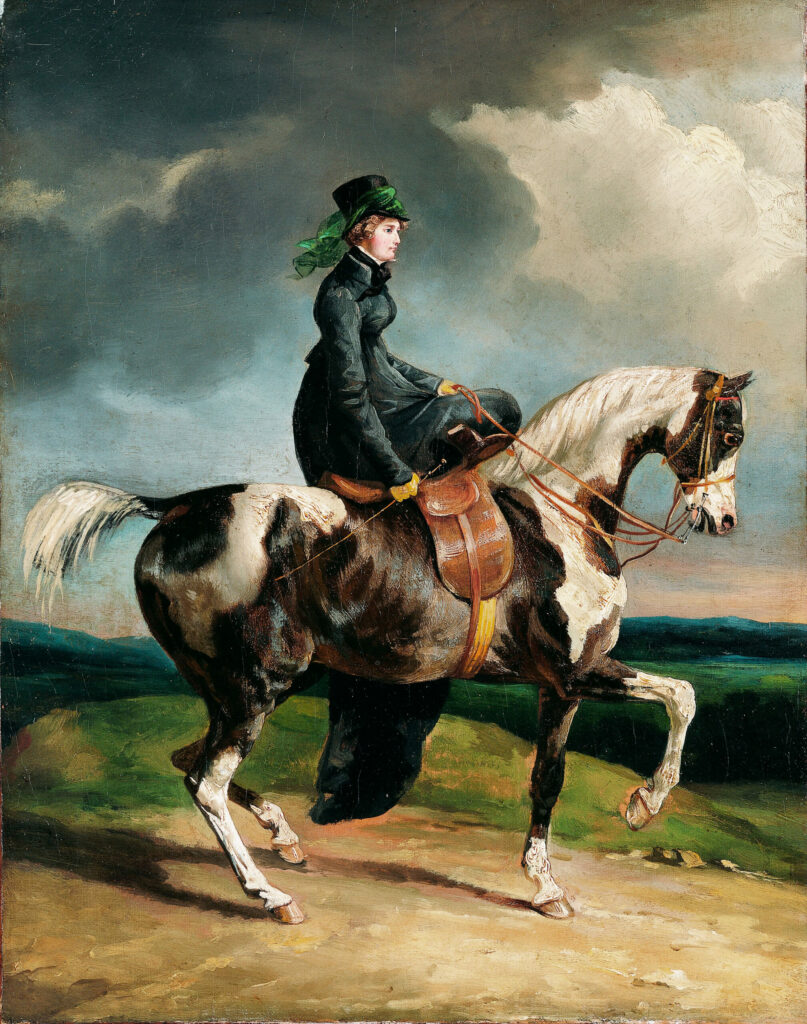
Paris, early 1820s. Géricault observes a horsewoman mastering her mount with sovereign elegance. He takes up his brushes to immortalize this perfect alliance between strength and grace.
See this woman in a black riding habit, seated sidesaddle on a piebald horse with tensed muscles. She sits upright, gaze fixed on the horizon, indifferent to the turbulent sky gathering behind her. The horse moves at a walk. Géricault composes this scene like an ancient frieze: rider and mount stand in profile in perfect balance. The brushstrokes are swift on the horse’s coat, alternating deep black and luminous white. The green of the landscape contrasts with the ochre tones of the ground and the dramatic blue-gray of the clouds.
The Horsewoman, Figure of Feminine Power
This work reinvents a classic French motif: the Amazon. The term evokes those legendary warriors of Antiquity, renowned for their courage in battle. Géricault transposes this mythology to 19th-century England, where he stayed in 1820-1821. There he discovered a refined equestrian culture that fascinated him. The precise identity of this horsewoman remains mysterious, but her bearing makes her the embodiment of a femininity in command of its destiny, far from the conventions of the era.
Géricault, a Painter Passionate About Horses
Théodore Géricault (1791-1824) devoted a consuming passion to horses, which he studied anatomically throughout his brief career. A French Romantic painter, he revolutionized the art of his time through his energetic touch and sense of drama. This horsewoman synthesizes his equestrian obsession and his compositional genius.
Think about it
💭 How does this horsewoman break with the conventions of feminine representation in French academic painting of the early 19th century?
About This Work
- Horsewoman
- Théodore Géricault
- 1820 or later
- Oil on canvas
- 44.5 × 34.9 cm
- The Metropolitan Museum of Art, New York
- https://www.metmuseum.org/art/collection/search/438113