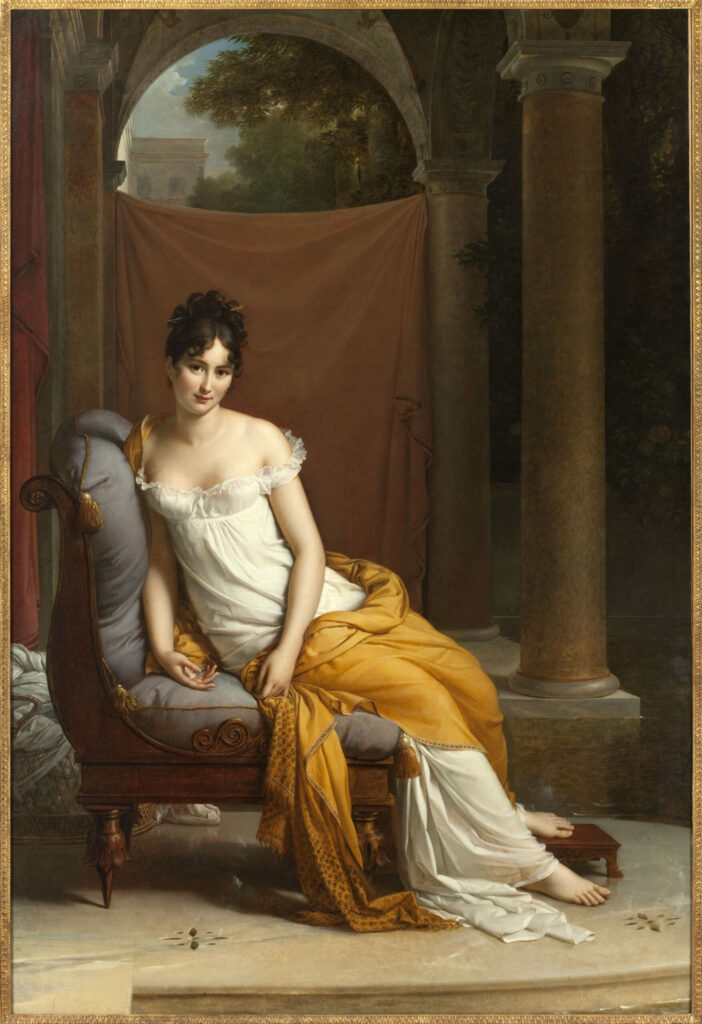
In this portrait of incomparable grace, Baron Gérard immortalizes Juliette Récamier, one of the most admired women of her time, in all her natural allure.
The artist depicts her in a relaxed yet studied pose, seated on an Etruscan chair within a neoclassical setting of elegant columns evoking an ancient bath.
Her white Empire-style dress, enhanced by an ochre shawl with rich borders, embodies the quintessence of period fashion. The particularly refined treatment of light accentuates the delicate complexion of the young woman and the vaporous transparency of the fabrics.
Her facial expression, both modest and confident, perfectly conveys the legendary charm of this salonnière who captivated the most illustrious minds of her era.
Further Context
- Portrait of Juliette Récamier, née Bernard (1777-1849) by Baron Gérard, c. 1802-1805
- 225 x 148 cm
- Paris Musées, Musée Carnavalet, Histoire de Paris
- https://www.parismuseescollections.paris.fr/fr/musee-carnavalet/oeuvres/portrait-de-juliette-recamier-nee-bernard-1777-1849
Baron François Gérard (1770-1837) was one of the most celebrated painters of his time, heir to Davidian neoclassicism and the portraitist of choice for European high society. Initially David’s student, he developed a more fluid and graceful style than his master, particularly suited to fashionable portraiture.
As principal painter to Kings Louis XVIII and Charles X, he excelled in the art of flattering his subjects while maintaining their likeness, combining Empire elegance with pre-Romantic sensibility. His exceptional career saw him paint portraits of Napoleon and his family as well as the sovereigns of the Restoration period.
Juliette Récamier, Subject of All the Masters
Juliette Récamier (1777-1849) did not sit for Gérard alone. She commissioned her portrait from the most celebrated artists of her time: Jacques-Louis David began one in 1800 but left it unfinished after a falling-out; Antonio Canova produced a sculptural bust. Récamier thus engaged all three major disciplines of her era (painting, sculpture, engraving) to construct a carefully orchestrated public image of herself. The portrait by Gérard, commissioned in 1801, is the one she chose to circulate: she had copies distributed as engravings, and gave the original to Prince Augustus of Prussia in 1822. This diplomatic gesture illustrates the political uses that elites of the period made of their portraits.
The Récamier Salon, Heart of Parisian Intellectual Life
Settled with her husband Jacques-Rose Récamier, a banker, in the Chaussée-d’Antin district of Paris, Juliette Récamier hosted one of the most influential salons of the early 19th century. Artists, writers, politicians and exiles all found a place there, with Chateaubriand as a central figure. This portrait by Gérard is therefore not simply the image of a beautiful woman: it documents the silhouette of a woman of power, whose influence operated through cultural and social networks rather than through formal institutions.
Gérard in David’s Studio
François Gérard (1770-1837) trained under Jacques-Louis David before developing a personal style that was more fluid and graceful, particularly well suited to the society portrait. His career brought him to the position of official painter to Kings Louis XVIII and Charles X. To portray Récamier at the age of thirty, at the height of her influence, was for him a demonstration of mastery: the rendering of the white Empire-style dress, the shawl, the Etruscan chair, and the model’s simultaneously modest and assured expression constitutes a canonical example of the French Neoclassical portrait.