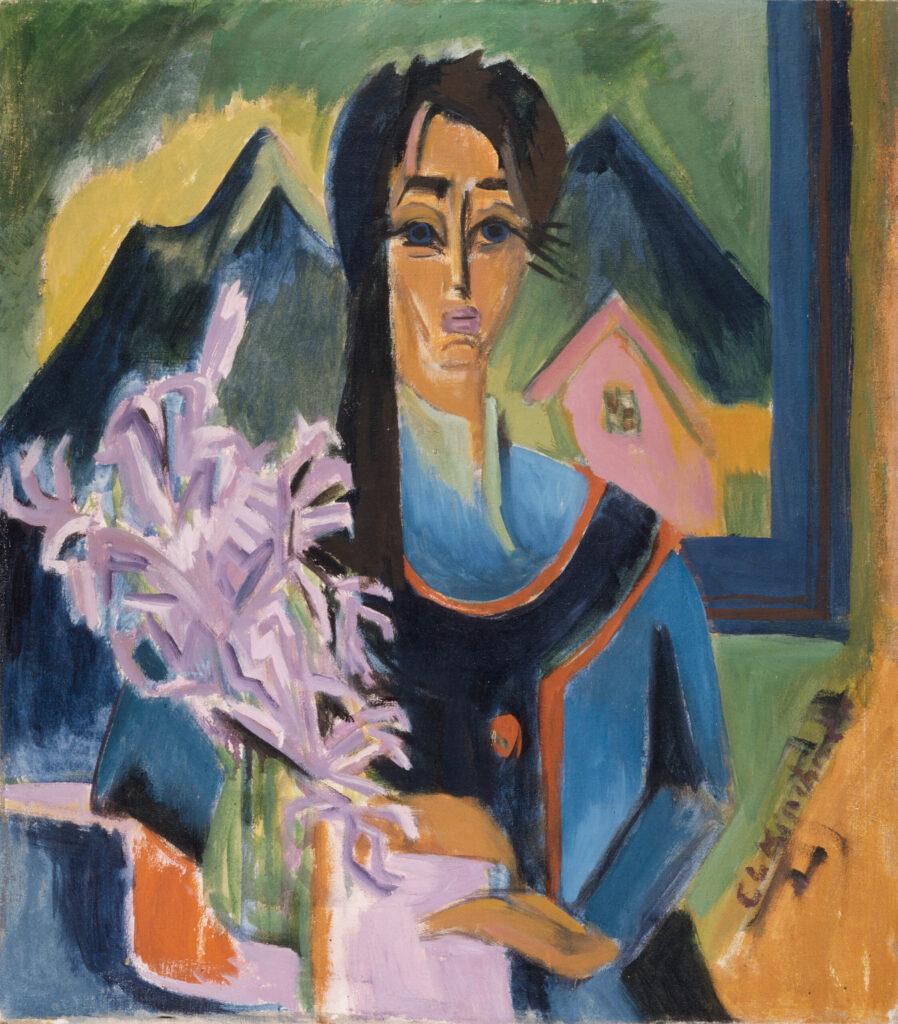
Davos, 1918. Far from the chaos of war, German artist Ernst Ludwig Kirchner finds renewed creative energy. Before his easel, he captures the essence of a young woman holding a bouquet of pink carnations, a fragment of tenderness in an upturned world.
A Portrait in Expressionist Colors
The hues vibrate on the canvas. The deep blue of the dress contrasts with the warm tones of the face with its stylized features. Kirchner simplifies forms, elongates the neck, geometrizes the face. The pink carnations burst forth on the left, an almost abstract floral mass. Behind Maryli, a mountain landscape takes shape: Alpine houses, angular peaks. The brushwork is lively, nervous. Flat areas of color juxtapose without concern for realism. This oil on canvas reveals the emotional intensity characteristic of German Expressionism.
Swiss Exile, Artistic Rebirth
In 1917, Ernst Ludwig Kirchner fled Germany, broken by the First World War. In Davos, he rebuilt his life and his art. The Alpine landscape now permeates his compositions. He also inspired young Swiss sculptors such as Hermann Scherer and Albert Müller. In this mountain refuge, Kirchner renewed his palette, sometimes softening his forms while preserving that expressive urgency that defined Die Brücke, the movement he co-founded in Dresden in 1905.
Ernst Ludwig Kirchner, Visionary Artist
Ernst Ludwig Kirchner (1880-1938) remains one of the pioneers of Expressionism. His work explores modern alienation, sensuality, and anxiety. In Davos, he painted peasants, landscapes, and portraits imbued with a rediscovered humanity.
Think about it
💭 When you meet Maryli’s gaze, what emotion do you perceive lingering in her eyes?
About this work
- Maryli (Young Woman with a Bouquet of Carnations)
- Ernst Ludwig Kirchner
- 1918-1919
- Oil on canvas
- 91.44 × 81.28 cm (36 × 32 in.)
- Los Angeles County Museum of Art (LACMA), Broad Contemporary Art Museum
- https://collections.lacma.org/node/233350
Die Brücke and the Origins of the Movement
Ernst Ludwig Kirchner (1880-1938) was one of the founders of Die Brücke (“The Bridge”), an Expressionist group formed in Dresden in 1905. The group, which also included Fritz Bleyl, Erich Heckel, and Karl Schmidt-Rottluff, represented a radical break with academic naturalism: non-naturalistic colours, deliberate distortion of forms, and emotional expressiveness prioritised over likeness. Die Brücke dissolved in 1913, but its influence on German and European art throughout the 20th century was immense. Maryli, painted in 1918-1919, is a work from Kirchner’s Alpine period, following his departure from Berlin for Davos in 1917, exhausted by the war and by serious health problems.
Davos: Renewal and Final Tragedy
Kirchner’s move to Davos in 1917 marked a profound transformation in his work. Contact with Alpine landscapes, mountain inhabitants, and a light radically different from that of the cities renewed both his palette and his subjects. Maryli belongs to this period of renewal: the angular peaks and houses in the background are characteristic of his treatment of the Alpine environment. But this Swiss refuge did not protect him from history: in 1937, the Nazis confiscated 639 of his works from German museums as part of the “Entartete Kunst” (Degenerate Art) exhibition. This symbolic destruction of his life’s work, combined with the annexation of Austria in 1938, drove him to suicide on 15 June 1938 in Davos. A museum dedicated to him now stands in that same city.
A Work at LACMA
Maryli is held at the Los Angeles County Museum of Art (LACMA), in the Broad Contemporary Art Museum section. LACMA possesses one of the most significant collections of German Expressionist art in the United States, the result in part of the emigration of works and collectors fleeing Nazism in the 1930s and 1940s. The presence of this painting in Los Angeles is therefore indirectly connected to the persecutions that Kirchner himself suffered. The work is catalogued under collection number 233350.