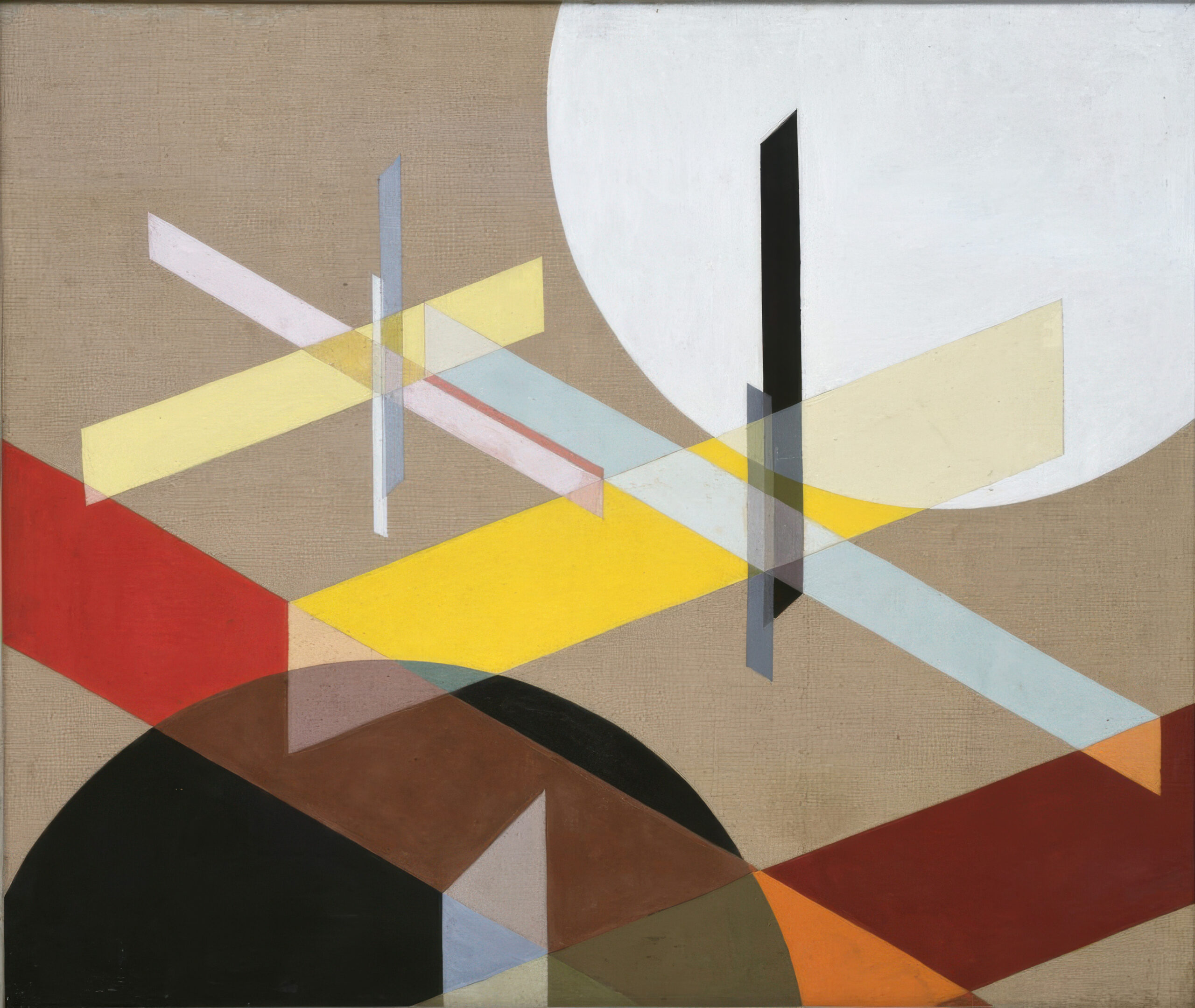
We are in the realm of pure abstraction here, though an abstraction with nothing cold about it. Standing before “Z VIII“, what strikes me first is the scale: a canvas large enough for the composition to breathe, letting the eye move freely from one form to another. Moholy-Nagy builds a play of tension between circles and rectangles that seem to float one above the other, suspended at different altitudes. A sense of depth achieved without any classical perspective, through overlap and layering alone. This is characteristic of his Berlin period: the same geometric rigour found in his photograms, transposed here into tempera, a technique that lends the colour a particular matte quality, almost powdery, quite unlike the sheen of oil paint.
What I admire in this painting is precisely this paradox: forms of an almost childlike simplicity, and yet a gaze that never quite settles, it slides, hesitates, returns. The colours, restrained and reduced to a handful of tones, make no attempt at immediate seduction; instead they establish a quiet, almost silent equilibrium, leaving the construction of form to speak for itself.
Seeing
Look at this yellow, translucent band cutting diagonally across the canvas. It crosses a vertical grey-blue blade, raised like an antenna. Further on, a white circle occupies the upper right corner, vast, almost filling the frame. A black pillar cuts through it, dark and upright. Below, two overlapping half-circles, one brown, one black, sit like two shadows cast one over the other. Red, orange, pale pink, washed-out blue: the colours accumulate without ever truly blending, like a snapshot taken just before everything shifts.
Understanding
In late 1921, Moholy-Nagy began exploring the spatial function of geometric forms in his paintings. Settled in Berlin since the winter of 1919-1920, he remained deeply influenced by ideas circulating around the Hungarian journal Ma. Its founder, Lajos Kassák, wrote in 1922 that art was not concerned with “the image of the world” but with its architecture. Moholy-Nagy applied this idea to painting: abstract forms build autonomous constructions against a neutral ground. He also drew on the utopian vision of a glass architecture flooded with light, imagined by Paul Scheerbart. The forms in “Z VIII“, drawn with ruler and compass, appear to emerge into real space from the unprimed canvas. Painted in tempera, the surface retains a matteness that heightens this sense of weightlessness. The critic Ernő Kállai described it in 1924 as an “unhindered floating.” Hungarian-born, Moholy-Nagy would soon teach at the Bauhaus, alongside Kandinsky and Klee. There he developed a way of thinking about light that would extend beyond painting, into film and photography.
Feeling
Before “Z VIII”, the eye never comes to rest. It jumps from one plane to another, searching for an anchor it never quite finds. This instability is not a flaw, it is the very programme of the work. Moholy-Nagy constructs a space that moves without ever moving, a century before screens. Stand before the canvas for a few minutes. Let the forms rearrange themselves under your gaze, without forcing them.
Current exhibitions
In the summer of 2026, the Neue Nationalgalerie in Berlin, home to “Z VIII”, continues an especially rich programme centred on early twentieth-century art. Through 9 August 2026, the museum hosts a Constantin Brancusi retrospective organised with the Centre Pompidou, while “Ruin and Rush – Berlin 1910-1930” (25 April 2026 – 3 January 2027) revisits the artistic ferment of the German capital during the Weimar Republic, the direct historical context for the creation of “Z VIII“. In autumn 2026, a further exhibition devoted to “degenerate art”, the category under which the Berlin avant-garde, Moholy-Nagy included, was banned by the Nazi regime — will complete this programme.
Source: museumsportal-berlin.de
A question for you
💭 Kassák called it “pictorial architecture.” But an architecture with no weight, no ground, no load-bearing wall, is it still architecture, or something else entirely?
About this work
- Z VIII
- László Moholy-Nagy
- 1924
- Tempera on canvas
- 114 x 132 cm
- Neue Nationalgalerie, Berlin
- https://recherche.smb.museum/detail/964847/z-viii