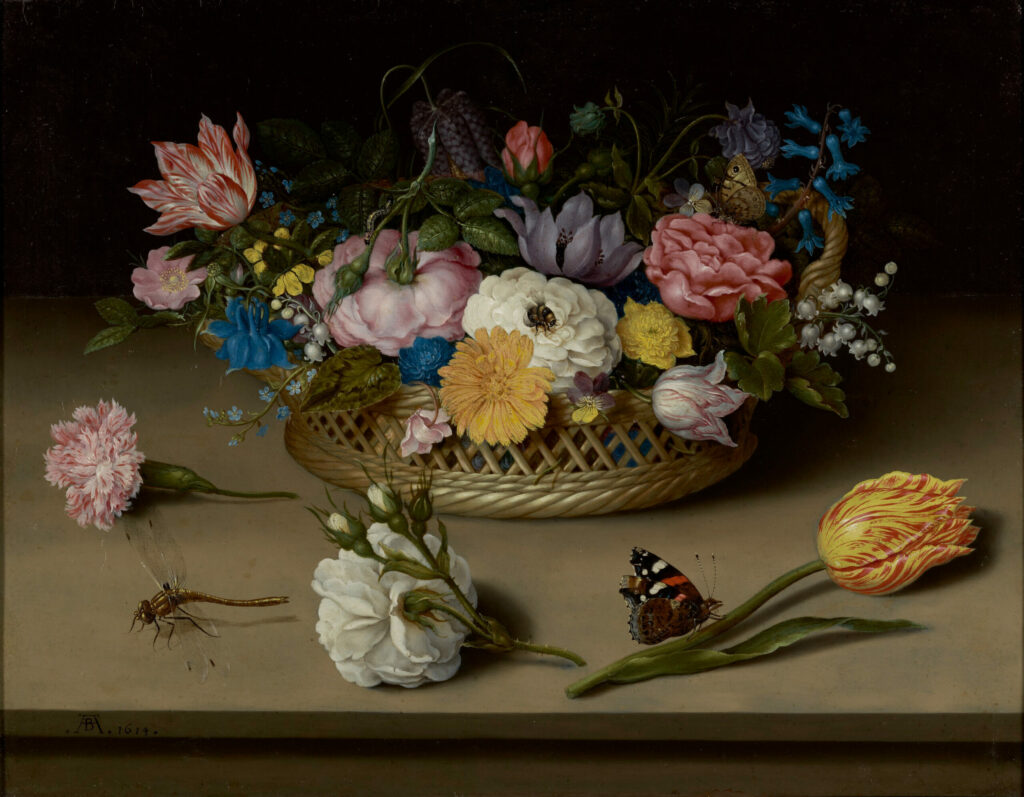
Netherlands, 1614. Ambrosius Bosschaert the Elder composes an impossible bouquet. In his studio, he paints flowers that never bloom together: spring tulips, summer roses, autumn cyclamens. Time is suspended.
An Orchestrated Profusion
A woven basket overflows with colors. Tulips striped with red and yellow, tender roses, delicate lily of the valley, purple hyacinths, and azure forget-me-nots intertwine in skillful balance. Three flowers in the foreground guide the eye. Bosschaert works in oil on copper, a smooth surface that allows microscopic precision. Each petal reveals its silky texture. Buds open with palpable fragility. A dragonfly with translucent wings alights, a Red Admiral butterfly deploys its finely detailed antennae. Insects inhabit this painted garden with the same attention as the plants.
The Golden Age of Flowers
At the dawn of the 17th century, the Dutch Republic experienced an unprecedented botanical fever. Tulips from the East were worth fortunes. Botanists catalogued, collectors competed for rare species. Bosschaert responded to this passion by creating eternal bouquets, defying seasons and death. For these flowers inevitably fade. The still life becomes a discreet memento mori: beauty and fragility intertwine.
Bosschaert the Elder, the Founding Master
Ambrosius Bosschaert the Elder (1573-1621) inaugurated the great Dutch tradition of floral painting. Born in Antwerp, a refugee in Middelburg, he passed his art to his three sons. His goldsmith’s precision and architectural compositions established a model for an entire generation of specialized painters.
Think about it
💭 Faced with this meticulously orchestrated bouquet, which flower first catches your eye?
About This Work
- Flower Still Life
- Ambrosius Bosschaert the Elder
- 1614
- Oil on copper
- 30.5 × 38.9 cm
- J. Paul Getty Museum, Los Angeles
- https://www.getty.edu/art/collection/object/103RFM
Middelburg, Botanical Fever, and the Birth of a Genre
Floral Still Life was painted at the heart of one of the most fascinating periods in European economic and cultural history: the Dutch obsession with exotic flowers, and tulips in particular, that would culminate in the “tulip mania” of the 1630s. Ambrosius Bosschaert the Elder (1573-1621) was one of the founding figures of this specifically Dutch genre of floral still life. Born in Antwerp, he settled in Middelburg in 1587 to escape religious persecution, joined the Guild of Saint Luke, and later became its dean. It was in this Zeeland port, a hub for the spice and exotic plant trade with the East Indies, that he developed his style: bouquets of almost architectural symmetry, painted on copper for maximum precision, in which each flower is treated as a botanical portrait.
The Impossible Bouquet: Artifice as Programme
What distinguishes Bosschaert from his contemporaries is a deliberate awareness of artifice. The bouquet in this 1614 still life assembles species that never bloom simultaneously in nature: spring tulips alongside summer roses and autumn cyclamens. This “impossible bouquet” is not a botanical error, it is a pictorial declaration. Bosschaert suspends time and abolishes seasons to offer his patron a synthesis of all floral beauty in a single gaze. The dragonfly with translucent wings and the meticulously rendered Red Admiral butterfly add a vanitas dimension to the composition: these fragile insects, like cut flowers, do not last. The work is today at the Getty Museum, which also holds paintings by his sons Ambrosius II, Johannes, and Abraham, themselves flower painters, testifying to the true artistic dynasty that Bosschaert founded.
Copper as the Support of Precision
The choice of copper as support is not a technical detail: it is an aesthetic decision. The smooth surface of the metal, unlike canvas or wood panel, presents no visible grain that might break the illusion. Paint can be applied with an almost miniaturist precision, glazes layer without bleeding, and the luminosity of the underlying metal gives colours a depth and vibration that other supports cannot achieve. It is on this perfect surface that Bosschaert builds the silky texture of petals, the translucency of the dragonfly’s wings, and the grain of the leaves, technical virtuosity in the service of a beauty that only art can render eternal.