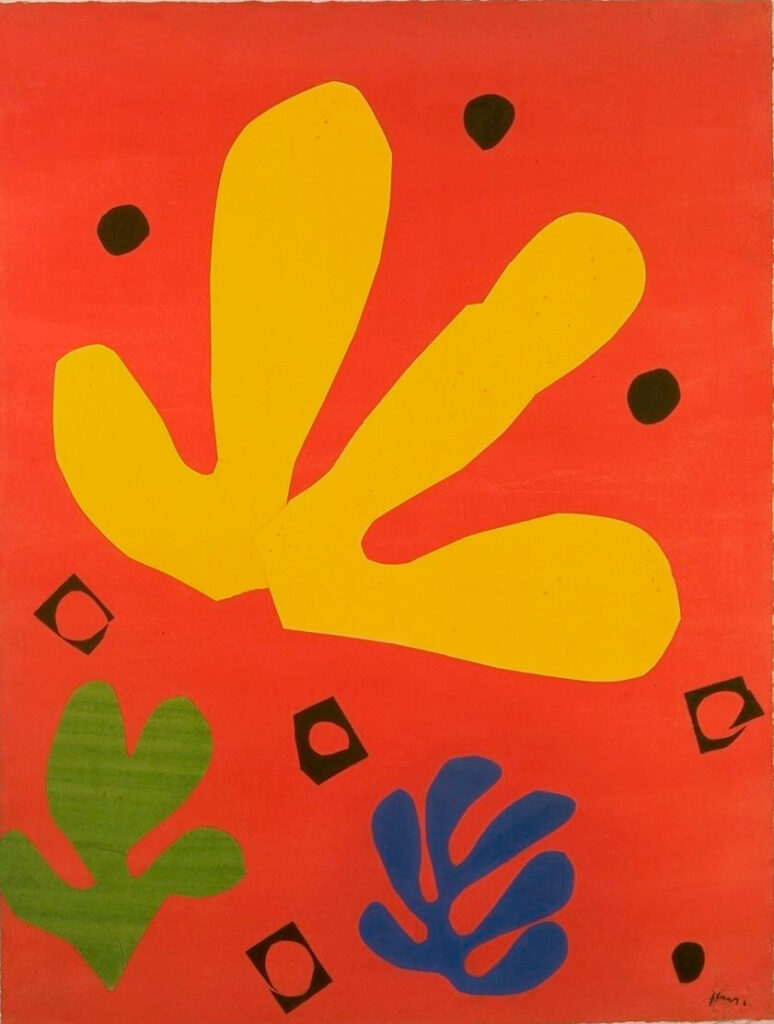
1947. Henri Matisse, bedridden after major surgery, invents a new way to create. Too weak to paint standing up, he cuts shapes from gouache-painted paper and composes directly with scissors. This artistic revolution gives birth to Éléments végétaux (Plant Elements), an explosion of pure color and liberated forms.
The Dance of Cut-Out Forms
Against a vibrant red-orange background, three stylized plant forms seem to float in space. A large yellow leaf dominates the composition, its rounded lobes evoking an open hand or giant seaweed. Below, a green form and a blue one respond to this upward movement. Circles punctuate the whole, creating a visual choreography. The gouache applied to paper before cutting gives the colors a matte, almost tactile intensity. Matisse no longer draws: he sculpts color with scissors, eliminating everything that is not essential. Each form breathes, stretches, dances.
The Invention of Paper Cut-Outs
This technique was born from a constraint that became freedom. After his surgery in 1941, Matisse transformed his disability into radical innovation. The cut-out gouache papers allowed him to “draw in color,” as he himself put it. Éléments végétaux embodies this period when the artist achieved a perfect synthesis between drawing and painting.
Matisse, the Master of Fauvism Reinvented
Henri Matisse (1869-1954) revolutionized painting in 1905 with Fauvism. He then explored decorative arabesques and the human figure before arriving at this ultimate simplification. The paper cut-outs mark the culmination of his quest for pure expression, stripped of all anecdote.
A Question for You
💭 Can pure color, freed from drawing, express what words cannot say?
About This Work
- Éléments végétaux
- Henri Matisse
- 1947
- Gouache cut-out on canvas
- 65 × 50 cm
- Staatliche Museen zu Berlin, Berggruen Museum
- https://recherche.smb.museum/detail/966784/%C3%A9l%C3%A9ments-v%C3%A9g%C3%A9taux