Paris, 1738. In Jean-Marc Nattier’s studio, a young woman takes her pose. For a few hours, she is a water nymph.
A grace suspended in light
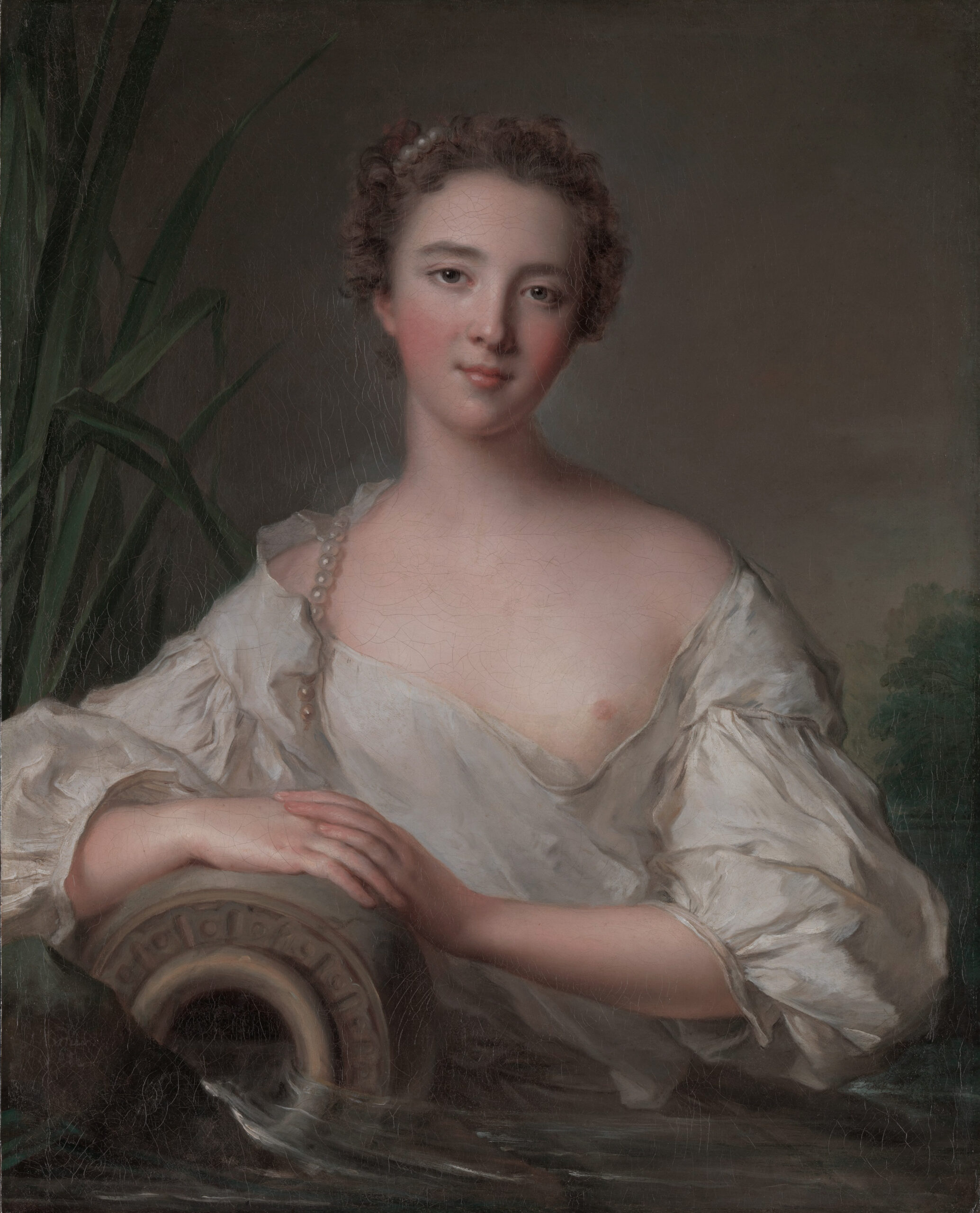
The figure emerges from a grey-brown background, almost weightless. Her white silk chemise slips from her shoulder, light as a breath. The painter works in fluid, almost aerial strokes. The complexion is pearlescent, the cheeks tinged with a powdery softness. Look at her hand: it barely grazes an antique urn adorned with meander motifs, from which water flows. The green reeds to the left anchor the scene in an imagined aquatic setting. Light caresses the neck, the shoulder, the forearms, everything converges toward that calm face, turned slightly, meeting your gaze with quiet assurance.
A nymph for the art market
In the eighteenth century, mythology offered painters a precious freedom. Depicting a woman as a nymph or antique water source allowed them to unite sensuality with classical culture. Nattier excelled at this. The identity of the model remains mysterious: long attributed to Louise Henriette de Bourbon-Conti, this attribution is now disputed. The free brushwork and seductive composition suggest a work destined for the private market, painted to please, to circulate, to captivate a discerning collector.
Jean-Marc Nattier (1685–1766)
Nattier established himself as the favourite portraitist of the ladies of Louis XV’s court. He invented a hybrid genre: the portrait as goddess or allegory. His Rococo painting unites formal elegance with luminous sensitivity. La Source is a perfect illustration of both.
A question for you
💭 This work raises a question that remains entirely relevant today: do commissioned art and market-driven art follow the same rules of creation?
About this work
- The Spring (La Source)
- Jean-Marc Nattier
- 1738
- Oil on canvas
- 80.6 × 65.1 cm
- The Metropolitan Museum of Art, New York
- https://www.metmuseum.org/art/collection/search/437184
Portrait as Mythology: Nattier and the Art of Disguise
La Source is a near-perfect example of the genre Jean-Marc Nattier (Paris, 1685 – Paris, 1766) brought to its highest point at the court of Louis XV: the portrait en déesse, or mythological portrait. A woman is shown as a water nymph, her white silk chemise slipping from one shoulder, her hand resting on an antique urn decorated with meander motifs from which water flows. The sitter’s identity remains disputed, an earlier attribution proposed Louise Henriette de Bourbon-Conti, but this has not been definitively established by modern scholarship.
Nattier at the Court of Versailles
The son of a portraitist and grandson of an engraver, Nattier built his entire career in the service of the French aristocracy. His recognizable style, luminous flesh tones, draperies in the antique manner, softly blued landscape backgrounds, came to define the aesthetic of the female portrait under Louis XV. La Source offers a characteristic example: the figure is simultaneously a specific social identity and a poetic embodiment of nature, a real woman and a water goddess. This blend of realism and mythological fiction answered a deep desire of court society to see itself reflected in a dignity that transcended mere rank to reach something timelessly classical. The genre Nattier perfected had precedents in earlier court portraiture, but no other painter of his era managed its conventions with such consistent ease and pictorial intelligence.
The Metropolitan Museum’s Collection
The Metropolitan holds several works by Nattier that allow one to trace the consistency of his mastery across his career. La Source, dated 1738, belongs to the height of his maturity, when aristocratic commissions arrived in steady succession and his standing at court was at its peak. The composition’s remarkable economy, a few well-chosen elements build an entire world, reflects a formal refinement that places Nattier at the summit of the French allegorical portrait tradition. Displayed alongside other French eighteenth-century paintings, this canvas demonstrates why he remains the essential reference for the mythological portrait in the age of the Ancien Régime, and why his work has reclaimed critical esteem after a long period of relative neglect.