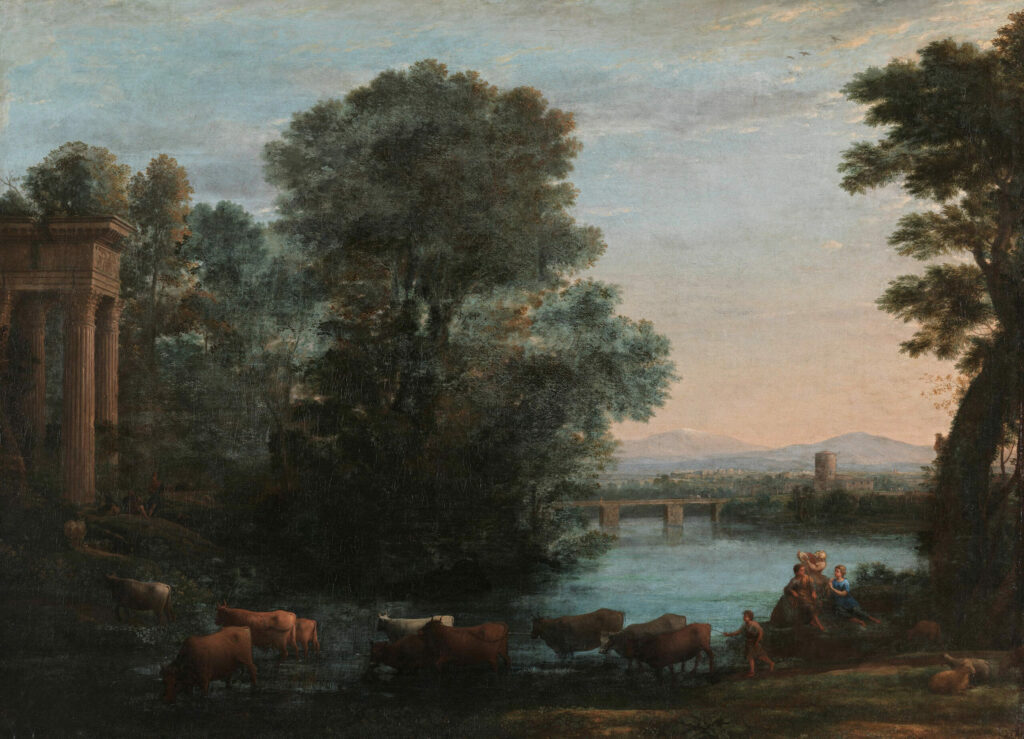
Rome, 1670. Franz von Mayer, a Bavarian privy councillor, commissions from the most celebrated artist in Europe a series of three landscapes. Claude Lorrain accepts. He begins with this one.
Light as Raw Material
The eye glides naturally toward the horizon. There, behind bluish mountains, the sun gently sets. The sky shifts from cool blue to a pearlescent pink, almost tangible. In the foreground, a herd of cattle crosses a ford. To the right, pastoral figures rest, indifferent to the grandeur of the moment. To the left, antique columns emerge from the vegetation. Lorrain paints in glazes: translucent layers laid one upon another create an incomparable luminous depth. Each plane recedes toward infinity with mathematical precision.
One Commission, Three Masterpieces
This canvas inaugurates a prestigious triptych. Von Mayer soon owned three landscapes by the Lorrain master. The second, A Harbour at Sunrise, is also held today in Munich. The third is in London, at the Dulwich Picture Gallery. The work draws directly from an etching Lorrain made in 1636 — proof that the artist revisited his own compositions. At the height of the European Baroque, this idealised landscape embodies the aristocratic taste for antique Arcadia: a harmonious and serene world.
Claude Gellée, known as Le Lorrain
Born in Lorraine, Claude Gellée (c. 1600–1682) settled permanently in Rome at the age of twenty. He invented the ideal classical landscape: raking light, antique architecture, sublimated nature. His influence on Turner, Corot, and the whole of European landscape painting remains immense.
Think about it
💭 As you look at this evening light on the water, what memory of a day’s end does this painting bring to the surface?
About this work
- Idyllic Landscape at Sunset
- Claude Lorrain (Claude Gellée)
- 1670
- Oil on canvas
- 72 × 96 cm
- Alte Pinakothek, Bayerische Staatsgemäldesammlungen, Munich
- https://www.sammlung.pinakothek.de/de/artwork/ZKGPJP2xgA/claude-lorrain-claude-gellee/idyllische-landschaft-bei-untergehender-sonne