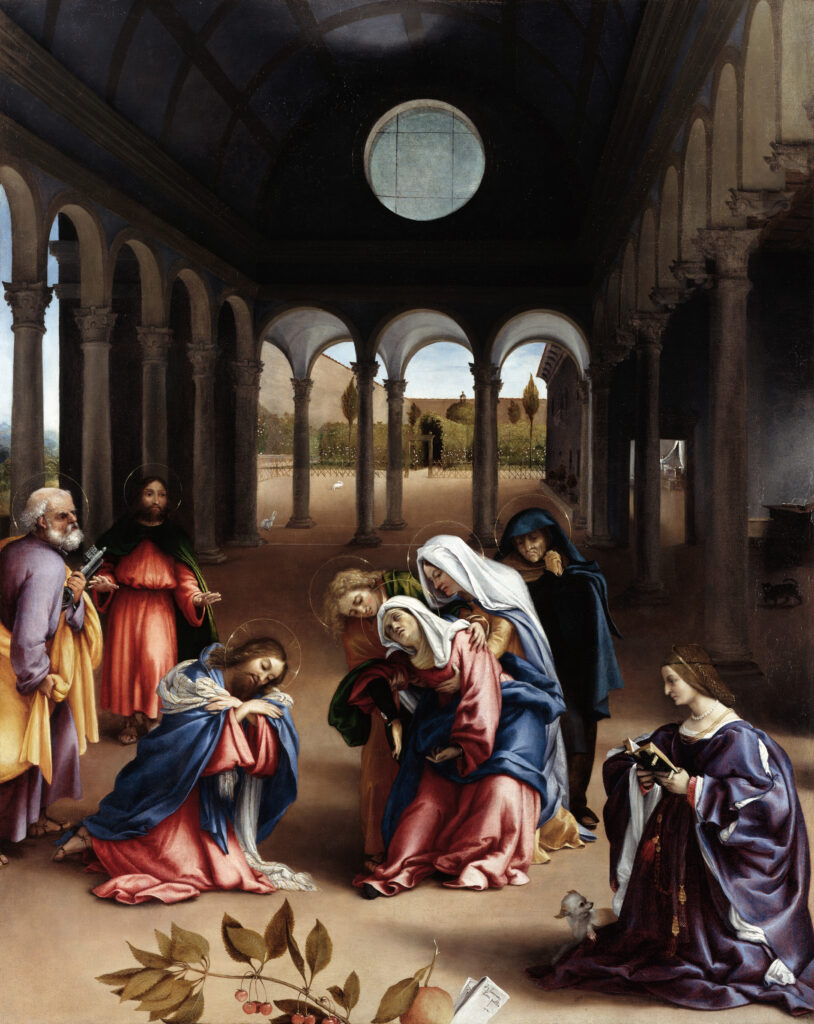
Bergamo, 1521. Lorenzo Lotto captures a suspended moment: Wednesday evening of Holy Week, at Bethany, Christ kneels before his mother before the Passion. A moment of overwhelming intimacy.
A Scene of Intimate Devotion
Observe this theatrical composition. Christ, kneeling, arms crossed, asks for his mother’s blessing. Mary collapses in the arms of John and Mary Magdalene. Peter and another apostle witness the scene. Lotto deploys a sumptuous chromatic palette. The painting reveals a fluid and expressive touch. In the foreground, a branch of cherries and an orange function as repoussoir, symbols of redemptive blood and Paradise. On the right, the kneeling female donor, accompanied by a small dog, piously contemplates the scene.
Architecture as Spiritual Metaphor
The action unfolds beneath a barrel vault supported by columns, evoking the courtyards of Bergamo palaces. On the left, the landscape opens onto the Lombard countryside. In the background appears a garden enclosed by high walls with a cruciform pergola. This symbolic architecture structures the pictorial space while bearing profound meaning. The theme, popularized by the Meditations of Pseudo-Bonaventure and the mysteries of the Passion, remains relatively rare in Italian Renaissance painting.
Lorenzo Lotto
Established in Bergamo between 1513 and 1525, Lorenzo Lotto (circa 1480-1556) developed a singular style blending Northern and Italian influences. He borrowed from Correggio the kneeling posture of Christ, while integrating the lessons of Raphael and Leonardo da Vinci. His psychological sensitivity distinguishes his religious works.
Think about it
💭 Why did the artist choose to place cherries and an orange in the foreground of this farewell scene?
About This Work
- Christ Taking Leave of His Mother
- Lorenzo Lotto
- 1521
- Painting on canvas
- 127.4 × 102 cm
- Gemäldegalerie, Staatliche Museen zu Berlin
- https://recherche.smb.museum/detail/867120/christi-abschied-von-seiner-mutter
The Eve of the Passion: An Image of Parting
Christ Taking Leave of His Mother is one of the most emotionally powerful works by Lorenzo Lotto (Venice, c. 1480 – Loreto, 1556), painted during his Bergamo period between 1513 and 1525, one of the most fertile phases of his long itinerant career. The canvas represents a moment not found in the canonical Gospels but attested in popular devotion and medieval spiritual literature: Christ’s farewell to his mother on the eve of the Passion. Christ kneels before Mary, who collapses into the arms of Saint John and Mary Magdalene; Peter and another apostle are also present, alongside a kneeling donor accompanied by a small dog. In the foreground, cherries and an orange, symbolic fruits associated with redemptive blood and Paradise, are arranged with clear allegorical intent.
Composition and Sources
The kneeling pose of Christ has been linked to compositional solutions developed by Correggio at the same period, reflecting the active exchanges between the artistic centers of northern Italy in the early sixteenth century. The barrel-vaulted architecture in the background and the cruciform pergola, a barely-disguised symbolic reference to the Passion to come, inscribe the scene in a space that visually anticipates Christ’s fate. The Lombard landscape opening behind the architecture contrasts with the emotional density of the foreground, providing spatial breathing room that concentrates the grief of the figures by contrast.
Lotto in Bergamo
Lotto was a wandering painter who never settled permanently in Venice despite his Venetian origins. His Bergamo years produced some of his most original work, characterized by a psychological expressiveness and a palette of sharp, luminous colors that set him clearly apart from his Venetian contemporaries. The Gemäldegalerie in Berlin holds this canvas as one of the most significant works of the Italian High Renaissance in its collection. It is a painting that asks to be stood before at some length: the range of emotional states Lotto captures across the figures, grief, composure, bewilderment, the quiet dignity of the donor at the margin, makes it as much a study of how humans respond to anticipated loss as a devotional image in the traditional sense. Few painters of the sixteenth century could match Lotto’s ability to individualize suffering, and this canvas is among his most achieved demonstrations of that rare gift.