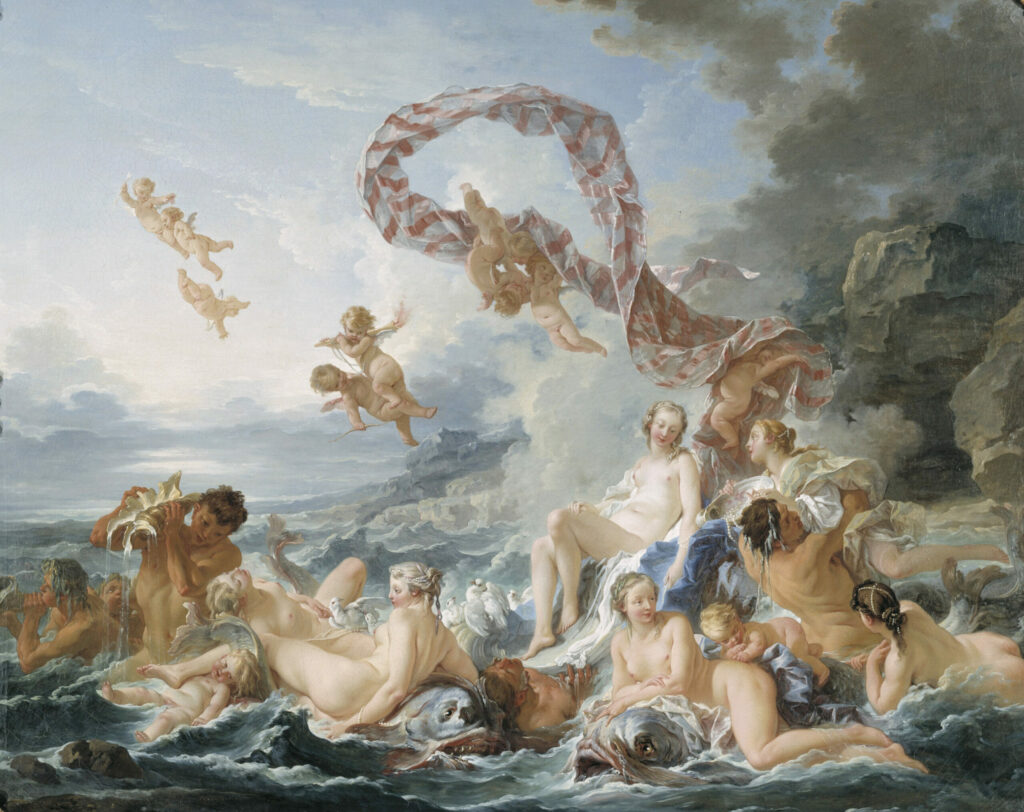
Paris, 1740. François Boucher must create a mythological scene for Carl Gustaf Tessin, Swedish diplomat and passionate collector. The painter to Louis XV takes up his brush and, with remarkable audacity, composes this celebration without multiplying preparatory sketches.
A Symphony of Flesh and Foam
Venus reigns, surrounded by a whirlwind of bodies. Naiads with milky flesh entwine with muscular tritons. Fish leap from the waves. Cupids flutter in the air, holding a pink veil that ripples in the sea wind. Boucher paints with a lively, light touch. His palette mingles pale blues, pearly pinks, and luminous golds. Bodies intertwine in a movement that guides the eye toward the goddess. The pictorial matter is fluid. Observe how the flesh seems to pulse under the light.
Rococo at Its Pinnacle
This oil on canvas illustrates the triumph of French Rococo. At Versailles, Louis XV reigns and Boucher embodies the taste of his time. The aristocracy seeks graceful sensuality, the pleasure of the senses sublimated. This painting transposes the ancient myth of Venus’s birth into a gallant and voluptuous celebration. In 1749, Tessin must sell his collection. The Swedish royal family acquires this work, which travels to Stockholm. In 1866, the Nationalmuseum welcomes this masterpiece into its collections.
François Boucher, Painter of Desire
First Painter to the King, Boucher (1703-1770) dominated the French artistic scene. He excelled in mythological scenes where sensuality expresses itself without restraint. His technical virtuosity and fertile imagination made him the undisputed master of Rococo.
Think about it
💭 What if Venus emerged today from our screens rather than from sea foam? How would you represent the triumph of love in our era?
About This Work
- The Triumph of Venus
- François Boucher
- 1740
- Oil on canvas
- 130 × 162 cm
- Nationalmuseum, Stockholm
- https://collection.nationalmuseum.se/en/collection/item/17773/
Carl Gustaf Tessin and the Road to Stockholm
The Triumph of Venus was not commissioned by a French patron but acquired directly from Boucher’s studio by Carl Gustaf Tessin (1695-1770), diplomat, art collector, and Swedish ambassador to Paris. Tessin was one of the greatest collectors in Europe of his time, assembling in Paris an exceptional collection of 18th-century French paintings and drawings, including several works by Boucher. Faced with serious financial difficulties, he was forced to sell his collection in 1749: this is how the painting entered the Swedish royal collection. The royal collection was subsequently transferred to the Royal Museum in 1865, before being integrated into the Nationalmuseum in Stockholm in 1866. The work is held there under inventory number NM 770.
Boucher, First Painter to the King
François Boucher (1703-1770) reached the pinnacle of official recognition in France when he was appointed Premier Peintre du Roi (First Painter to the King) in 1765, the highest distinction in the kingdom’s artistic hierarchy. In 1740, when this painting was made, he was already at the heart of Parisian artistic life and enjoyed the support of the court of Louis XV. His studio was one of the most active and most copied of his era. A detail documented by the Nationalmuseum: despite the complexity and elaboration of the composition of The Triumph of Venus, Boucher executed this work with remarkably few preliminary sketches, a testament to a compositional mastery that no longer required the support of preparatory drawing.
Rococo and the Gallant Mythology
The Triumph of Venus illustrates what the Rococo style does with ancient mythology: not a moral lesson or a heroic narrative, but an occasion to deploy grace, sensuality, and pictorial virtuosity within a legitimate framework. The palette of cold blues and pearly pinks, the intertwined bodies of naiads and tritons, and the fluttering cupids with their pink veil all respond to an aristocratic taste that valued visual pleasure and formal elegance above all else. This painting is representative of a precise moment in the history of French art, when history painting and mythology placed themselves entirely at the service of sensory delight.