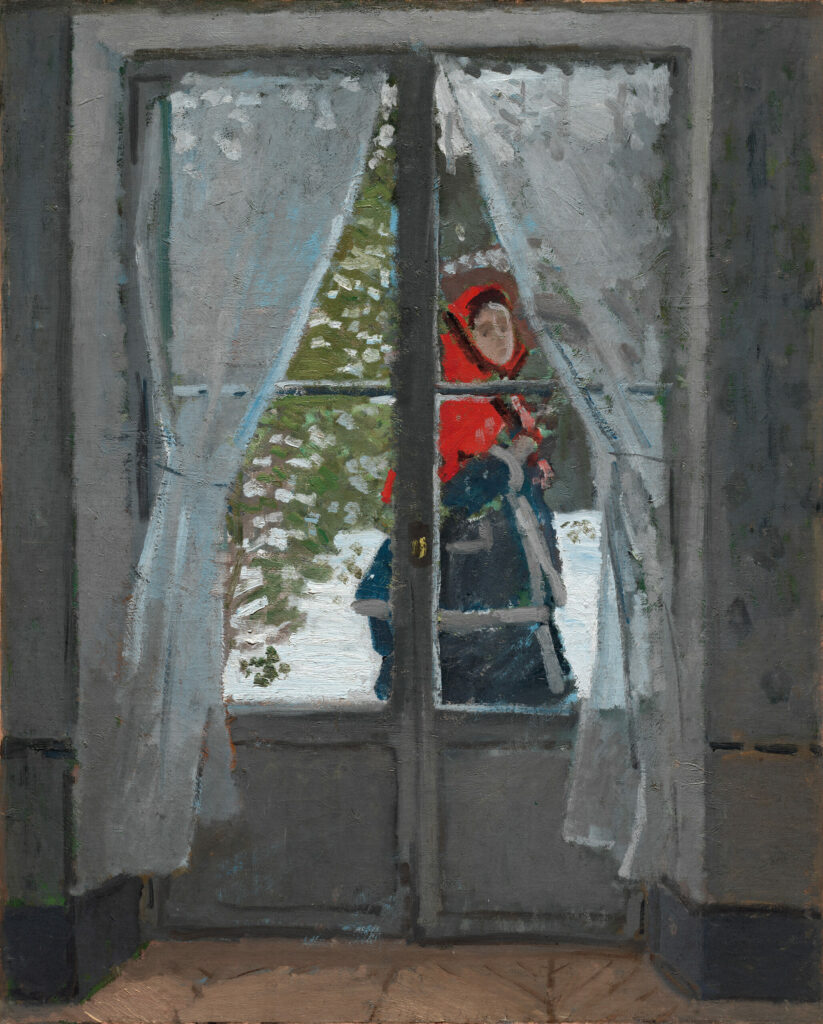
Circa 1868-1873. Camille crosses the snow-covered garden and passes before the French window. Claude Monet seizes the instant. Her red kerchief blazes in the white of winter.
A Silhouette in Light
Observe this vibrant scarlet patch. Camille’s red kerchief cuts through the immaculate snow of the garden. Her face is merely a sketch, a few quick touches of pink and ochre paint. Monet applies color in broad, fragmented brushstrokes. The snowflakes are pure white touches, almost brutal. The trees are reduced to green and gray streaks. The French window frames the scene like a painting within the painting. The white curtains undulate, suggesting movement and cold. This bold Impressionist technique captures the ephemeral: a moment of domestic life seized in a few minutes.
The Intimacy of Argenteuil
This oil on canvas testifies to a happy period for Claude Monet. He paints his wife and his daily life. The garden becomes his pictorial laboratory. Impressionism was born precisely from these experiments with winter light. Monet rejects academic details in favor of pure visual impression. He paints what the eye actually perceives: patches of color that, at a distance, reconstitute reality. This revolutionary approach would shock the Salon but open the way to modernity.
Monet, Painter of the Instant
Claude Monet (1840-1926), trained by Boudin and Jongkind, became the leader of Impressionism. From La Grenouillère to the Water Lilies at Giverny, he devoted his life to capturing variations of light. Here, Camille is his favorite model, the one who embodies the spontaneity of his new art.
Think about it
💭 Do you see in this pictorial audacity the founding gesture that would later authorize Cézanne, Matisse, or Kandinsky to challenge conventions even further?
About this Work
- The Red Kerchief
- Claude Monet
- circa 1868-1873
- Oil on canvas
- 99 × 79.8 cm
- Cleveland Museum of Art
- https://www.clevelandart.org/art/1958.39
Camille through the Glass: An Image of the Ephemeral
The Red Kerchief is one of the most intimate and singular paintings in Claude Monet’s career: his first wife, Camille Doncieux (1847-1879), passes before the French doors of their home in Argenteuil on a snowy day, her red kerchief becoming the sole warm point in a world of whites and greys. The composition is radically modern: the window frame divides the surface like the edge of a photograph, Camille is glimpsed through the glass, almost blurred, her face reduced to a few touches of pink and ochre applied with a speed that is itself the painting’s subject. Monet does not paint Camille, he paints the fleeting impression of a presence passing by. In a biographical fact that is rare for so prolific a seller, he kept this painting for his entire life, never resolving to part with it.
Argenteuil as Pictorial Laboratory
The broad date range of the painting (c. 1868-1873) reflects an uncertainty that is itself revealing: Monet was experimenting so rapidly during this period that dating his works to within a few years is often difficult. The Argenteuil period (1871-1878) is the heart of this laboratory: it is there that Monet refined his technique of pure, fragmented colour “patches,” that his garden became a space of visual repetition, that he observed tirelessly the effects of light at different times on the same motifs. The Red Kerchief anticipates this serial method: the window frames the motif, the glass introduces a distance and a slight optical distortion, and the white snow offers a neutral ground on which colour can assert its full independence. The Cleveland Museum acquired the painting in 1958 through the bequest of Leonard C. Hanna Jr., one of the great patrons of European art in the United States.