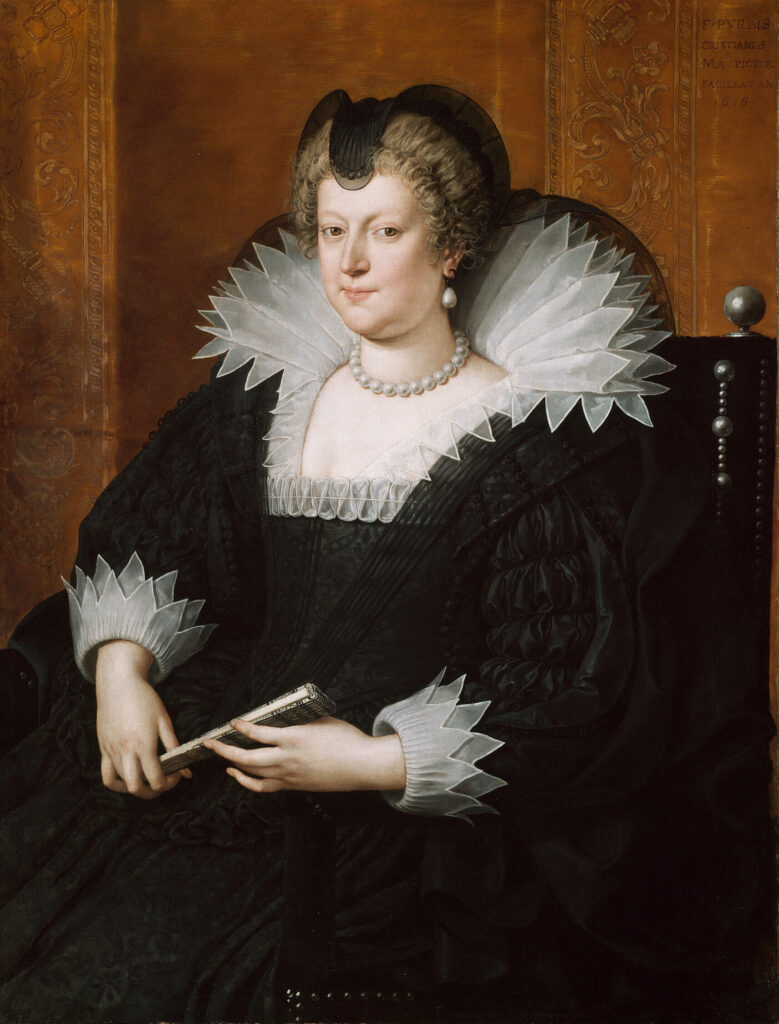
This is not the portrait of a woman. It is the portrait of a claim to power. In 1616, Marie de’ Medici, Florentine, widow of Henri IV (assassinated six years earlier), regent and then de facto ruler in the name of her young son Louis XIII, has herself depicted as an untouchable icon. And she needs to: a woman and a foreigner, a Medici among the Bourbons, she holds a power that Salic law says a woman should not hold.
So every detail is an argument. The black is not only mourning: it is gravity, the weight of legitimacy. Pourbus, the Flemish portraitist she brought to France for exactly this, builds a fortress of satin and lace around her, rendered with a goldsmith’s precision. The details speak for themselves: the pearls, the pleated ruff rising like architecture, the fan, the silver-studded chair. This is not vanity: it is a machine for manufacturing authority. And like any image of propaganda, it comes in editions. Pourbus and his workshop painted several versions of it, Queen Marie de’ Medici turned now to the right and now to the left, made to be circulated. A few years later she will aim higher still, with the twenty-four canvases of Rubens’s Marie de’ Medici Cycle, her entire life turned into myth.
And yet. Look at the face, above the armor of pearls: it does not triumph. It is closed, a little weary, alone. That is where the canvas reaches us, through what the magnificence cannot quite hide: precariousness. We are in 1616, very near the summit, and the very next year her own son will have her favorite murdered and exile her to Blois. The queen most heavily armored in images will end in exile, in Cologne, with almost nothing. We are watching someone armor themselves in power just before losing everything.
Five years earlier, Pourbus had painted the other piece of the same game: Louis XIII, the ten-year-old boy-king, in ceremonial dress as well. Mother and son, two images for a single legitimacy, the one she wields in his name.
A question for you
Behind the armor of pearls, is it power that Pourbus shows us, or already its fragility?
Further information
- Marie de’ Medici, in 1616, by Frans Pourbus the Younger
- 99.7 × 77.5 cm (39 1/4 × 30 1/2 in.)
- The Art Institute of Chicago, displayed in European Painting and Sculpture, Gallery 208
- https://www.artic.edu/artworks/78591/marie-de-medici