Paris, 1767. Lagrenée stages a silent betrayal. Three figures, a room hung with dark drapery, and a jealousy that will destroy everything.
Beauty before the fall
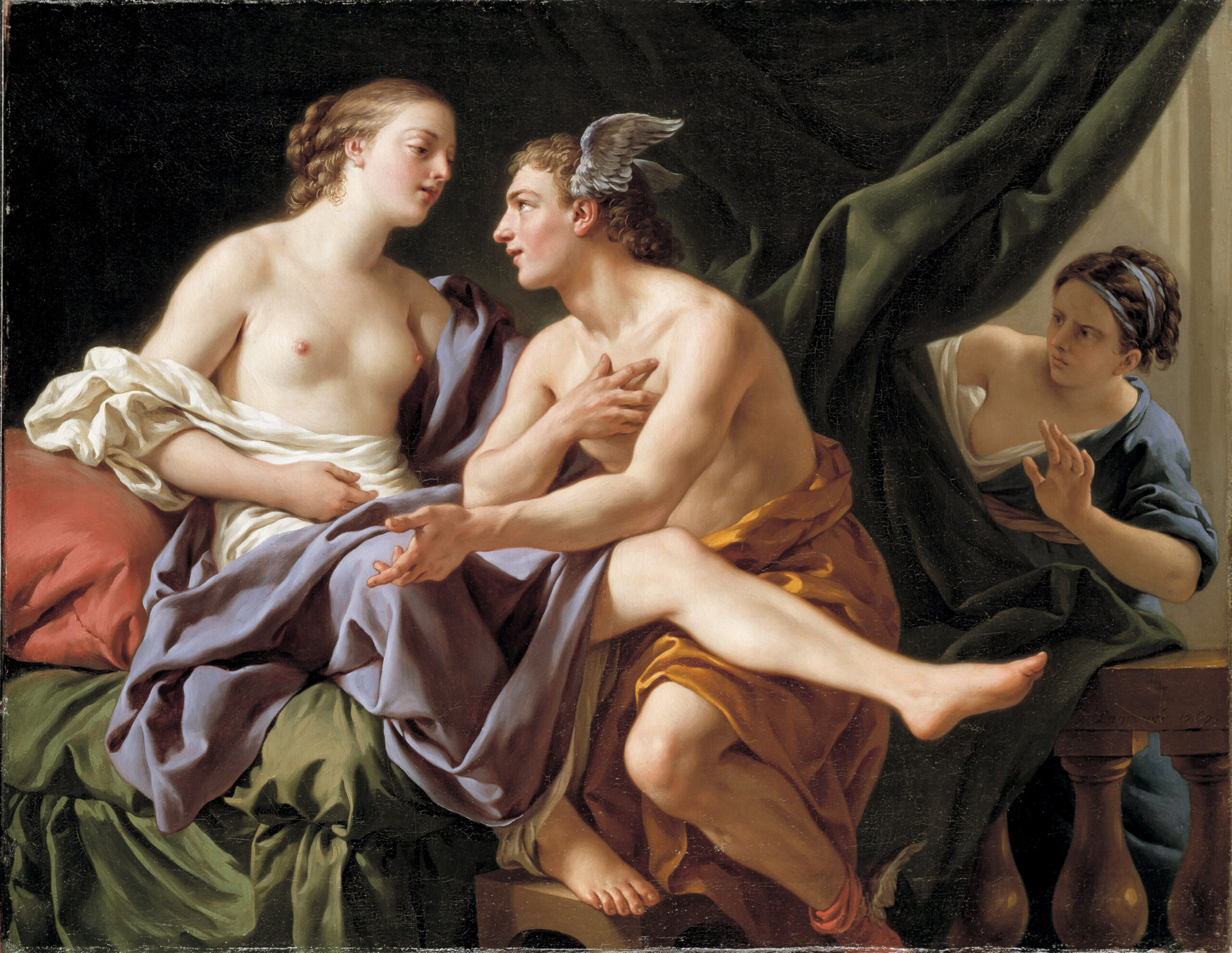
At the centre, Mercury, recognisable by the silver wings on his helmet, leans toward Herse with restrained ardour. Herse, half-draped, meets his gaze with a soft expression. Now look at the third figure: Aglauros, lurking to the right, one hand raised in a gesture of warning. Her expression is dark, closed off. Lagrenée works with a warm, luminous palette typical of late Rococo. The flesh tones are rendered in the manner of Boucher, pearlescent, almost translucent. The draperies structure the composition throughout.
A jealousy carved in stone
The myth comes from Ovid’s Metamorphoses. Mercury, enamoured of Herse, has bribed Aglauros to gain access to her sister. But Minerva, angered, sows a consuming jealousy into Aglauros’s heart. She blocks the entrance and refuses him passage. Mercury then turns her to black stone, darkened by envy. Lagrenée paints the precise moment of confrontation, just before the metamorphosis. In 1767, the painting was exhibited at the Paris Salon, before entering the collection of Gustaf Philip Creutz, Swedish ambassador to France, and eventually joining the Nationalmuseum in Stockholm.
Lagrenée the Elder
Louis-Jean-François Lagrenée the Elder (1725–1805) trained at the Académie royale de peinture et de sculpture. First Painter to the Tsar in Saint Petersburg, he embodies the transition between Rococo and Neoclassicism. His mastery of mythological subjects made him one of the most celebrated names at the eighteenth-century Parisian Salon.
Think about it
💭 Do you recognise that moment when jealousy takes hold of a face, before a single word has been spoken?
About this work
- Mercury, Herse and Aglauros
- Louis-Jean-François Lagrenée the Elder
- 1767
- Oil on canvas
- 55 × 70 cm
- Nationalmuseum, Stockholm
- https://collection.nationalmuseum.se/en/collection/item/17842/
The Mythological Programme: Jealousy, Petrification, Desire
Mercury, Herse and Aglauros (1767) draws its subject from Book II of Ovid’s Metamorphoses. The story is one of thwarted desire: Mercury, passing through Athens, catches sight of Herse among her companions and falls in love with her. To gain access, he bribes her sister Aglauros with gold, asking her to ease his entry into the house. But Minerva, angered by an old offence from Aglauros, infects her with a poison of jealousy that gnaws at her as she watches Mercury draw closer to her sister. When Aglauros finally places herself on the threshold to block the god’s passage, Mercury transforms her into black stone. The canvas (55 × 70 cm, Nationalmuseum Stockholm) selects a precise narrative moment: the confrontation between the god and the jealous mortal on the threshold, in a composition where gestures and glances condense the Ovidian story into a single image.
Lagrénée and the Transition to Neoclassicism
Louis-Jean-François Lagrénée (1725-1805), known as Lagrénée the Elder to distinguish him from his younger brother who was also a painter, is one of the key figures in the transition from late Rococo to Neoclassicism in French painting. A pupil of Carle Van Loo and Prix de Rome laureate in 1749, he spent time in Italy and Russia (where he served as court painter in Saint Petersburg from 1760 to 1762) before returning to Paris and joining the Académie royale. Mercury, Herse and Aglauros dates from 1767, a period when French taste was beginning to turn away from the decorative arabesques of Boucher toward the linear clarity and moral gravity championed by Winckelmann and the Neoclassical theorists. Lagrénée retains in this work a warm palette and a sensuality in the rendering of flesh that recalls his Rococo masters, while adopting a more frontal composition and a more directly legible narrative structure.