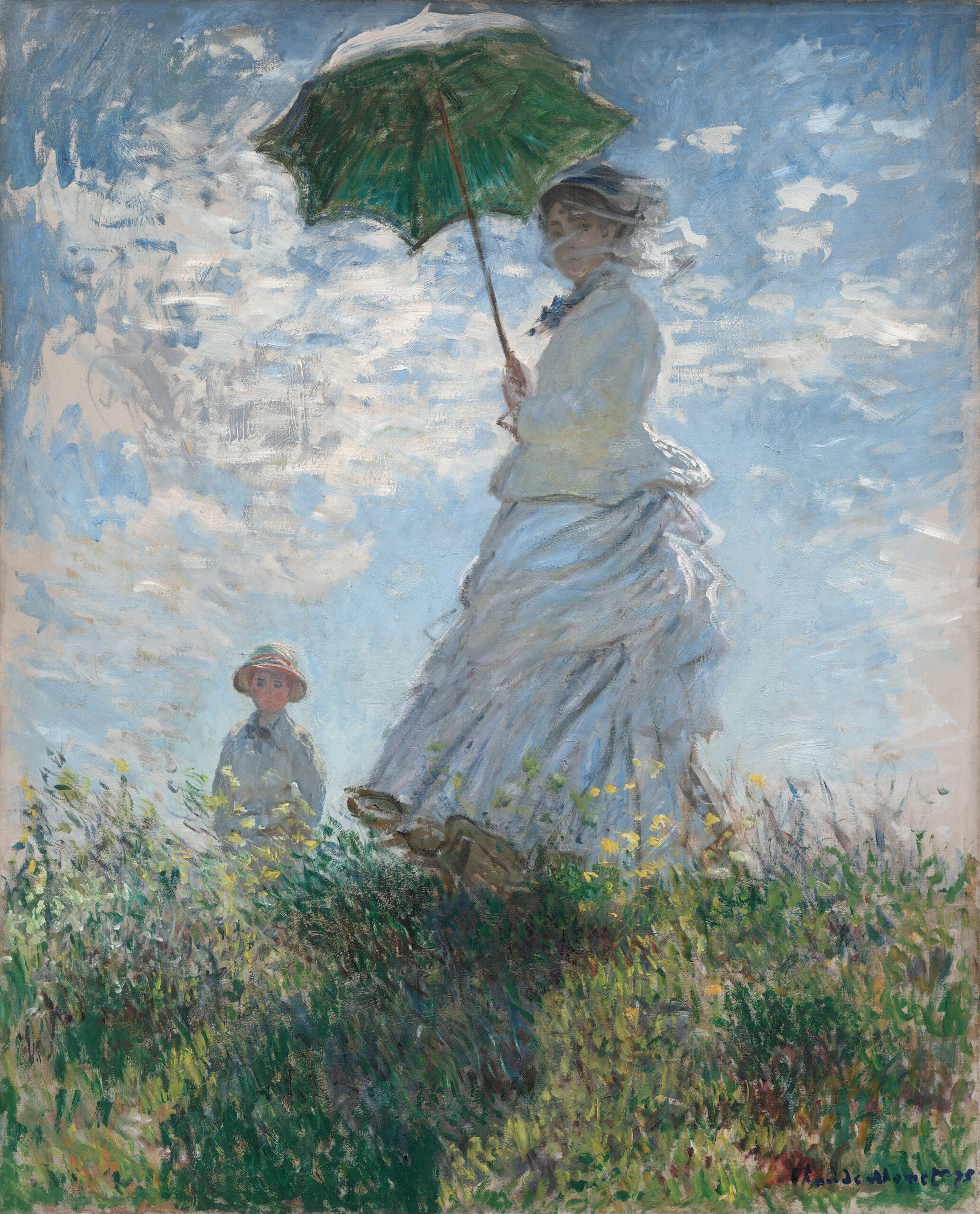
Argenteuil, summer 1875. The wind blows across the hillside. Camille turns, parasol in hand. Her son Jean stands behind her, almost swallowed by the tall grass. Monet captures everything — in a single session.
A light you can almost feel
Look at Camille’s dress: touches of pale blue, grey and yellow vibrate together. The broad white strokes on her skirt catch the light like a flash of sun. A veil floats across her face, a few brushstrokes are enough. The grass is dense, streaked with green, brown and blue. Bursts of yellow suggest buttercups. Monet paints quickly, freely. Some areas of canvas are left bare. The sky is brushed in, the clouds jostled. The vertical composition places Camille at the very heart of the painting, a monumental silhouette against the blue.
Impressionism in full stride
In 1875, Impressionism was still an affront in the eyes of the official Salon. Monet painted outdoors, chasing the fleeting instant rather than the frozen pose. This canvas embodies his whole programme: capturing natural light, atmospheric effects, the movement of the wind through skirts and clouds. Camille Doncieux, his companion, and Jean, their seven-year-old son, were his most frequent models. The work is not a portrait in any academic sense, it is a sensation. A suspended walk. An afternoon that never ends.
Claude Monet
Born in Paris, Claude Monet (1840–1926) became the leading figure of Impressionism. Obsessed with shifting light, he painted in series, outdoors, in all weathers. Woman with a Parasol distils the essence of his approach: colour, movement, the truth of a glance.
A question for you
💭 Camille has no clearly defined face, just a few strokes, a veil, a silhouette. Is this still a portrait, or is Monet inventing something else entirely?
About this work
- Woman with a Parasol — Madame Monet and Her Son
- Claude Monet
- 1875
- Oil on canvas
- 100 × 81 cm
- National Gallery of Art, Washington
- https://www.nga.gov/artworks/61379-woman-parasol-madame-monet-and-her-son
Camille and Jean at Argenteuil: Impressionism as Family Life
Woman with a Parasol, Madame Monet and Her Son is one of the most iconic images of nascent Impressionism. The scene takes place at Argenteuil, where Monet had settled with his family in 1871. The foreground figure is Camille Doncieux, his companion and wife since 1870; behind her, almost swallowed by the tall grass, stands their son Jean, born in 1867 and seven or eight years old at the time of the scene. The composition is vertical and dynamic: Camille stands out against a luminous sky, her green parasol forming a visual counterweight to her wind-blown dress. The freedom of the brushwork, rapid strokes suggesting wildflowers, the ripple of grass, the shimmering of silk, conveys less a description than a sensation: the warmth of a summer afternoon, a light breeze, the shifting light of a cloudy backlit day.
The Effaced Face and the Conquest of Immediacy
Camille has no clearly defined face in this painting: a few brushstrokes, a veil, a silhouette. This treatment is not incompleteness but a deliberate choice: Monet paints the instant, and in the instant, the face of a moving figure is no more than a pale patch in the light. This approach breaks radically with academic portraiture, founded on likeness and permanence. Camille Doncieux died in 1879 at thirty-two, of cancer, Monet would paint her face on her deathbed in a final canvas haunted by guilt and grief. Woman with a Parasol of 1875, luminous and mobile, belongs to a different moment in their shared life, when Argenteuil still resembled a summer paradise.
Two Series, Two Women
In 1886, Monet returned to the woman with a parasol motif in two paintings made at Giverny (now in the Musée d’Orsay), but the models this time are anonymous, Camille had been dead for seven years. These two late versions face into the wind from a grassy promontory, like a melancholy echo of the 1875 canvas. This persistence of the motif reflects Monet’s attachment to an image that condenses both the formal ambitions of Impressionism and the memory of a beloved presence.