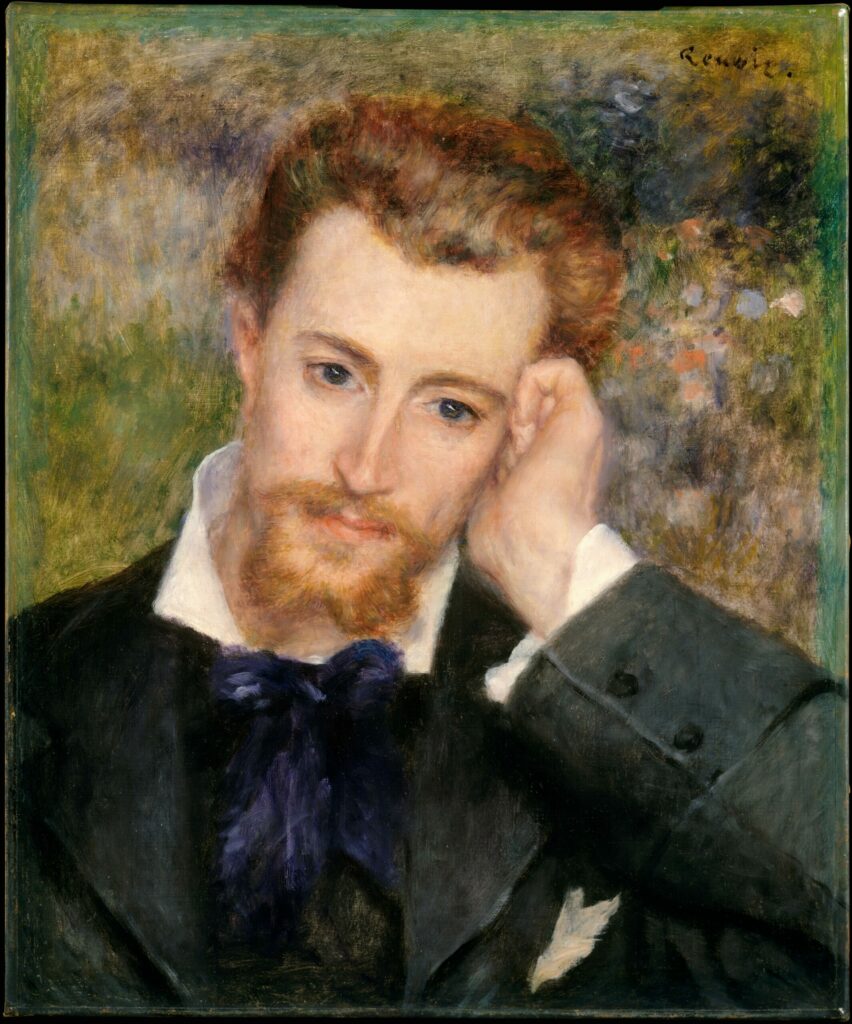
In this striking portrait, Renoir presents a remarkable psychological study of Eugène Murer, a fascinating figure of Parisian life.
The artist brilliantly captures the duality of his subject: both dreamer and man of action, artist and entrepreneur. The tight framing on the face, the meditative pose, hand supporting head, and the gaze lost in the distance create an atmosphere of contemplative intimacy. Renoir’s characteristic vaporous brushwork unfolds in the verdant background, while the more precise treatment of the face highlights the carefully trimmed reddish beard and the elegance of the attire, with the deep blue bow tie punctuating the composition. The work demonstrates the painter’s technical mastery, particularly in the subtle rendering of flesh tones and the chromatic dialogue between the warm tones of the face and the shimmering greens of the background. Eugène Murer would become a great collector, passionate about the Impressionists; he owned about fifteen of Renoir’s paintings.
Further Information
- Eugène Murer (Hyacinthe-Eugène Meunier, 1841–1906) by Auguste Renoir, 1877
- 47 × 39.4 cm (18½ × 15½ in.)
- The Metropolitan Museum of Art, Fifth Avenue, New York, exhibited in Gallery 821
- https://www.metmuseum.org/art/collection/search/438011
Pierre-Auguste Renoir (1841-1919) is one of the undisputed masters of the Impressionist movement. From a modest background, he began as a porcelain painter before dedicating himself to easel painting.
His unique technique, combining spontaneity of gesture and sensuality of touch, revolutionized the art of portraiture. His ability to capture the essence of his subjects, as in this portrait of Murer, while maintaining an incomparable freshness of execution, made him one of the most sought-after portraitists of his time. His influence on modern art is considerable, paving the way for a new conception of human representation where emotion and technique merge in perfect harmony.
Eugène Murer: Pastry Cook, Collector, Friend of the Impressionists
Portrait of Eugène Murer depicts one of the most singular figures in the Impressionist circle. Hyacinthe-Eugène Meunier, known as Eugène Murer, born in Poitiers on 14 May 1841, died in Auvers-sur-Oise on 22 April 1906, ran a pastry shop at 95 Boulevard Voltaire in Paris. It was there that, every Wednesday evening, he welcomed remarkable guests to his table: Renoir, Monet, Cézanne, Pissarro, and later Van Gogh. A childhood friend of Armand Guillaumin, who introduced him to the Impressionist circles, Murer was also an amateur painter, a writer who published under the pseudonym Gêne-Mûr, and over the years assembled a collection of some one hundred Impressionist canvases, including around fifteen by Renoir, built not on inherited wealth but on genuine taste and loyal friendship. Pissarro would paint his portrait the following year, in 1878, a canvas now held at the Museum of Fine Arts in Springfield, Massachusetts, testimony to the sincere attachment these painters felt for the man.
The Thinker’s Pose
What Renoir captures here is less an official likeness than a presence, a man caught in a moment of reverie, his hand supporting his chin, his gaze drifting slightly beyond the picture plane. Murer’s red beard and the deep blue bow tie are the two chromatic anchors of the composition. Against them, Renoir plays the duality that is characteristic of his portraiture at its most intimate: a vaporous, almost dissolved background in grey-blues and ochres, against which the face is rendered with a psychological precision that is something else entirely. This stylistic contrast, blurred and precise within the same canvas, builds a sense of closeness that commissioned portraits rarely achieve. The painting is now on view in Gallery 821 of the Metropolitan Museum of Art in New York.
Renoir and the Portrait of Inner Life
1877 was the year of the third Impressionist exhibition, at which Renoir showed seventeen works and began for the first time to attract a bourgeois clientele. Portrait of Eugène Murer belongs to this transitional period in which he was refining his art of the intimate portrait, not the large-format academic likeness but the half-length, mid-scale picture that captures a person in their private world rather than their public role. That Renoir chose this meditative pose and this softened treatment for a friend who had not placed a formal commission, but who had fed, sheltered, and championed these painters during years when their canvases went unsold, says something about the nature of the bond: less a portrait than a quiet act of gratitude.