London, 1895. A woman turns the pages of a book. Two little girls hold their breath. The magic of Kipling fills the drawing room.
What the Eye Discovers
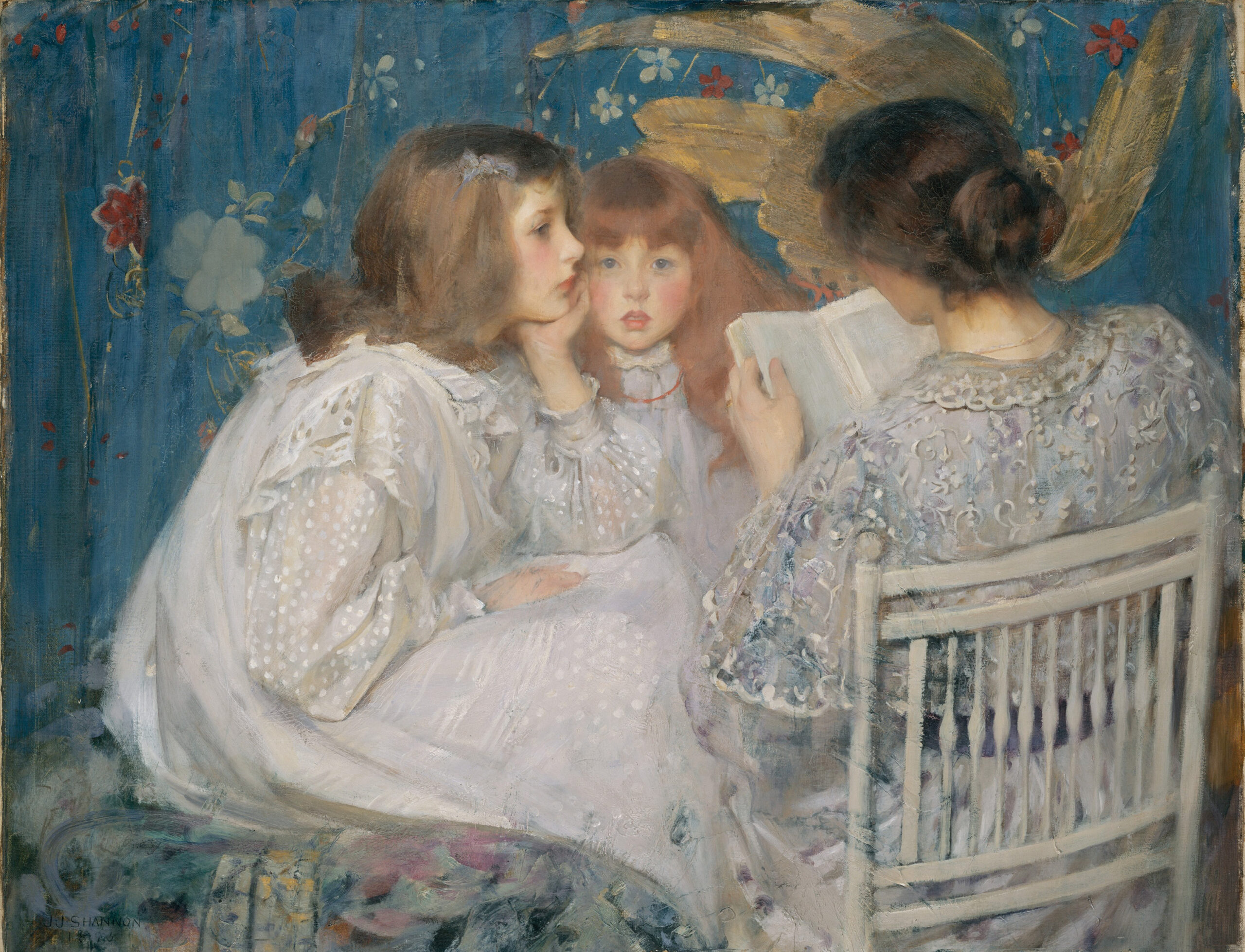
Look at this intimate scene. A mother, seen from behind, holds an open book. To her left, two children listen, spellbound. The youngest stares at an invisible point, eyes wide open. Shannon commands light with precision. The faces are modelled with photographic realism. The white muslin dresses, embroidered and dotted, catch the light. The blue background, scattered with stylised flowers and gilded highlights, anchors the composition in a Japoniste decorative aesthetic.
A Painting Born from a Bestseller
In 1894, Rudyard Kipling published The Jungle Book. Its success was immediate, it would be translated into numerous languages. Shannon painted this family scene the following year. The work is a portrait of his own household: his wife reads to their daughter Kitty and another child. The title confirms the literary allusion. In 1895, depicting a cultivated family reading the sensation of the moment was an assertion of social belonging. It was also a celebration of the power of storytelling over the childhood imagination. The late Victorian era prized these domestic moments, elevated to the rank of noble subject.
James Jebusa Shannon
Born in the United States, Shannon (1862–1923) settled in London in the 1880s and built a brilliant career as a society portraitist. His style blends Impressionist influence with academic precision. He was elected a full member of the Royal Academy in 1897, two years after this painting.
A Question for You
💭 Shannon sets two pictorial languages against each other on a single canvas: the arresting realism of the faces and the decorative abstraction of the background. That dialogue between figure and ornament would soon become Klimt’s signature. Coincidence, or something in the air?
About this work
- Jungle Tales
- James Jebusa Shannon
- 1895
- Oil on canvas
- 87 × 113.7 cm
- The Metropolitan Museum of Art, New York
- https://www.metmuseum.org/fr/art/collection/search/12552
A Victorian Interior in the Shadow of Kipling
Jungle Tales was painted the year following the publication of Rudyard Kipling’s The Jungle Book (1894), a detail that casts the title in an unexpectedly specific light. The canvas depicts an intimate interior scene: a woman seen from behind, holding an open book, with two young girls listening intently beside her. Shannon shows his own family here, in his London home. The girls’ white embroidered muslin dresses capture the light with precision; the decorative background with its stylised floral motifs and gilded accents reflects the japonisant aesthetic that ran through English painting of the 1890s. The painting says much about Victorian bourgeois life: reading aloud as a family ritual, literature as shared experience, and art as an assertion of cultivated social belonging.
Shannon between London and the Royal Academy
James Jebusa Shannon (Auburn, New York, 1862 – London, 1923) was born in the United States but made his entire career in England, settling there after his studies at the South Kensington Art School in London in the early 1880s. A successful society portraitist in London circles, he was elected to the Royal Academy in 1897, two years after completing Jungle Tales. His style combines academic precision in the rendering of faces with an Impressionist sensibility in the treatment of light and fabrics, a synthesis that makes him a characteristic figure of Anglo-American painting at the turn of the twentieth century. The Metropolitan Museum’s decision to hold this canvas reflects a recognition that Shannon’s best domestic scenes carry an emotional warmth and technical refinement that lift them well above the ordinary production of society portraiture.