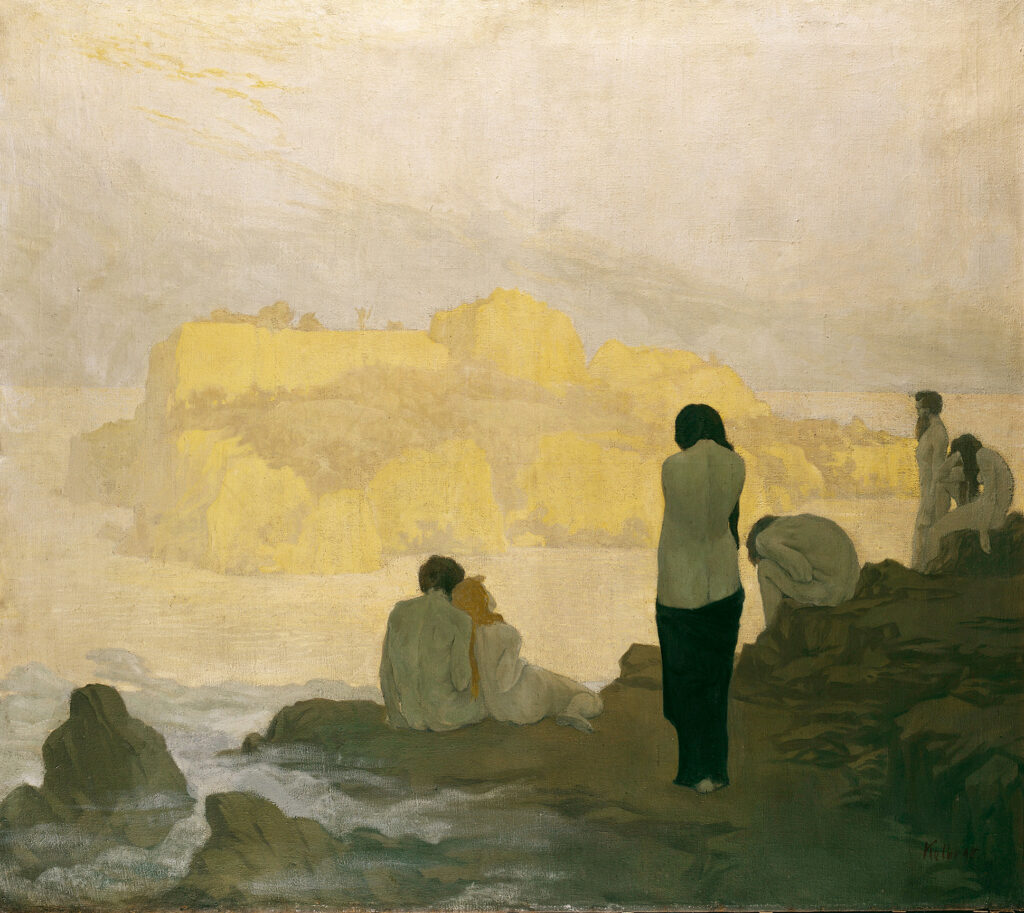
Berlin, 1898. Georg Kolbe stands before a strange and silent canvas. He paints the ultimate refuge of the soul: a golden island suspended between dream and reality, where figures contemplate the motionless horizon.
A Palette of Introspection
An almost monochromatic harmony of pearl gray, muted ochres, and pale gold unfolds. On the left, a seated couple huddles in the rocky darkness. At the center, a woman standing with her back turned gazes at the golden island emerging from the mists. Her sharp silhouette stands out like a motionless sentinel. The contours are clear, stylized into universal archetypes. The pictorial touch remains restrained, almost effaced. Kolbe favors flat areas and soft transitions to create a dreamlike atmosphere, suspended outside of time.
Fin-de-Siècle Symbolism
At the end of the 19th century, the motif of the solitary island haunts artists. After Böcklin’s “Isle of the Dead,” imbued with melancholy, Georg Kolbe proposes a more elegiac vision. His painting reflects the influence of Schopenhauer’s philosophy, for whom the world is but illusion. Kolbe then frequents the circle of the poet Ludwig Derleth, a group of intellectuals seeking spiritual renewal. The work embodies this “Land of Our Desire,” as Kolbe himself writes in 1898. The pensive figures, inherited from Caspar David Friedrich, embody the Romantic aspiration for elsewhere.
Georg Kolbe, an Artist Between Painting and Sculpture
Georg Kolbe (1877-1947) leaves Berlin for Rome shortly after completing this canvas. Influenced by Böcklin and Max Klinger, he gradually abandons painting for sculpture, the discipline that will make him famous. This painting remains testimony to his Symbolist period, marked by Novalis’s “Hymns to the Night,” which he was then illustrating.
Think about it
💭 And you, what golden island do you contemplate when the everyday fades away?
About This Work
- The Golden Island
- Georg Kolbe
- 1898
- Oil on canvas
- 106.5 x 120.3 cm
- Alte Nationalgalerie, Berlin
- https://recherche.smb.museum/detail/959619/die-goldene-insel