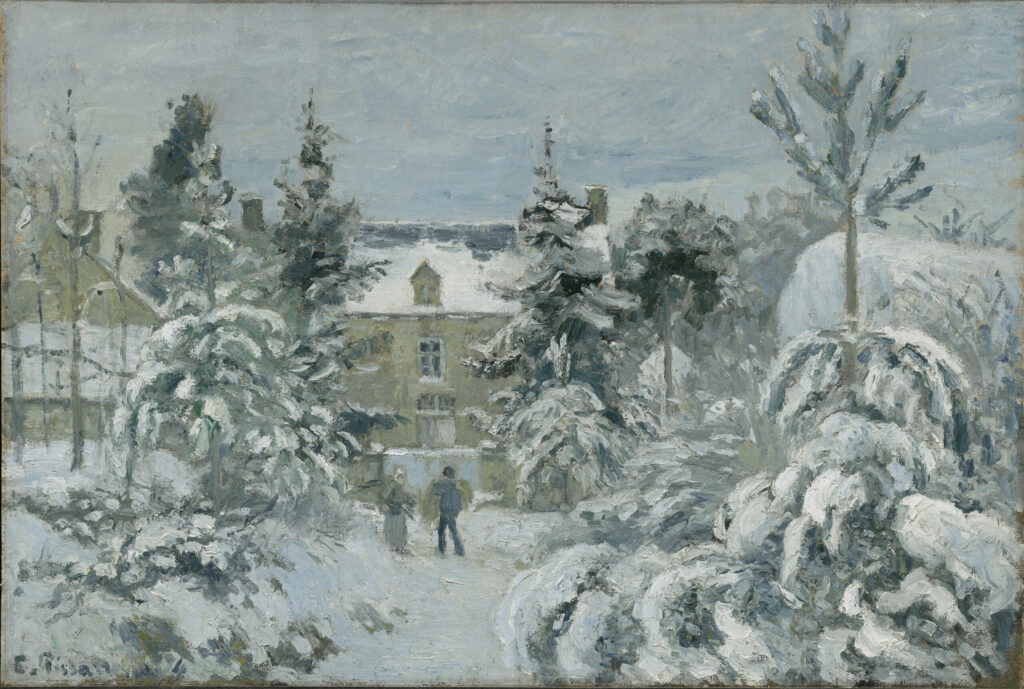
Montfoucault, winter 1874. Camille Pissarro braves the bitter cold to paint the farm of his friend Ludovic Piette. Under thick snow, the dwelling merges into a muffled landscape where white dominates.
An Impressionist Vision of Winter
Observe this masterful composition: the snow-covered roofs align behind frosted trees. Pissarro uses a restrained palette of bluish greys, whites, and muted ochres. The pictorial matter reveals his speed of execution: thick, energetic brushstrokes leave the raw canvas visible in places. This alla prima technique conveys the painter’s urgency facing the elements. Generous impasto sculpts the snow piled on the conifers. Two dark silhouettes animate the center of the canvas, tiny against the winter landscape.
Friendship in Service of Art
This is a pivotal period for Pissarro and the nascent Impressionist movement. In 1874, a few months after this winter stay, the first Impressionist exhibition would be held in Paris. Piette, an animal painter, regularly offered hospitality to Pissarro on his rural property. The artist could concentrate on landscape painting en plein air, far from Parisian bustle. The humble subject of a snow-covered farm illustrates the rejection of academic themes in favor of everyday scenes.
Pissarro, Impressionist Pioneer
Born in Saint Thomas, Camille Pissarro (1830-1903) remains the only artist to have participated in all eight Impressionist exhibitions. Considered the patriarch of the movement, he influenced Cézanne and Gauguin. His vision privileges atmospheric effects and spontaneity of vision.
Think about it
💭 Facing this peaceful scene, do you feel the bite of cold or the protective tranquility of snow that isolates from the world?
About This Work
- Piette’s House at Montfoucault
- Camille Pissarro
- 1874
- Oil on canvas
- 46.4 × 68.6 cm
- Clark Art Institute, 1955.826
- https://www.clarkart.edu/ArtPiece/Detail/Piette-s-House-at-Montfoucault