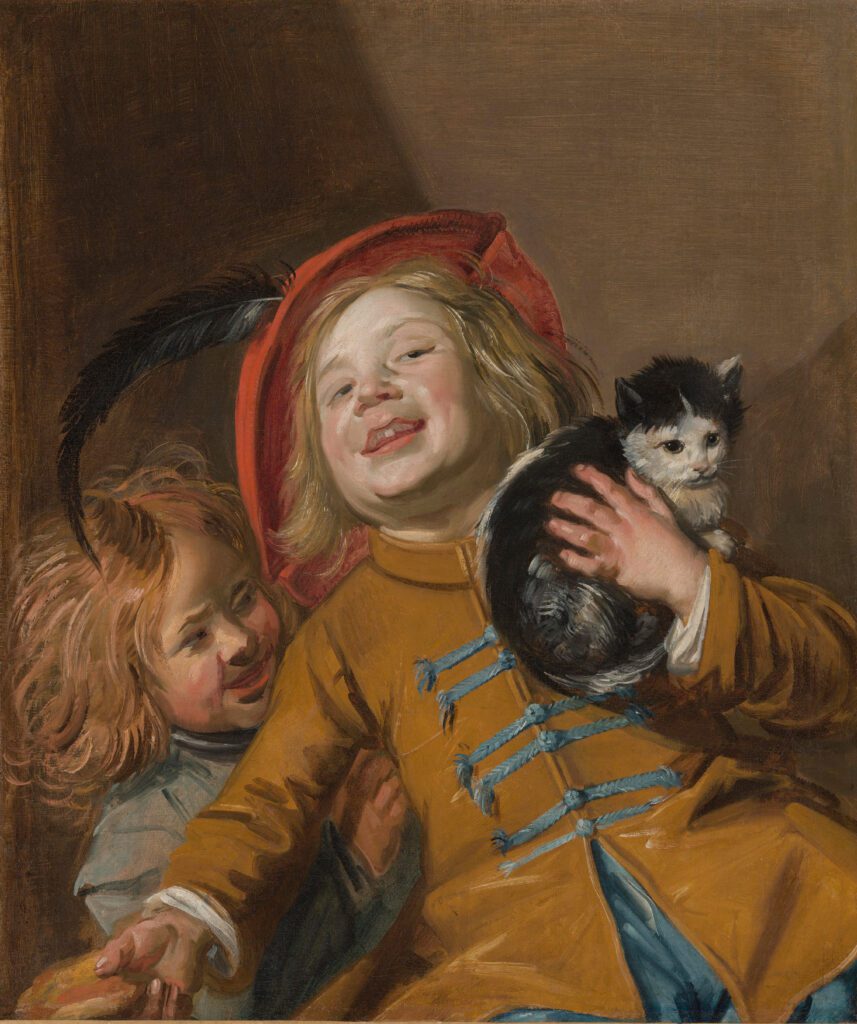
This scene, brimming with mischief, captures a playful moment between two children and a cat, where innocence meets impishness.
The central boy, dressed in a splendid chamois costume adorned with blue braiding, displays a wide teasing smile beneath his cheerful red hat. With a quick gesture, he snatches away the treat that had tempted the feline, while firmly holding the animal with his other hand. To the left, the second child, with long blonde hair falling over one shoulder, observes the scene with an expression that mingles amusement and apprehension.
Leyster’s warm palette and spontaneous brushwork infuse this composition with infectious energy, orchestrated through a masterful play of diagonals. The uniform brown background focuses attention on the action, while the light delicately illuminates the faces, revealing the fresh vitality of childhood. This canvas demonstrates Leyster’s genius for capturing everyday emotions with genuine authenticity.
Additional Information
- Two Children with a Cat, by Judith Leyster, c. 1630
- Oil on canvas, 61 x 52 cm
- The Rijksmuseum, Amsterdam
- https://www.rijksmuseum.nl/en/collection/object/Two-Children-with-a-Cat–48386a71cb4e77d5b3e501ac633f23a6
Judith Leyster (1609-1660) stands as a remarkable figure among the few female painters of the Dutch Golden Age. Admitted to the Haarlem Guild of Saint Luke in 1633, she demonstrated exceptional mastery of genre scenes and portraiture. She developed a vibrant style characterized by free brushwork and acute psychological observation.
As the wife of painter Jan Miense Molenaer, she often signed her works with her distinctive monogram accompanied by a star, a wordplay on her surname (“ley ster” meaning “guiding star”). Long forgotten, her work was rediscovered in the 19th century and continues to be celebrated today for its freshness and humanity.
Judith Leyster and Genre Painting in Haarlem
Two Children with a Cat is a characteristic demonstration of Judith Leyster’s (Haarlem, 1609 – Heemstede, 1660) ability to seize the spontaneity of a moment and the liveliness of childhood. A boy in an ochre and brown costume with blue trim and a red hat teases a cat he holds up as if it were a puppet, while a blonde girl watches him with a blend of amusement and concern. The animal, visibly uncomfortable, anchors a triangular composition that Leyster organizes with remarkable economy: a neutral ground, few props, and all attention drawn to the three protagonists and their distinct, immediately readable expressions.
An Exceptional Career in Seventeenth-Century Haarlem
Judith Leyster was among the very few women painters admitted to the Guild of Saint Luke in Haarlem, an achievement she reached in 1633, and she signed her works with a personal monogram: an intertwined J and L topped by a star, a play on her surname’s resonance with “lodestar” in Dutch. She ran her own workshop and trained apprentices, a practice then exceptionally rare for a woman. Her style borrows from Frans Hals the free, direct touch, but with a compositional intelligence and handling of light that distinguish her work from his. After her marriage to the painter Jan Miense Molenaer in 1636, her production diminished; she was subsequently forgotten for two centuries, with several of her canvases wrongly attributed to Hals until scholars began reconstructing her oeuvre in the nineteenth century.
The Rijksmuseum’s Holding
The Rijksmuseum’s Two Children with a Cat represents one of the most appealing examples of Leyster’s genre work and of the Haarlem school’s gift for rendering the textures of everyday life with warmth and precision. What makes it linger in the memory is less the scene itself, children teasing a pet is a familiar enough subject in Dutch Golden Age painting, than the quality of attention Leyster brings to each figure individually: the boy’s concentration, the girl’s ambivalent watchfulness, the cat’s mute discomfort. The painting is a small canvas that rewards sustained looking, in the way the best Dutch genre works do.