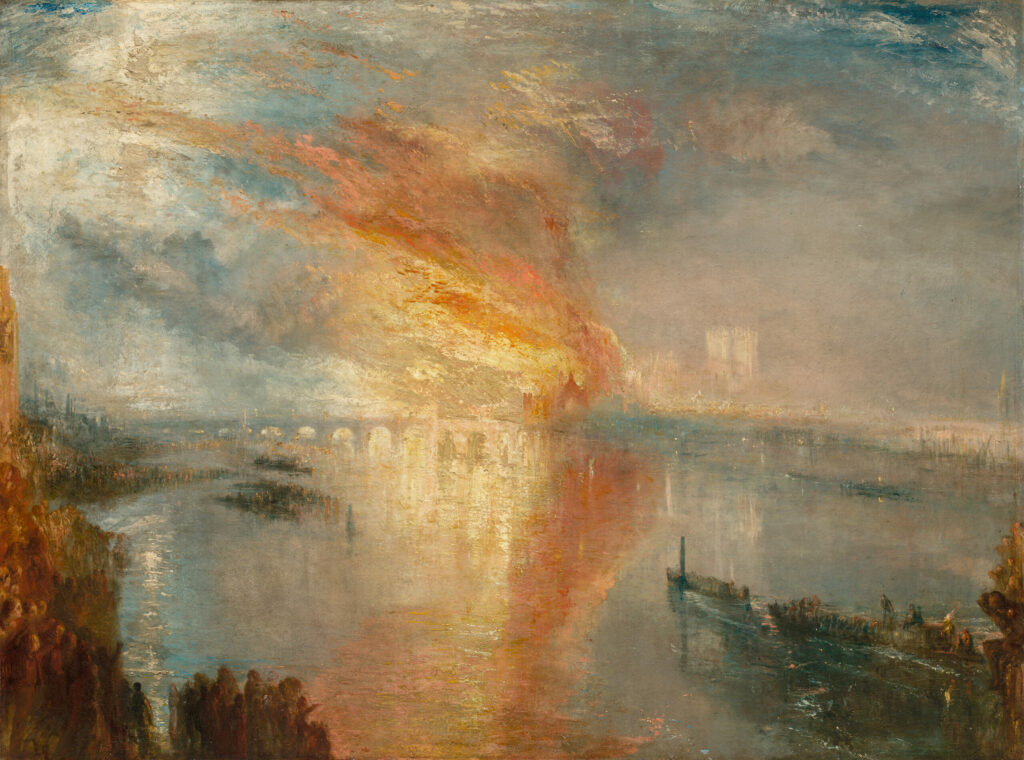
London. As flames devour the British Parliament on October 16, 1834, Turner depicts the fire as if he were standing there, among the crowd gathered on the banks of the Thames, sketching this Dantesque spectacle that will mark history and art history.
An Apocalyptic Inferno
Swirls of orange and ochre smoke explode into the night sky, almost swallowing the Gothic architecture of the Houses of Lords and Commons. Turner paints with stunning freedom: broad brushstrokes dissolve forms into luminous expanses where yellow, red, and gray merge. The water reflects the fire in trembling golden columns. In the foreground, dark silhouettes observe, powerless. The technique borders on abstraction: no more sharp contours, only colored masses that vibrate and suggest heat, smoke, chaos.
Catastrophe as Romantic Revelation
Turner actually witnesses this fire that destroyed the historic seat of British power. But he does not seek faithful reportage. He amplifies the flames, dramatizes the atmosphere to explore his obsession: the crushing power of natural elements against human fragility. This painting becomes a manifesto of English Romanticism, where nature—here fire—reigns as a sublime force. The historical event serves as a pretext for a meditation on destruction and the sublime.
Turner, Master of Light
Joseph Mallord William Turner (1775-1851) revolutionizes British landscape painting. Trained at the Royal Academy, he evolves toward an increasingly free style, foreshadowing Impressionism. Light, color, and atmosphere become his true subjects.
Think about it
💭 Turner transforms a catastrophe into tragic beauty. What do you see beyond the flames?
About This Work
- The Burning of the Houses of Lords and Commons, 16 October 1834
- Joseph Mallord William Turner
- 1835
- Oil on canvas
- 92 × 123.2 cm
- The Cleveland Museum of Art
- https://www.clevelandart.org/art/1942.647