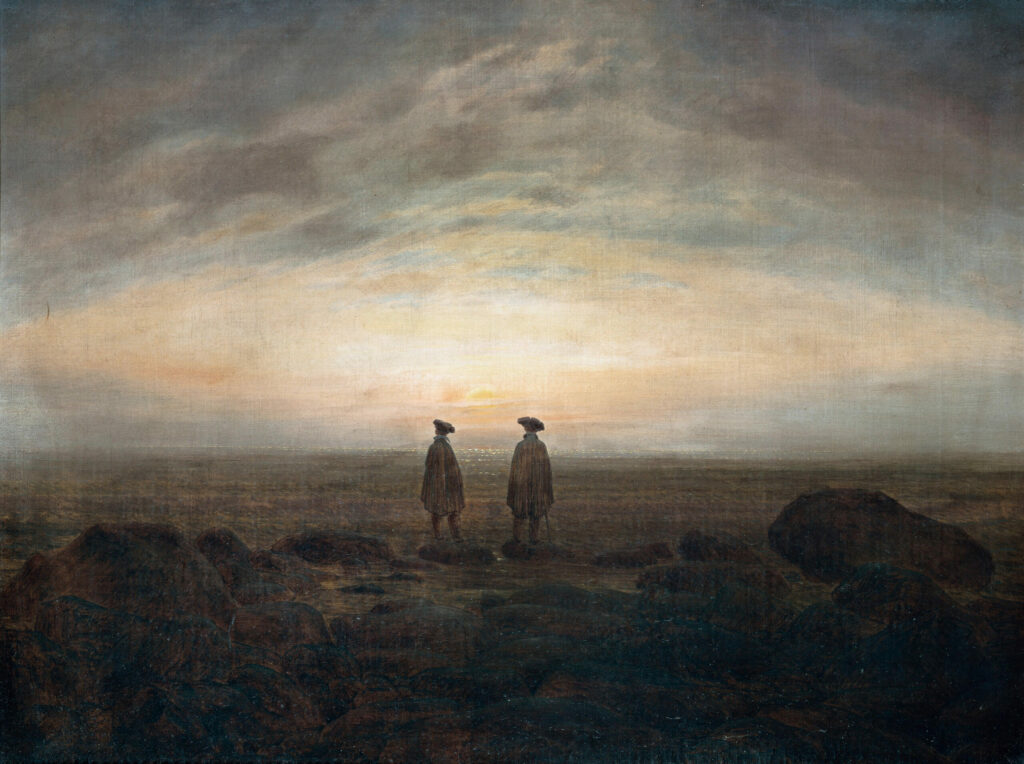
Dresden, 1817. Friedrich completes a canvas that will become an icon of German Romanticism. Two motionless silhouettes stand before the marine vastness. The painting creates a sensation at the Dresden Academy that year.
A Composition of Overwhelming Simplicity
Two men seen from behind stand on the shore. Their dark silhouettes are outlined against the twilight sky. They wear the German patriotic costume, with its characteristic long capes. The work captures the subtle nuances of the sky: gray, ochre, and blue merge in a contemplative atmosphere. Friedrich’s technique favors transparent glazes that create this recognizable diffuse luminosity.
A Political and Spiritual Manifesto
This work belongs to the Germany of the Restoration, a period of repression following the Napoleonic Wars. The choice of traditional costume is not insignificant: this garment of medieval inspiration, a democratic and liberal symbol, was forbidden. The poet Ernst Moritz Arndt had promoted it as a patriotic emblem as early as 1814. Friedrich transforms the landscape into philosophical meditation. The figures seen from behind invite the viewer’s identification. The contemporary press praised the “originality” of the artist who “elevates landscape painting to poetic heights.”
Caspar David Friedrich
Caspar David Friedrich (1774-1840) embodies German Romanticism. The painter makes nature a spiritual space. He creates multiple representations of contemplative figures facing the elements. His spare compositions privilege inner experience over picturesque description.
Think about it
💭 Can nature still today confront us with the sublime, with that grandeur that surpasses and moves us?
About This Work
- Two Men by the Sea
- Caspar David Friedrich
- 1817
- Oil on canvas
- 51 × 66 cm
- Staatliche Museen zu Berlin, Alte Nationalgalerie / Jörg P. Anders Public Domain
- https://recherche.smb.museum/detail/967700/zwei-m%C3%A4nner-am-meer