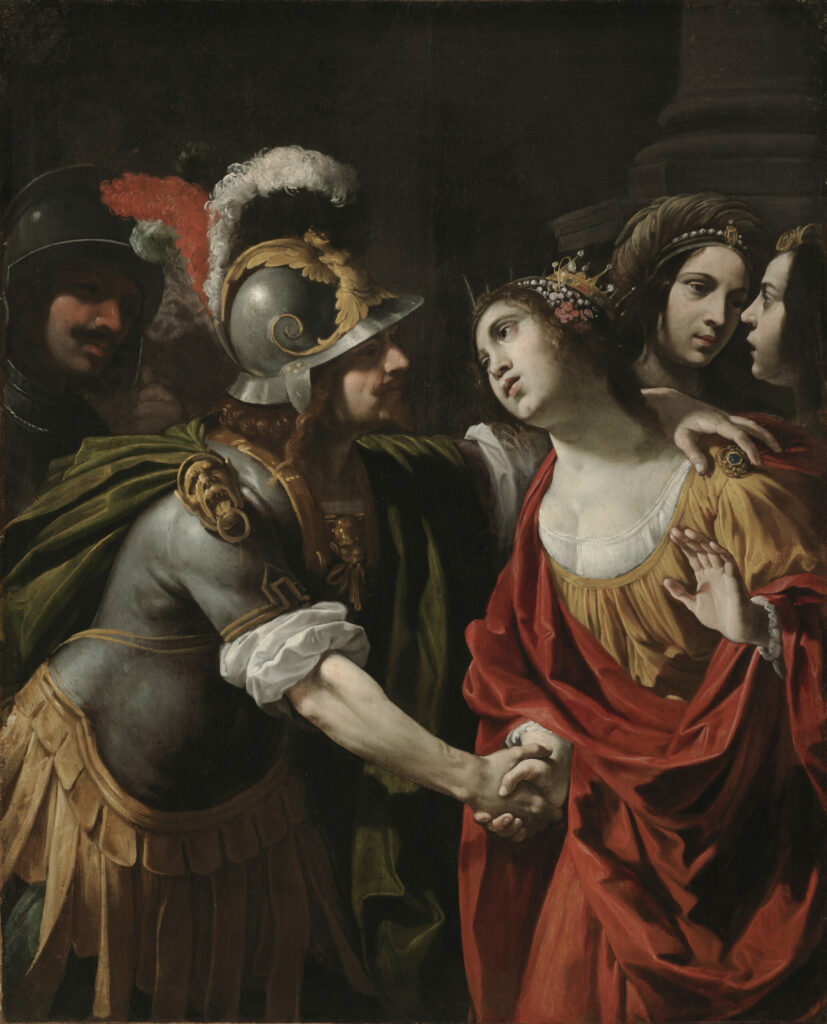
Siena, circa 1630. Manetti freezes the tragic moment when love falters. On this Italian Baroque canvas, a helmeted warrior clasps the hand of a queen crowned with flowers. Aeneas, Trojan prince in gleaming armor, prepares to leave Carthage. Dido holds him back with a desperate gesture, eyes raised toward him. Behind them, figures witness this separation helplessly. Manetti composes the scene as theatrical drama, with luminous contrasts and intense colors: the red of Dido’s drapery, the gold of her gown, the gray of Aeneas’s armor.
The Power of Chiaroscuro
The Sienese painter masters the interplay of shadow and light inherited from Caravaggio. Faces emerge from darkness, concentrating emotion. Every fabric fold, every reflection on metal reveals meticulous observation. The joined hands of the two protagonists form the magnetic heart of the composition.
An Ancient Legend Reinvented
Virgil recounts in the Aeneid how the Trojan hero abandoned the Queen of Carthage to found Rome, obeying destiny. Dido, in despair, took her own life. This theme captivated the Baroque 17th century, enamored with great tragic passions and heroic narratives. Manetti reinterprets Antiquity with the sensibility of his time, transforming epic into intimate scene.
Rutilio Manetti: Master of Sienese Baroque
Trained in his father’s workshop, Manetti (1571-1639) developed a personal style blending Caravaggesque naturalism with Florentine elegance. Active primarily in Siena, he painted religious altarpieces and mythological scenes with equal dramatic intensity.
Think about it
💭 How would you represent today this moment when duty prevails over love? This work, held at LACMA, questions our own choices between passion and reason.
About This Work
- Dido and Aeneas
- Rutilio Manetti
- circa 1630
- Oil on canvas
- 146 × 117 cm (57 1/2 × 46 1/4 in.)
- Los Angeles County Museum of Art (LACMA)
- https://collections.lacma.org/node/246666