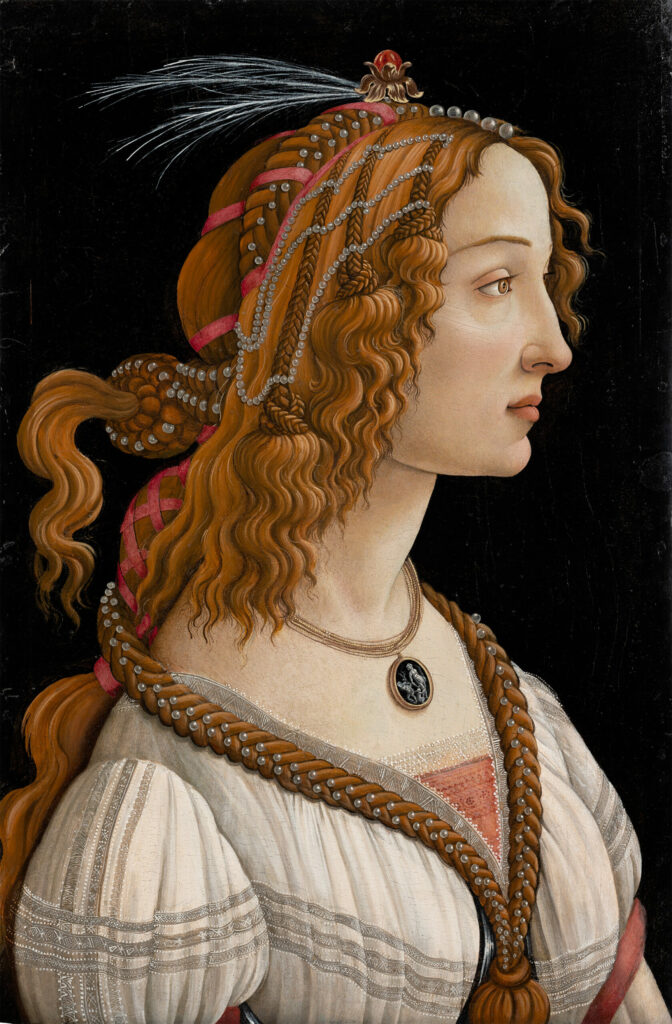
Florence, circa 1480. Botticelli celebrates a vanished beauty. In his studio, the painter composes a timeless portrait, transforming Simonetta Vespucci, who died too young, into a mythological figure. This is no longer a simple woman he paints, but an idealized nymph.
A Cascade of Gold and Pearls
The young woman appears in profile against a black background, her hair undulating. Botticelli multiplies precious ornaments: pink ribbons, tightly strung pearls, interwoven braids topped with an elegant feather. Each curl follows a perfect graphic rhythm. The mixed technique on poplar allows for minute details. Her ivory complexion contrasts with the white dress. At her neck, a circular pendant reproduces an ancient cameo from the Medici collection. This adornment is not insignificant: it signals belonging to Florence’s most exclusive circle.
Memory of a Favorite
Simonetta Vespucci was the mistress of Giuliano de’ Medici before her early death in 1476. Botticelli paints her several years later, transfiguring her into a mythological creature. This idealized portrait surpasses physical resemblance to create an archetype of feminine beauty. In Renaissance Florence, commissioning such portraits testified to the power of great families.
Botticelli: Poet of Lines
Sandro Botticelli (1445-1510) masters like no other the serpentine line and idealized grace. Trained in Florentine workshops, he became the Medici’s favorite painter. His style privileges the elegance of contours over anatomical realism, creating ethereal figures of timeless beauty.
Think about it
💭 Why does the Renaissance transform female models into mythological figures rather than realistic portraits?
About This Work
- Idealized Portrait of a Lady (Portrait of Simonetta Vespucci as a Nymph)
- Sandro Botticelli
- circa 1480-1485
- Mixed technique on poplar
- 81.3 × 54 cm
- Städel Museum, Frankfurt am Main
- https://sammlung.staedelmuseum.de/en/work/idealised-portrait-of-a-lady