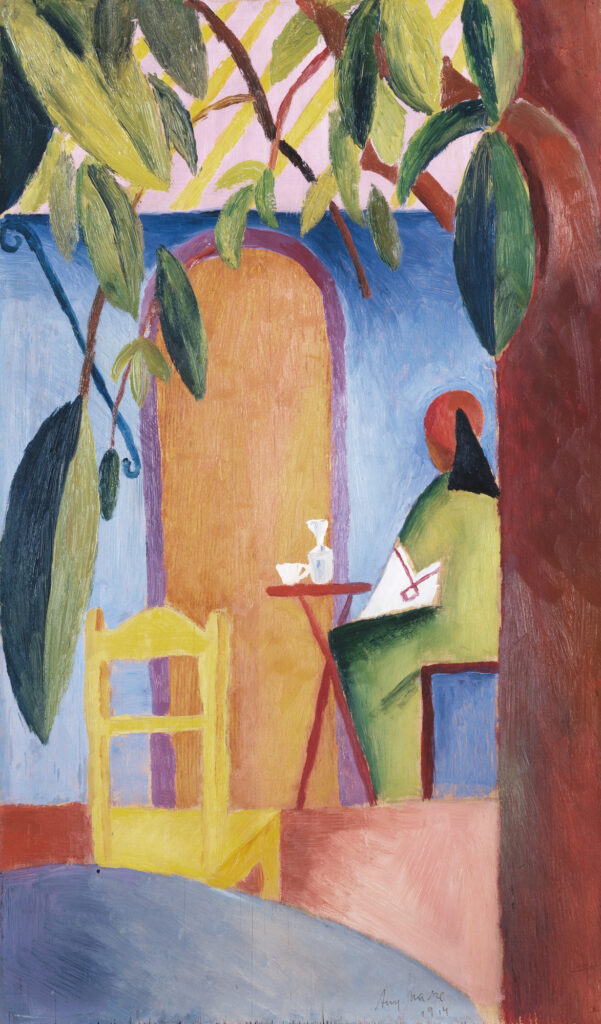
Sidi-Bou-Saïd, April 1914. August Macke sets up his easel in front of the Café des Nattes. Tunisian light floods the scene. The German artist captures the moment in an explosion of pure colors that transcends reality.
A Symphony of Pure Colors
Observe this bold composition: an intense blue wall, a green seated figure, a brilliant red fez. Macke paints with an almost abstract freedom. Surfaces are juxtaposed without modulation. The orange and violet of the doorway create an almost irreconcilable complementary contrast. The yellow of the chair responds to the blue of the wall. Each element becomes an autonomous colored form. The technique is direct, without embellishment. The brushstrokes assert the materiality of the paint.
The Tunisian Journey: Creative Apex
This painting was born from the legendary Tunisian journey undertaken by Macke, Paul Klee, and Louis Moilliet in spring 1914. Three weeks of immersion in Southern light transformed their artistic vision. Macke produced dozens of watercolors and sketches. Upon returning to Germany, he transposed his impressions into oil paintings. This version of Turkish Café pushes formal simplification to its peak. German Expressionism here achieves its most luminous, most Mediterranean dimension. A few months later, World War I broke out. Macke died at the front in September 1914, aged 27.
August Macke: Artist of Color-Emotion
August Macke (1887-1914) belonged to the Der Blaue Reiter group alongside Kandinsky and Franz Marc. He sought an “inner necessity” through chromatic purity. His brief but intense body of work explores modern life with sensitivity.
Think about it
💭 What emotion do you feel facing these color contrasts: tranquility or intense vibration?
About This Work
- Turkish Café
- August Macke
- 1914
- Oil on wood
- 60 × 35 cm
- Städtische Galerie im Lenbachhaus und Kunstbau Munich, Bernhard and Elly Koehler Foundation 1965
- https://www.lenbachhaus.de/en/digital/collection-online/detail/tuerkisches-cafe-30019622